




































































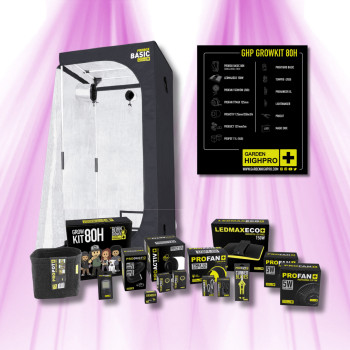

Professionals
0 products
Items you may be interested in
Related posts
Help & advice
Frequently asked questions
About Professionals — click a question to see the answer.
How to choose LED lighting for professional indoor cultivation?
For professional LED lighting, I advise you to consider several essential criteria. The first is the actual power consumed, not the equivalent HPS power. Next, the light spectrum must be adapted to the different growth phases of your plants. I also recommend checking the luminous efficacy (PPF/W) and the durability of the equipment, as professional equipment must last in the long term. Finally, modularity and thermal dissipation are major assets for optimizing your installation.
What is the difference between LED and HPS for professional indoor cultivation?
The main difference, in a professional context, lies in energy efficiency and the light spectrum. LEDs are much more efficient, consume less energy for the same amount of useful light (PPF), and produce less heat, which simplifies climate management. The LED spectrum is also more precise and customizable. HPS, although cheaper to purchase, are more energy-intensive and generate a lot of heat, which can be a major drawback for large areas.
What is the purpose of the light spectrum in horticultural LED lamps?
The light spectrum is absolutely fundamental! It determines which wavelengths are emitted by your lamp and, consequently, what the physiological reactions of the plants are. Blue promotes vegetative growth, red promotes flowering and fruiting, and green is important for light penetration into the canopy. A good spectrum, often called 'full spectrum' or adjustable, allows you to optimize each development phase to maximize your yields.
What LED power to choose for professional indoor cultivation?
The LED power for a professional installation is measured in PPFD (Photosynthetic Photon Flux Density), which is the amount of useful light your plants receive per second per square meter. I recommend aiming for a PPFD of approximately 600-800 µmol/m²/s for vegetative growth and 800-1200 µmol/m²/s for flowering, depending on the species cultivated. You then need to choose the electrical power of your luminaire to achieve these values over the surface you wish to illuminate. Also, don't forget to consider the height of your grow shelves.
At what distance should LED lamps be installed for indoor cultivation?
The installation distance of LEDs is crucial for lighting uniformity and to avoid light stress. Generally, for powerful professional LEDs, I advise starting with a distance of 30 to 60 cm above the canopy. However, this will depend heavily on the power of your luminaire and the manufacturer's specifications. The ideal is to use a photometer to measure the PPFD at the height of your plants and adjust the distance accordingly to achieve the target values.
What LED lighting for which cultivation phase (vegetative or flowering)?
For the vegetative phase, I favor a spectrum richer in blue, which promotes compact and robust plant development. For flowering, a spectrum with a higher proportion of red and far-red is ideal for stimulating flower and fruit production. Many professional LED luminaires offer adjustable spectra or pre-programmed modes for these different phases, which is a major asset for optimizing your harvests.
Are LEDs suitable for commercial indoor cultivation?
Absolutely, LEDs are not only suitable, but I would say they have become the standard for commercial indoor cultivation. Their energy efficiency significantly reduces operating costs on a large scale, and their low heat emission simplifies climate management, which is a huge advantage in a professional environment. Furthermore, the extended lifespan of LEDs minimizes maintenance and replacement costs, an essential point for profitability.
Which horticultural LED product to choose for a large indoor area?
For a large indoor area, I recommend opting for modular LED bars or large LED panels, specifically designed to cover vast areas uniformly. Systems with good light distribution and high efficiency (PPF/W) are paramount. I advise choosing brands known for their reliability and technical support, as an investment of this magnitude requires robust and high-performance equipment in the long term.
Cannot find your answer? 01 88 33 45 52 or by message.


