


































































VDL
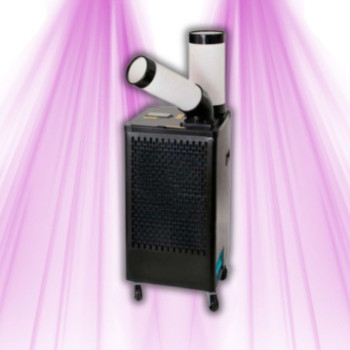
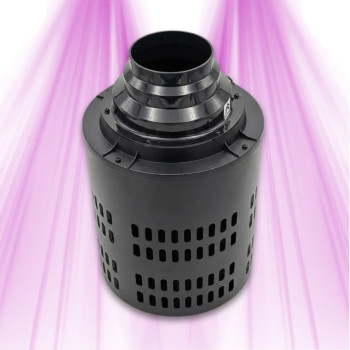
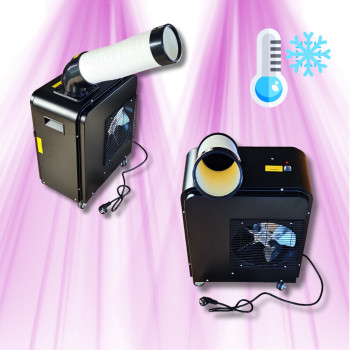
Specific air conditioner for cultivation chamber - Fresh air supply by tube -…
Ships within 2 weeks
629,00 € or 3× 209,67 €

Product successfully added to your shopping cart
Ça pousse dans le bon sens

2 products
Cooling a production room is not a matter of picking a rating: cooling capacity follows from a heat balance dominated by the lighting, and the heat rejection architecture is decided on the building plan.
In a sealed room, almost all the installed lighting power reappears as heat: 20 kW of fixtures means around 20 kW to be removed, before motors and gains through the building fabric. A watts-of-cooling-per-square-metre rule describes none of this.
Then comes rejection. A single-package unit placed inside the room it claims to cool cannot succeed: it moves the heat within the same space and adds the work of its own compressor. Three architectures answer this: the ducted monobloc, with the condenser connected outside the treated volume; the split; and the chiller, the only one that can be shared between several rooms.
An air conditioner dehumidifies for as long as it is cooling. But as soon as the temperature setpoint is reached it stops — precisely when transpiration continues and humidity climbs again. Hence the pairing of a cooling stage and a dehumidification stage, interlocked by the same control system.
Net capacity, heat rejection and integration with the control system depend on the building as much as on the crop: room cooling is sized from the floor plan and the installed power, then priced on a quotation. Since the sensible and latent loads are calculated together, industrial dehumidification handles the second. The trio of heat, light and ventilation sets out the basics, and this section forms part of industrial climate control.
Help & advice
About Industrial Air Conditioning — click a question to see the answer.
In indoor cultivation, air conditioning is essential for precisely controlling temperature and humidity. Unlike simple fans, it allows you to create a stable and optimal environment for your plants, which is crucial for their growth and yield, especially with powerful lighting that generates a lot of heat.
The difference is fundamental: fans merely circulate the air and mitigate heat through convection, but they do not remove it or control humidity. Air conditioning, on the other hand, actively removes heat from the space and can also dehumidify the air, offering much finer and indispensable control for professional cultivation.
Professional air conditioning is often equipped with an integrated or compatible thermostat and humidistat, allowing you to set precise thresholds. I often see growers use external environmental controllers that manage air conditioning, extractors, and humidifiers/dehumidifiers in a coordinated manner to maintain a perfect climate 24/7.
It's not a question of "or" but rather "and." LEDs are certainly more efficient and emit less heat than HPS, but they still produce some. For optimal control, especially in large installations, air conditioning remains essential to manage the residual heat from LEDs and maintain stable temperature and humidity, which LEDs alone cannot do.
The most common mistake is to undersize your system, which causes it to run constantly and inefficiently. I also often see problems related to poor condensate drainage or lack of filter maintenance, which reduces performance and can create humidity issues. Also, ensure that cold air is well distributed throughout the space.
You will know that your air conditioning is suitable if it manages to maintain the desired temperature and humidity stably, without running at full capacity constantly. If you notice temperature spikes or that the unit struggles to reach the set points, especially during the hottest hours, it's a sign that it may be undersized or poorly adjusted.
Cannot find your answer? 01 88 33 45 52 or by message.