





































































Prima Klima
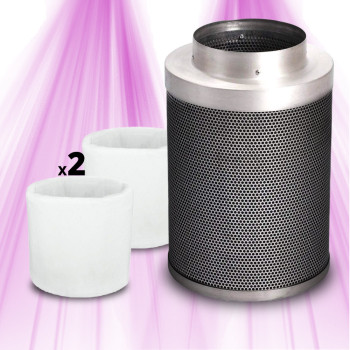
Prima Klima Carbon Filter Ø150/160mm – L65cm – 900m³/h
Ships within 2 weeks
150,28 € or 3× 50,09 €

Product successfully added to your shopping cart
Ça pousse dans le bon sens

19 products
Standard range carbon filters are the basic solution for effectively neutralizing odors in your indoor growing space. These filters use quality activated carbon to absorb odor particles, ensuring total discretion. Whether you're just starting out or looking for reliable, no-frills equipment, this range offers unbeatable value for money.
The standard range stands out for its ease of use and proven effectiveness. The ProActiv Ø125 mm - 250 m3/h is perfect for small setups up to 1m², while the ProActiv Ø150mm - 840m3/h easily handles larger spaces. These filters incorporate an activated carbon layer 38-40mm thick, sufficient to capture most odor molecules. The advantage? An affordable price and plug-and-play installation. Honestly, for starting out or equipping a secondary space, this is exactly what you need. The ProActiv Ø125mm - 460 m3/h even offers an interesting intermediate flow rate for medium configurations.
The choice is based on three main criteria: the diameter of your extractor, the required flow rate, and the size of your space. For a 125mm extractor, opt for corresponding models like the Prima Klima Ø125mm - 480m3/H which offers an excellent length/flow compromise with its 40cm. 150mm extractors pair perfectly with the ProActiv Ø150mm - 690 m3/h. Calculate approximately 3 to 5 air changes per hour: for a 2m³ space, a 250-400 m3/h filter is more than enough. Don't forget that the filter's length impacts the space it takes up in your setup.
Unfortunately, the standard range is generally limited to 125mm and 150mm diameters. For a 200mm extractor, you will either need to use a reducer (which reduces efficiency) or opt for a professional range. 200mm to 150mm reducers exist but create turbulence that reduces effective flow by about 15-20%. If your budget allows, investing in a dedicated 200mm filter will be more efficient in the long run.
The optimal installation consists of suspending the filter high up with adjustable straps, with the outlet directed towards the extractor. Maintain a space of 20-30cm around the filter for uniform suction. Connect the filter directly to the extractor with a short rigid duct (maximum 1 meter) to avoid pressure losses. The pre-filter must be tightly fitted around the filter body, without creases that would create unfiltered air passages. Ensure the entire assembly is stable to avoid vibrations.
A standard carbon filter lasts between 12 and 18 months depending on use and incoming air quality. The first signs of wear: odors starting to pass through despite a clean pre-filter, reduced airflow even after cleaning the pre-filter. Activated carbon gradually saturates and loses its absorption capacity. To maximize lifespan, maintain stable humidity (50-60%) as excessive humidity accelerates carbon saturation. A filter overloaded with particles ages faster.
The pre-filter should be cleaned every 2-4 weeks depending on the environment. Gently remove it, vacuum dust with a low-power vacuum cleaner, or shake it outdoors. For a more thorough cleaning, wash it in lukewarm water with a mild detergent, rinse thoroughly, and let it dry completely before reassembly. A clogged pre-filter reduces airflow by 30-40% and strains the extractor. Always have a spare pre-filter to maintain rotation. Some growers use thin tights as an auxiliary pre-filter, which are cheaper and just as effective.
For a 2x2m space (i.e., approximately 6-8m³ depending on height), a standard filter is largely sufficient. Choose a model with a flow rate of 300-500 m3/h to ensure 3-4 air changes per hour, which is the optimal flow for filtration. An undersized filter (less than 200 m3/h) would not capture all odors, while an oversized one (more than 800 m3/h) would create too fast a flow, reducing contact time with the carbon. Efficiency also depends on the airtightness of your installation: any unfiltered air leak compromises the overall result.

Help & advice
About Standard range — click a question to see the answer.
As an expert, I can confirm that the primary role of a carbon filter in indoor growing is to neutralize odors emitted by your plants. It contains activated carbon which absorbs odor molecules, thus ensuring essential discretion, especially in urban environments. It is a key element for serene cultivation without inconvenience to those around you.
To determine the ideal power, I recommend that you calculate the volume of your grow space (length x width x height) and multiply it by 60 to obtain the necessary airflow in m³/h. The carbon filter should have a flow rate slightly higher than or equal to that of your extractor for optimal efficiency. For example, for a small tent, a Prima Klima PITPUK 240m³/h might be sufficient.
In general, both brands, Prima Klima and ProActiv (Garden HighPro), offer excellent standard range carbon filters. The main difference often lies in the type of activated carbon used and the filter design. Prima Klima is renowned for its high-quality coconut carbon, while ProActiv offers robust and efficient solutions, such as the ProActiv Ø150mm - 840m3/h. The choice will often depend on your personal preferences and the availability of models suited to your specific needs.
The lifespan of a standard range carbon filter generally varies between 6 and 18 months of continuous use, depending on the quality of the carbon, ambient humidity, and the intensity of the odors to be filtered. I advise changing it as soon as you start to perceive odors in your space or if the airflow seems reduced. Good maintenance can slightly extend its useful life.
For a carbon filter to be suitable, its connection diameter (flange) must first match that of your air extractor. Then, its maximum airflow must be sufficient to process the volume of your grow tent. I recommend always choosing a filter whose flow rate is at least equal to, or even slightly higher than, that of your extractor for optimal efficiency. Don't forget to check the physical dimensions of the filter to ensure it fits in your tent.
Cannot find your answer? 01 88 33 45 52 or by message.


