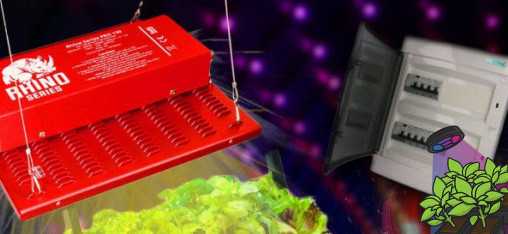
Professional Indoor Growing Equipment: Gear That Goes the Distance
When it comes to professional indoor growing setups, we're not messing around with equipment. Gone are the makeshift solutions and compromises on quality – here, every component must keep up 24/7. Whether for a commercial operation or a large-scale project, professional equipment makes the difference between a profitable investment and a financial black hole.
Why Invest in Professional Equipment for Your Indoor Grow
The difference between amateur and professional equipment is, first and foremost, durability. A professional electronic ballast will handle 50,000 hours of operation without a hitch, whereas an entry-level model might fail after 20,000 hours. The same logic applies to extractors: an industrial centrifugal fan maintains its performance for years, with ball bearings that withstand continuous rotation.
Energy efficiency is the other crucial point. Professional LEDs easily reach 2.8 µmol/J, compared to 1.8 µmol/J for consumer models. For a 100m² setup, this difference represents several thousand euros in savings per year. Not to mention that professional ventilation systems consume less while moving more air – a 315mm inline extractor can push 2500 m3/h with only 270W.
In terms of control, professional equipment often integrates advanced sensors and monitoring systems. Temperature, humidity, pressure, airflow – everything is measured in real-time. Some ballasts even communicate their data via DALI protocol for centralized lighting management.
How to Choose Your Professional Indoor Growing Equipment
First criterion: size your equipment according to your actual surface area, not your ambitions. For a 4x4m tent, count on a minimum of 1000W of full spectrum LED, a 2000 m3/h extractor, and a ventilation system with at least 4 air circulators. Pros always calculate a 20% margin on specs to anticipate heat peaks.
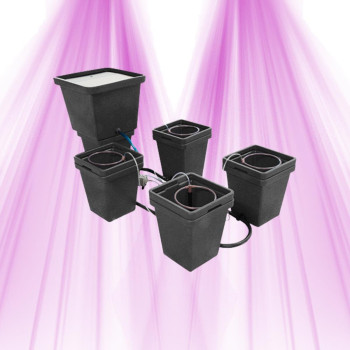
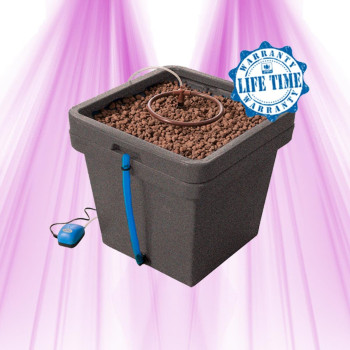
Modularity is essential for a professional setup. Opt for scalable systems: extensible lighting rails, controllers that accept multiple zones, extractors with integrated dimmers. Modular hydroponics allows you to adjust the number of plants according to production cycles.
Regarding budget, expect between 150 and 250€/m² for a complete professional quality installation. This includes structure, lighting, ventilation, climate control, and irrigation system. Energy savings and reliability quickly amortize this initial investment.
Don't forget maintenance: choose brands that offer spare parts and responsive after-sales service. A broken extractor can compromise an entire production in just a few hours.
Frequently Asked Questions
What size indoor grow tent should I choose for my professional space?
For a professional operation, assume a minimum ceiling height of 2.5m to allow for optimal growth. For surface area, allow 1m² per plant in flowering for medium-sized varieties. A 3x3m tent comfortably accommodates 9 plants, while a 4x4m space can hold up to 16 plants with careful management. Modular tents allow you to adjust the configuration according to your production cycles. For installations over 20m², prefer custom grow rooms over prefabricated tents.
How do I install a complete hydroponic system for an indoor operation?
Installing a professional hydro system begins with choosing the technique: NFT for leafy greens, DWC for large productions, or ebb & flow for versatility. Plan for a minimum 200L reservoir per m² of cultivation, with a pump capable of renewing the volume every 2 hours. The drainage system must evacuate 150% of the irrigation flow to prevent overflow. Absolutely install an automatic pH/EC monitoring system – nutrient imbalances can ruin a harvest in 48 hours. Hoses must be opaque and of appropriate diameter: 16mm for irrigation, 25mm for gravity return.
What is the difference between an inline air extractor and a centrifugal fan for professionals?
An inline extractor mounts directly into the duct and excels for linear installations with few bends. It generates less noise (35-40 dB) but quickly loses efficiency if the duct is longer than 5m or has multiple bends. A centrifugal fan develops much higher static pressure (up to 800 Pa) and maintains its flow even with complex ducting. For a professional installation, a centrifugal fan is essential when exceeding 1500 m3/h or when using bulky carbon filters. EC (electronically commutated) models consume 40% less than classic AC versions.
How do I maintain and clean an electronic ballast to prevent failures?
A professional electronic ballast requires monthly dusting of the ventilation grilles with a vacuum cleaner or low-pressure compressed air. Every 3 months, check that connections are tight – vibrations can gradually loosen them. The operating temperature should never exceed 60°C (verifiable with an infrared thermometer). Replace the internal fan as soon as it becomes noisy – it's often the first component to fail. Dimmable ballasts should be calibrated annually to maintain their accuracy. Always keep 20cm of clear space around the ballast for air circulation.
Which mineral substrate is most cost-effective for large-scale indoor cultivation?
Rockwool remains the benchmark substrate for professional operations due to its excellent value for money and reusability. Expect 2-3€/m² compared to 8-12€/m² for premium coco fiber. It retains 20 times its weight in water while maintaining 15% air, which limits the risk of overwatering. 10x10cm cubes cost about 0.30€ each and can be reused 2-3 cycles after sterilization. Expanded perlite (2-6mm particle size) is an economical alternative at 1.5€/m², particularly suitable for ebb & flow systems. Avoid ready-made mixes, which cost 3 times more than separate components.