Aller au contenu principal
5 produits

Ventilateurs

Fans for indoor growing: air exhaust and circulation

Fans are the respiratory system of your grow space. Whether it's extracting stale air, bringing in fresh air, or circulating the atmosphere around your plants, they ensure a healthy and productive environment. Without proper ventilation, temperature and humidity quickly become unmanageable.

...

Fans for indoor growing: air exhaust and circulation

Fans are the respiratory system of your grow space. Whether it's extracting stale air, bringing in fresh air, or circulating the atmosphere around your plants, they ensure a healthy and productive environment. Without proper ventilation, temperature and humidity quickly become unmanageable.

Why choose fans adapted for indoor growing

Ventilation plays several crucial roles in your setup. First, it removes the heat generated by lighting – a 200 m³/h extractor is usually sufficient for a 150W LED lamp in a 0.8m² space. Second, it renews the air to maintain optimal CO2 levels and prevent humidity buildup, which promotes mold growth.

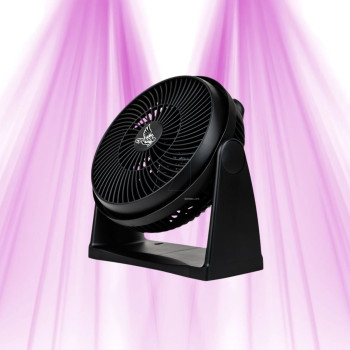
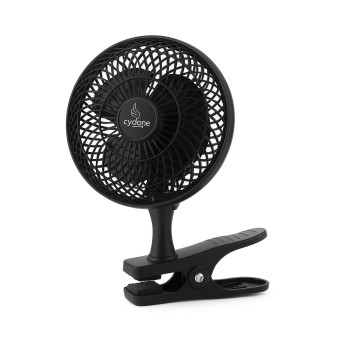
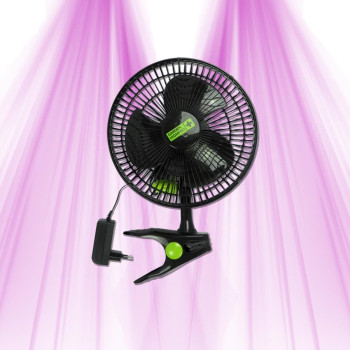
Air circulation strengthens stems and simulates natural conditions. An oscillating fan creates micro-movements that stimulate growth without causing stress. Clip-on models easily attach to structural bars and direct airflow precisely where needed.

Centrifugal extractors better withstand the static pressure of ducts and carbon filters. Their EC motor consumes 30 to 40% less than a classic AC motor while remaining quieter – a crucial point for discretion.

How to choose your grow fans

The airflow is calculated by multiplying the volume of your space by 60 (hourly air changes). For a 1m x 1m x 2m grow tent, count on a minimum of 120 m³/h, but increase to 200-250 m³/h if you use a carbon filter, which reduces airflow by 20 to 30%.

Noise level matters greatly. Quiet extractors go below 35 dB at reduced speed thanks to their soundproofed casing and optimized blades. Models with integrated dimmers allow fine-tuning of airflow as needed.

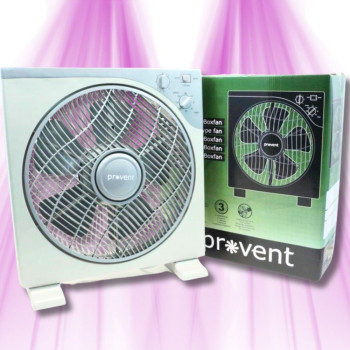
For air circulation, opt for fans with multiple speeds and adjustable oscillation. Power should remain moderate (15-30W) to avoid drying out plants. A diameter of 15-20 cm is perfect for most home setups.

Frequently Asked Questions

What airflow in m³/h should I choose for an exhaust fan in a 1m² tent?

For a 1m² tent with a height of 2m (2m³), the basic calculation gives 120 m³/h (volume x 60). But in practice, count on 180-200 m³/h to compensate for the resistance of the carbon filter and ducts. If you use high-heat HPS lamps, go up to 250 m³/h. Extractors in this range generally run between 4000 and 6000 revolutions/minute and consume 35 to 50W depending on the model.

Should I use an oscillating or clip-on fan to circulate air without damaging plants?

Both have their advantages depending on the configuration. An oscillating fan covers a wider area and creates natural air movement that uniformly strengthens stems. Clip-on models offer more precision to target a specific area or avoid fragile plants. The important thing is to maintain a constant light breeze without ever creating a "storm" – leaves should just rustle, not bend. Place it 50-80 cm from the plants and direct the airflow slightly upwards.

How to install an extractor with a carbon filter without air leaks?

Sealing is crucial for filtering efficiency. Use metal clamps at each junction between the extractor, filter, and duct – plastic clamps loosen over time. Wrap aluminum tape around the connections to perfect the seal. Check that the filter diameter exactly matches that of the extractor (125mm, 150mm, 200mm). An air leak drastically reduces filter efficiency and can create residual odors.

What's the difference between a Prima Klima VKO fan and a Vents TT for small indoor growing?

The Prima Klima VKO focuses on discretion with its soundproofed casing and curved blades that reduce turbulence. It stays below 32 dB even at full power, ideal for apartments. The Vents TT prioritizes value for money with higher airflow (up to 15% more) but generates more noise. In terms of durability, both use ball bearings, but the Prima Klima often integrates a more economical EC motor. For discreet growing, choose the VKO; to maximize airflow on a tight budget, opt for the TT.

How to clean and maintain a fan so it lasts several seasons?

Dust the blades every 2-3 months with a dry brush or a low-power vacuum cleaner – dust unbalances the rotor and increases noise. Check the bearings by manually spinning the propeller: it should turn freely without jerks. If it squeaks, a few drops of fine oil on the bearings are usually sufficient. Clean the casing with a damp cloth without aggressive detergents. For extractors, check the condition of the seals and replace them if they harden. Regular maintenance can double the lifespan of your equipment.

Showing 1 - 5 of 5 items
What is the fundamental difference between an exhaust fan and a circulation fan?
   

That's an excellent question to start with! In fact, they have very distinct roles. The exhaust fan is there to manage the overall airflow of your grow space. It will remove hot, stale, and humid air to replace it with fresh air. It's the lung of your setup. The circulation fan, on the other hand, has a more local action: it circulates the air inside the tent or room to create gentle movement around your plants, strengthening their stems and preventing stagnant air pockets.

What is the purpose of a fan in an indoor grow, beyond simple air circulation?
   

I often see this question, and it's important to understand the impact. A circulation fan does much more than just move air. It helps to strengthen your plants' stems by simulating natural wind, making them more robust. It also prevents the appearance of mold and diseases by reducing stagnant humidity around the foliage. Not to mention, it promotes better nutrient absorption by renewing the air around the leaf stomata. For more information, I invite you to read this article on improving your harvest through ventilation.

How do I choose the right fan power for my grow tent?
   

This is a crucial step! For the exhaust fan, I recommend calculating the volume of your space (length x width x height) and multiplying that figure by 30 to 60. The result will give you an estimate of the required airflow in m³/h. For circulation fans, there's no precise calculation, but I advise choosing models with multiple speeds and oscillation for optimal coverage, without 'blowing' too hard on the plants.

How do I calculate the necessary airflow (CFM or m³/h) for my exhaust fan?
   

To calculate the necessary airflow, it's quite simple in practice. You first need to determine the volume of your grow space in cubic meters (m³), which is length x width x height. Then, I recommend renewing the air in your space every 1 to 3 minutes. So, multiply the volume of your grow box by 20 (for renewal every 3 minutes) to 60 (for renewal every minute). For example, a 1m x 1m x 2m (2m³) box would require an exhaust fan between 40 m³/h and 120 m³/h. Don't forget to add a safety margin if you are using a carbon filter or if the ambient temperature is high.

Should I choose an intake fan or an exhaust fan for my indoor ventilation?
   

In fact, the ideal is to have both, but with a clear priority. Exhaust is absolutely essential. It's what will remove hot and humid air, and create a slight negative pressure that will naturally draw fresh air in through the passive openings of your grow box (this is passive ventilation). An intake fan (a fan that pushes fresh air in) becomes useful if your space is large, if you have temperature or humidity problems, or if you are using a CO2 system. I advise you to start with a good exhaust fan and then evaluate if an active intake fan is necessary.

What are common mistakes to avoid in indoor grow ventilation?
   

What I often see is the mistake of undersizing the exhaust fan, which leads to temperature and humidity problems. Another mistake is not having air circulation, which promotes diseases and weakens plants. You should also avoid directing a circulation fan directly onto the plants constantly, as this can stress them. Finally, neglecting the maintenance of filters and ducts can significantly reduce the efficiency of your system. Good ventilation is the key to a successful harvest, as I explain in our dedicated category.

What type of oscillating fan do you recommend for air circulation in a grow tent?
   

For air circulation, I strongly recommend an oscillating fan. This allows for more homogeneous air distribution without creating 'hot spots' or 'cold spots' and without excessively stressing a specific area of your plants. I prefer models with multiple speeds so you can adjust the intensity of the airflow according to your plants' growth stage. Small clip-on fans are very practical for small tents, as they are easy to position and move.

Blog navigation

Latest posts

VIVOSUN Grow Cam 6mm 2K QHD WiFi Grow Camera

Tired of anxiety when you're away from your grow? The VIVOSUN Grow Cam 6mm 2K QHD WiFi Grow Camera lets you keep an...

Read more
STOP à la Tourbe ! Découvrez les 4 Meilleurs Substrats Écologiques pour une Culture Indoor Explosive

Le monde du jardinage connaît une transformation silencieuse mais profonde. Face à l'urgence climatique et à la prise...

Read more
Master Pack PRO Advanced Nutrients: Created by GrowLED for demanding growers!

When you're starting out or looking to optimize your indoor growing, the hardest part is often choosing the right...

Read more