











































































GrowLED Essentials
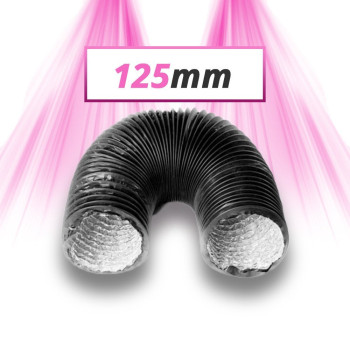
Combi alu/PVC ducting 3 m – Ø 152 mm
Available in 8 models
In stock · Shipped within 24 h
11,88 €

Product successfully added to your shopping cart
Ça pousse dans le bon sens

4 products
Ventilation ducting forms the backbone of your indoor growing aeration system. These conduits transport fresh air to your plants and remove stale air, creating optimal airflow in your grow space. Whether you're setting up a 60x60cm grow tent or a multi-square-meter room, choosing the right ducting determines the efficiency of your ventilation.
Poorly sized or low-quality ducting can create significant pressure drops, force your extractors to work harder, and generate noise. Conversely, appropriate ducting ensures quiet and efficient airflow, an essential condition for successful cultivation.
Ventilation ducting for indoor growing must withstand specific conditions: high humidity, temperature variations, and continuous operation. Flexible multi-layer aluminum ducting offers valuable installation flexibility in confined spaces, while rigid PVC ducting ensures maximum airflow with less turbulence.
Thermal insulation becomes crucial when your ducting passes through unheated areas. Insulated ducting prevents condensation that could damage your setup and maintains the temperature of the transported air. For silent installations, acoustic ducting drastically reduces noise transmission from extractors.
Diameter plays a fundamental role: 100mm ducting is suitable for extractors up to 200m3/h, while 150mm can handle 400-500m3/h without excessive pressure drop. Large volumes require diameters of 200mm or more to maintain reasonable air speeds.
The diameter must exactly match that of your extractors and intake fans. Forcing a connection with reducers creates turbulence and noise. Precisely measure your needs: total length, number of necessary bends, and space constraints.
For material, flexible aluminum remains the standard for its ease of installation and resistance to humidity. Rigid PVC ducting is better suited for long, straight runs where efficiency is paramount. Insulated versions are essential if your ducting passes through attics, cellars, or unheated spaces.
Thickness also matters: thin ducting deforms easily and creates restrictions. Opt for a minimum thickness of 0.12mm for aluminum. Check the service temperature: some cheap ducting degrades quickly with the heat from HPS lamps.
For a standard kitchen, 125mm ducting is usually sufficient with a 300-400m3/h extractor. Bathrooms require 100mm for flow rates of 150-250m3/h depending on the surface area. In indoor growing, these same principles apply: calculate 6-8 air changes per hour and choose the diameter accordingly. A 1m² grow tent with 2m height requires 100-120m3/h, meaning a minimum of 100mm ducting.
Flexible aluminum ducting bends easily but creates more turbulence due to its internal corrugations. It loses about 15-20% of flow compared to rigid ducting. Rigid PVC ducting offers optimal flow but imposes installation constraints with bends to change direction. In indoor growing, flexible ducting dominates because it adapts to the confined spaces of grow tents and boxes.
Insulation becomes essential if your ducting passes through cold areas or if you want to avoid condensation. In winter, the warm, humid air from your grow space condenses on the cold walls of uninsulated ducting, creating drips that can fall on your plants. Thermal insulation also maintains the temperature of the transported air, preventing thermal shock. For noise, acoustic insulation reduces sound transmission from extractors by 10-15 dB.
Avoid tight bends that create turbulence: use gentle curves with a minimum radius of 1.5 times the duct diameter. Securely fasten the ducting to prevent vibrations from transmitting to structures. Never compress flexible ducting: it must maintain its nominal diameter throughout its length. Use appropriate clamps and sealing mastic on all connections to prevent air leaks.
Each 90° bend is equivalent to 3-5 meters of straight ducting in terms of pressure drop. Limit yourself to a maximum of 2-3 bends on a circuit. For length, stay under 6-8 meters for 100mm and 10-12 meters for 150mm with a standard extractor. Beyond that, pressure losses become significant, and your extractor loses efficiency. If you need to exceed these lengths, oversize the diameter or increase the extractor's power.
Available in 8 models
Available in 8 models
Available in 8 models
Available in 8 models
Help & advice
About Gaine — click a question to see the answer.
In indoor growing, ventilation ducts are crucial. They ensure air transport: they bring fresh, CO2-rich air to your plants, and expel hot, humid, and depleted air out of your space. It is thanks to them that you maintain optimal temperature and humidity, and ensure constant air renewal, essential for your plants' photosynthesis. Without them, your ventilation system would be inefficient.
To choose your ducts, I advise you to consider several points. First, the diameter must match that of your extractor and intake fan to avoid pressure losses. Then, the material: soundproof ducts are perfect if noise is a concern, while aluminum ducts are more economical. Finally, the length and number of bends will influence the necessary power of your extractor. I recommend reading my article on improving your harvest through ventilation for more details.
For a small 60x60cm grow tent, I generally recommend ducts of 100 mm or 125 mm in diameter. The precise choice will depend on the power of your chosen extractor and intake fan, as well as the length of the ducts and the number of bends. The goal is to ensure sufficient air renewal without overloading your extractor. Good ventilation is the key to successful cultivation, as I explain in my article on climate control.
The main difference lies in their use and properties. Flexible ducts, often made of aluminum or PVC, are very practical for complex installations with many turns, as they are easy to handle and cut. However, they can create more pressure losses and are noisier. Rigid ducts, on the other hand, offer better airflow, are quieter and more durable, but their installation is more complex and they are less suitable for small spaces or winding paths.
For installation, I advise you to start by planning the layout to minimize bends and length. Securely fix your extractor and intake fan. Then, connect the ducts to the devices and openings of your grow room using clamps. Make sure the ducts are taut to avoid air pockets and vibrations. If you are using soundproof ducts, be careful not to pierce them. My advice is to always check the airtightness of all connections to optimize the efficiency of your system.
The most common mistake I see is undersizing the ducts relative to the extractor, which significantly reduces its efficiency and increases noise. Also avoid ducts that are too long or have too many tight bends, as this creates significant pressure losses. Finally, neglecting the airtightness of connections is a mistake that can lead to air leaks and poor climate management. Always think of air circulation as a fluid system.
To know if your ducts are suitable, I invite you to observe several indicators. If your extractor is running at full speed but the temperature and humidity remain too high, or if you notice a persistent bad odor, it's a sign that your ducts may be undersized or poorly installed. Insufficient airflow or excessive noise can also indicate a problem. A simple test is to feel the airflow at the inlet and outlet of your space: it should be constant and powerful.
Cannot find your answer? 01 88 33 45 52 or by message.