




































































GrowLED Essentials
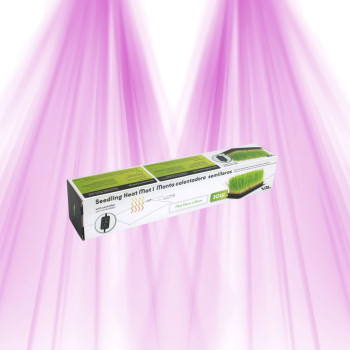
Heating mat for seedlings and cuttings - 15W 35x20cm - 30W 55x35cm
In stock · Shipped within 24 h
16,90 €

Product successfully added to your shopping cart
Ça pousse dans le bon sens

7 products
A heating mat is essential for successful seedlings and cuttings in indoor growing. This heating pad is placed under your germination trays to maintain a stable root zone temperature, typically between 20 and 25°C. Honestly, it's the small detail that makes all the difference between seeds that are slow to germinate and a uniform emergence in 3-5 days.
The principle is simple but effective: bottom heat stimulates root activity and accelerates germination. Your seedlings develop a denser root system, more quickly. And unlike ambient heating, which can dry out the air, the heating mat maintains substrate humidity while providing that crucial gentle warmth.
Soil temperature directly influences germination speed. With a heating mat, you go from 10-15 days of waiting to 3-7 days, depending on the variety. This is particularly noticeable for seeds that require constant warmth. The mat maintains this stable temperature 24/7, even if your grow room temperature drops at night.
The other major advantage is energy savings. Instead of heating the entire space with a fan heater that consumes 1500-2000W, a 50x35cm mat only draws 17-25W. You only heat where it's needed. And in terms of safety, recent models are waterproof (IP67) and can handle humidity without a hitch.
For cuttings, it's even more significant. Rooting hormones are better activated with this gentle bottom heat. Your cuttings root faster and with a much higher success rate. Whether in rockwool, peat, or coco coir cubes, the heating mat optimizes root conditions.
Size is the first criterion. Measure your seedling trays or cutting propagation trays. A 40x60cm mat generally covers 2-3 standard trays. For a mini propagation greenhouse, a 25x35cm model is more than enough. The idea is that the mat covers at least 80% of the container's surface area.
In terms of power, count approximately 10-15W per dm². A 50x35cm mat (17.5 dm²) therefore develops 17-25W, which is perfect for maintaining 22-24°C at root level. More powerful models (30-40W) are useful if your space is particularly cold or poorly insulated.
An integrated thermostat is a significant bonus. You set the desired temperature, and the mat automatically switches off when it's reached. Otherwise, an external thermostat with a probe works perfectly well. Waterproofing is crucial: check for a minimum IP65 certification; IP67 is even better for resisting water splashes.
Last thing: thickness. Thin mats (2-3mm) fit everywhere but are more fragile. Models 5-7mm thick last longer and distribute heat better. It's a question of budget and usage.
For a standard mini-greenhouse (60x40cm), a 17-25W mat is more than sufficient. Count 10-12W per dm² of surface to be heated. If your mini-greenhouse is 24 dm², a 25W mat will easily maintain 22-24°C at seedling level. More powerful models (30-40W) are only useful if your room drops below 15°C at night. The important thing is temperature regularity, not raw power.
Never directly on glass! Always place a 2-3mm spacer (polystyrene sheet, thick cardboard) between the mat and the glass surface. Glass conducts heat too well and creates hot spots that can damage the mat. On a metal or wooden shelf, direct contact is not a problem. The idea is to avoid overly conductive materials that create overheating zones.
An integrated thermostat really makes life easier, especially for beginners. You set it to 22°C, and you're good to go. Without a thermostat, you have to monitor with a thermometer and unplug manually if it gets too hot. An external thermostat with a probe costs 15-20€ and does the same job as an integrated model. It's a matter of budget: if the price difference is small, go for the integrated thermostat. Otherwise, a simple model + external thermostat works very well.
Condensation comes from the temperature differential between the warm substrate and the cooler air. Place the mat under the tray, not directly under the pots. Leave 1-2cm of air between the tray and the mat for more homogeneous diffusion. Regularly ventilate your seedling area, even 5 minutes a day. If you use a transparent lid, crack it open slightly to release excess humidity. The goal: 70-80% humidity, not 95%.
A properly used mat doesn't dry out the soil much more than usual. The problem often comes from a setting that's too hot (above 26°C) or direct contact with the pots. Maintain a maximum of 22-24°C and check substrate humidity daily. For maintenance, clean the mat with a damp cloth, never direct water, even if it's waterproof. Regularly check the power cable and store it flat, never folded. A good mat lasts 5-8 years with these simple precautions.
Available in 3 models
Available in 3 models
Available in 3 models
Help & advice
About Heating Mat — click a question to see the answer.
A heating mat is an essential tool for any gardener who wants to successfully grow seedlings and cuttings. Its primary role is to maintain a stable and optimal temperature at the substrate level, generally between 20 and 25°C (68-77°F). This gentle warmth stimulates seed germination and promotes rapid rooting of cuttings, resulting in more uniform emergence and more vigorous plants from the start. It's truly the foundation for giving your young sprouts the best boost.
For the germination of most seeds, I recommend maintaining a substrate temperature between 20 and 25°C (68-77°F). This is the ideal range to activate germination enzymes and ensure rapid and uniform emergence. Some species may prefer slightly different temperatures, but this range is an excellent universal starting point. In practice, I always advise checking the specific needs of your seeds to adjust as best as possible.
Absolutely! I consider a thermostat to be an indispensable accessory with a heating mat. Without it, your heating mat will heat continuously, which can lead to overheating and dry out the substrate, or even damage your young plants. A thermostat allows you to precisely regulate the temperature and keep it constant, thus avoiding harmful fluctuations. It's a small investment that makes a huge difference for the safety and efficiency of your setup.
That's an excellent question and a common problem if you don't pay attention. To prevent the heating mat from drying out the substrate too quickly, I recommend several things. Firstly, always use a thermostat to regulate the temperature and avoid excessive heat. Secondly, make sure your seed trays or cutting trays have lids or propagation domes to maintain high humidity. Finally, I recommend regularly checking the substrate's moisture and watering if necessary, but always sparingly so as not to drown the young roots.
Yes, you can leave a heating mat on permanently, but only if it is coupled with a thermostat. The thermostat will regulate the temperature and turn the mat on or off according to your settings, thus ensuring constant heat without the risk of overheating. Without a thermostat, I strongly advise against leaving it plugged in continuously as this could lead to excessive temperatures, damage your plants, and increase the risk of fire. Safety first!
For home use, I advise you to choose a heating mat of a size appropriate for your space and the number of trays you plan to use. Power is not the most important criterion, as most mats are designed to reach germination temperatures. What I prioritize is the quality of manufacturing and the presence of water protection. Don't forget to pair it with a good thermostat for precise temperature control. If I had to choose, I would pick a robust and reliable model, even if it's a bit more expensive, because it's a long-term investment for your crops.
Yes, unfortunately, a heating mat can potentially burn plants or damage a terrarium if not used correctly. That's why I emphasize so much the importance of a thermostat. Without regulation, the heating mat can reach excessively high temperatures, causing root burn, critically drying out the substrate, or even melting certain terrarium plastics. The thermostat is your best protection for maintaining gentle and safe heat.
Cannot find your answer? 01 88 33 45 52 or by message.