



































































Lumatek
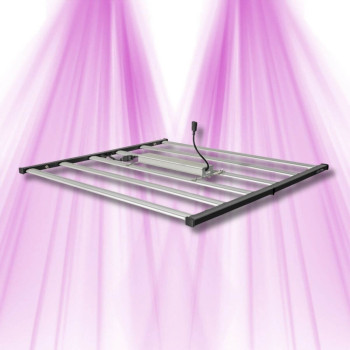
Lumatek Zeus 600W PRO 3.1 - Multi-Bar System by Lumatek - Sold complete
Available in 5 models
In stock · Shipped within 24 h
1 089,00 € or 3× 363,00 €

Product successfully added to your shopping cart
Ça pousse dans le bon sens

16 products
HPS and MH lighting systems of 900-1000 Watts represent the high-end of traditional horticultural lighting. This power allows covering large areas (up to 1.5m²) with a light intensity of 140,000 to 155,000 lumens depending on the model. Whether for professional installations or ambitious projects, this range offers the maximum photons available in HPS/MH technology.
Frankly, when we talk about 1000W, we're in the big leagues. These lamps deliver a PPFD (photosynthetic photon flux density) that can reach 1200-1500 µmol/m²/s at 30cm distance, which is exactly what you need to maximize photosynthesis. The difference with lower wattages? It's simple: more light penetration into the foliage, denser buds throughout the plant's height, and yields that can increase by 30 to 40% compared to 600W over the same area.
The advantage of 1000W HPS is their ability to maintain correct intensity even at 60-80cm distance. Perfect for stretching varieties or ambitious SCROG grows. On the MH side, the intense blue spectrum (4200K) at this wattage creates ultra-short internodes during growth – a real plus for structuring robust mother plants.
First crucial point: the ballast. At this power, forget basic magnetic ballasts that heat up like radiators. A dimmable electronic ballast will allow you to modulate between 600W, 750W, and 1000W depending on the growth phases. Actual consumption ranges between 920W and 1100W depending on the models – check the specs carefully to anticipate your electricity bill.
For the reflector, that's where it changes everything. A closed reflector like a cooltube becomes almost mandatory at this power to evacuate the 3400 BTU/h of heat generated. Plan for an extractor of at least 800 m³/h to maintain acceptable temperatures. Open reflectors are still possible but only with oversized ventilation and a ceiling height of at least 2.5m.
Regarding surface area, a 1000W lamp effectively covers 120x120cm in flowering, up to 150x150cm if you accept a drop in intensity at the periphery. In growth, you can easily manage 180x180cm thanks to the lower light demand of young plants.
The main difference lies in the light spectrum emitted by each technology. 1000W MH bulbs produce a blue-white spectrum (4200K-6500K) rich in blue photons, ideal for the growth phase as it promotes compact development with short internodes. 1000W HPS emit an orange-red spectrum (2100K-2700K) optimized for flowering, stimulating flower production and weight gain. In terms of light output, HPS are more efficient with 140-155 lumens/watt compared to 80-100 lumens/watt for MH. Many growers use MH for growth then switch to HPS for flowering, thus maximizing the benefits of each spectrum.
A 1000W lamp effectively covers a surface of 120x120cm (1.44m²) in flowering with an optimal PPFD of 800-1000 µmol/m²/s. You can extend up to 150x150cm (2.25m²) but the intensity at the edges will drop to 400-500 µmol/m²/s, which is sufficient but not optimal. In the growth phase, where light requirements are lower (300-600 µmol/m²/s), this same lamp can cover up to 180x180cm (3.24m²). The hanging height directly influences these surfaces: at 40cm you concentrate energy on 100x100cm, at 80cm you spread it over 150x150cm but with less intensity in the center.
Installing a 1000W system requires strict electrical safety precautions. The ballast must be placed on a rigid, non-flammable surface, with at least 30cm of clear space around it for ventilation – these devices heat up to 60°C during operation. It is imperative to use a dedicated circuit breaker of at least 16A and electrical cable with a cross-section of 2.5mm² to support the 4.5A consumption. The reflector must be suspended with straps designed to support 5-8kg, and fixings should be checked regularly. Install a smoke detector in the grow space and never leave the system running unsupervised during the first few hours. An electronic ballast heats up less than a magnetic one and significantly reduces risks.
Absolutely, reflectors for 1000W must be sized to manage the intense heat generated by these bulbs. Closed reflectors like cooltubes or air-cooled reflectors are almost mandatory: they allow heat to be evacuated directly via a dedicated air circuit, keeping the bulb at an acceptable temperature. A good 1000W cooltube measures at least 150mm in diameter with 150mm connectors for sufficient airflow. Open reflectors can still be used but only with oversized extraction (1200 m³/h minimum) and a hanging height of at least 80cm. For materials, prefer anodized aluminum or Miro surfaces that reflect 95% of the light without creating destructive hot spots.
A well-maintained 1000W HPS lamp retains 90% of its luminous flux for 12,000 to 15,000 hours of use. The reflector should be cleaned every 4-6 weeks with isopropyl alcohol and a microfiber cloth – avoid abrasive products that scratch reflective surfaces. The bulb itself should be gently cleaned with alcohol when cold, avoiding touching the base. Monthly check the electrical connections of the ballast and dust the ventilation grilles. The bulb needs to be replaced when the luminous flux drops below 80% of the initial value, which is generally after 8-10 months of intensive use. An electronic ballast extends the bulb's lifespan by 20-30% compared to a magnetic one, thanks to its progressive ignition and stable regulation.
Available in 5 models
Available in 7 models
Available in 7 models
Available in 2 models
Available in 3 models
Available in 2 models
Help & advice
About 900 - 1000 Watts — click a question to see the answer.
As an expert, I can tell you that the main difference lies in their light spectrum. MH (Metal Halide) lamps emit a bluer light, ideal for the vegetative growth phase as it promotes robust leaf and stem development. HPS (High Pressure Sodium) lamps produce a redder-orange light, perfect for flowering and fruiting, stimulating the production of flowers and fruits. I often recommend combining the two or using an MH for growth and an HPS for flowering for optimal results.
If you are aiming for high yields and have a significant growing space, generally between 1m² and 1.5m², then a 900-1000 Watt system is perfectly suitable. This power offers very high light intensity, essential for light-hungry plants. In practice, I often see this type of setup with experienced growers or for professional projects looking to maximize their production. You also need to consider the necessary ventilation to manage the heat generated.
My advice is clear: for the vegetative growth phase, opt for an MH lamp. Its blue spectrum promotes compact development and short internodes, which is ideal before flowering. Then, for the flowering phase, switch to an HPS lamp. Its red spectrum stimulates the production of flowers and resin, significantly increasing yield. This is the classic and most effective combination I recommend to get the most out of your plants.
With such power, the first mistake to avoid is poor heat management. These lamps generate a lot of heat, so it is crucial to have adequate ventilation and air extraction to maintain an optimal temperature and avoid thermal stress on your plants. Next, do not underestimate the distance between the lamp and the canopy; too close, you risk burning your plants, too far, they will not receive enough light. I advise you to always follow the manufacturer's recommendations and observe your plants carefully.
That's an excellent question, and the choice depends on several factors. 900-1000W HPS/MH offer raw power and often a lower initial cost, with proven results for large areas. However, they consume more energy and generate a lot of heat. LEDs, although their initial investment is higher, are more energy-efficient, generate less heat, and have a longer lifespan. If I had to choose for a new installation, I would lean towards LEDs for their long-term efficiency and precise spectrum control, but HPS/MH remain a very viable option for those looking for maximum power at a lower initial cost.
For a surface area of 1.2m x 1.2m (approximately 1.44m²), a 900-1000 Watt HPS/MH lighting system is ideal. This power will allow you to cover the entire surface with optimal light intensity, ensuring sufficient light penetration even for the lower parts of your plants. This is what I recommend to achieve the best yields on such a surface, while ensuring good heat management, of course.
Installing a 1000W system requires rigor. I advise you to start by securely fixing the reflector at an adjustable height. Then, connect the ballast to the lamp and the mains, strictly following the provided electrical diagrams and using cables of appropriate cross-section for the power. Make sure your electrical installation can handle the load. Don't forget a good air extraction system to manage heat and a fan to circulate the air. Safety is paramount, so if in doubt, call a professional.
Cannot find your answer? 01 88 33 45 52 or by message.