



































































HomeBox
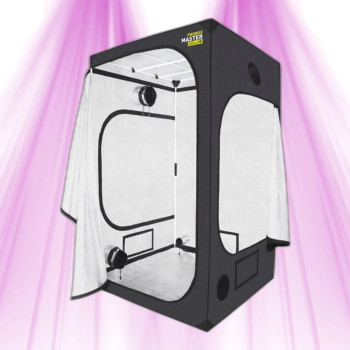
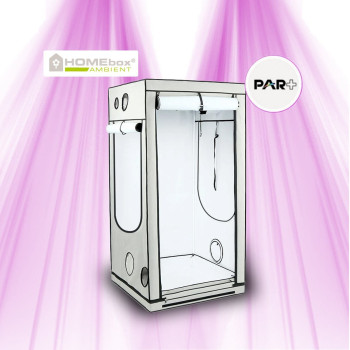
Homebox Ambient AQ 100+ culture chamber - 100x100x220 cm
In stock · Shipped within 24 h
269,00 € or 3× 89,67 €

Product successfully added to your shopping cart
Ça pousse dans le bon sens

67 products
Square grow tents are the most versatile solution for creating a controlled indoor growing environment. With their balanced dimensions, these tents offer optimal light distribution and facilitate the organization of your grow space. Whether you're starting with a small 60x60cm setup or aiming for 120x120cm, the square format maximizes the use of every available square centimeter.
The main advantage of square tents is their lighting efficiency. With a reflector or LED panel placed in the center, the distance between the light source and each corner remains identical – no more shaded areas that penalize your plants. This geometry also allows for more homogeneous air circulation, essential for preventing hot spots and maintaining a stable temperature throughout the space.
From a practical standpoint, square formats adapt perfectly to home spaces. An 80x80cm tent easily fits into a bedroom corner, while a 100x100cm offers enough space for 4 to 9 plants depending on your growing technique. The 120x120cm models are suitable for more experienced growers who want to maximize their yield in a compact area.
Installation is also simplified: the structural bars form perfect right angles, making it easy to mount reflectors, extractors, and other equipment. No need for makeshift adaptations – everything fits together naturally.
The size primarily depends on your available space and the number of plants you plan to grow. For beginners, a 60x60cm (0.36m²) allows you to grow 1 to 4 plants in pots up to 11L. The 80x80cm (0.64m²) and 100x100cm (1m²) formats offer more flexibility with 4 to 6 plants in 18L pots, while the 120x120cm (1.44m²) allows for up to 9 plants or more ambitious SCROG techniques.
Height is extremely important: a minimum of 160cm for compact varieties, 200cm for more developed plants. Remember that you will lose 40-50cm with lighting and pots – do not underestimate this aspect. The fabric thickness influences durability: 600D minimum, ideally 1680D for intensive use.
Also check the openings: observation windows, waterproof cable passages, doors with reinforced zippers. These details make a difference in daily use, especially for maintaining and monitoring your crops.
First, measure your space, leaving at least 30cm around the tent for ventilation and access. For a 120cm wide closet, opt for a maximum of 80x80cm. In a dedicated room, you can go up to 120x120cm. Don't forget the ceiling height: allow a minimum of 200cm for comfortable growing, 240cm for taller varieties. Also, leave room to open the doors completely.
In 1m² (100x100cm), you can grow 4 plants in 18-20L pots for optimal development, 6-9 plants in 11L pots for SOG (Sea of Green), or a single mother plant in a 50L pot. The SCROG technique allows you to optimize space with 2-4 plants trellised under a net. It all depends on your growing method and desired growth duration.
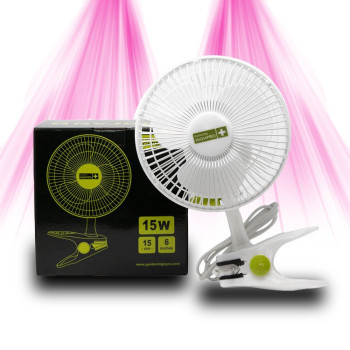
Place the extractor at the top of a back corner, and the passive air intake at the bottom of the opposite corner to create a diagonal flow. For an 80x80cm tent, a 125mm extractor (200-300m³/h) is sufficient. For a 100x100cm tent, upgrade to a 150mm (400-500m³/h). Add an oscillating fan to circulate the internal air and prevent stagnant zones. Ducts should be as short as possible to maintain efficiency.
For LED, count 30-40W per square foot (0.09m²), which means 300-400W for 1m². An 80x80cm tent requires 200-250W LED, a 100x100cm tent between 300-400W. For HPS, it's a minimum of 50W/square foot: 250W for 0.64m², 400W for 1m². Modern full spectrum LEDs offer better energy efficiency and less heat to dissipate, which is particularly beneficial in confined spaces.
Disassemble all equipment and vacuum up plant debris. Clean the walls with a mixture of water/white vinegar (50/50) or a suitable disinfectant solution. Rinse with clean water and let dry completely before reassembly. Check the condition of zippers and seams – replace if necessary. Take the opportunity to clean reflectors, pots, and accessories. Rigorous cleaning prevents contamination between cycles.
Help & advice
About Square — click a question to see the answer.
To choose the ideal square grow tent, I advise you to start by assessing the space you have available. Measure the floor area and available height. Then, consider the number of plants you want to grow and their mature size. A 60x60cm tent is perfect for a few small plants, while a 120x120cm will offer more volume. Also, think about the quality of the materials: thick fabric and robust zippers are guarantees of durability.
The main difference, as you might have guessed, lies in the available growing surface area. A 60x60cm tent is compact, ideal for confined spaces or for growing a few mother plants or cuttings. The 120x120cm, on the other hand, offers four times the surface area, allowing you to grow a larger number of plants or more imposing specimens. I often recommend the 120x120cm for more substantial production, as it also offers better thermal and humidity stability.
A square grow tent serves to create a closed and controlled environment for your indoor crops. It allows you to isolate plants from temperature and humidity variations in your room, concentrate lighting and optimize its efficiency, and manage air extraction and intake. In practice, it gives you total control over climatic conditions, which is essential for the health and yield of your plants.
To start, I often recommend a medium-sized square grow tent, such as an 80x80cm or a 100x100cm. This is an excellent compromise: large enough for a successful first experience with several plants, but not too imposing to be discouraging. This will allow you to familiarize yourself with climate and lighting management without feeling overwhelmed. This is what I often see as the most judicious choice for novices.
Setting up a square tent is generally simple. I recommend you start by assembling the metal frame according to the manufacturer's instructions. Then, unfold the fabric and slide it over the frame. Make sure all zippers are securely closed. Once the tent is assembled, you can install your equipment: lighting, extraction/intake system, and possibly a fan. Remember to position the ducts correctly for optimal air circulation.
The LED lighting power will depend on the size of your square tent and the type of crop. For a 60x60cm, I generally recommend an LED of about 100-150W in actual consumption. For an 80x80cm, aim for 150-200W, and for a 100x100cm, between 250 and 350W. For a 120x120cm, you will need to go up to 400-600W. The important thing is to look at the actual power consumed and not the equivalent power, and to choose full-spectrum horticultural LEDs for optimal growth.
To optimize lighting in a square tent, I advise you to position your LED lamp well in the center, at a height adapted to the growth phase of your plants. Use the reflective walls of the tent to maximize light diffusion. If you have a large tent, adding an oscillating fan can help distribute light and air evenly. Also, consider the photoperiod, which is essential for the life cycle of your plants. I explain in more detail how to reduce your electricity consumption in this article.
Cannot find your answer? 01 88 33 45 52 or by message.