



































































BloomLED
SpectraBUD X500 - 500W Full Spectrum LED Grow Light
Available in 3 models
Ships within 2 weeks
1 129,00 € or 3× 376,33 €

Product successfully added to your shopping cart
Ça pousse dans le bon sens

26 products
A 140cm x 140cm lighting area represents exactly 2m² of growing space, a perfect intermediate size for growers who want to upgrade without breaking their electricity budget. This surface requires precise and well-sized lighting to avoid shadow areas that ruin a harvest. Whether you opt for LED or HPS, every detail counts to maximize your yields over these 2m².
On 2m², you're playing in the big leagues. Too little power and your plants will stretch on the edges, too much and you'll burn through your electricity for nothing. The advantage of this area is that it allows you to install a powerful central lamp that uniformly covers the entire area. For LED, we generally aim for 300-400W actual power for this surface, which is about 150-200W/m². For HPS, a 600W does the job perfectly, even if it heats up more.
The key is light uniformity. On 140x140cm, you can afford a single, well-positioned central source rather than several small lamps. This simplifies installation, reduces hot spots, and optimizes light penetration. Frankly, this is the area where you start to see real results without breaking the bank.
First criterion: actual power. For 2m², aim for 300-400W in full spectrum LED or a 600W HPS. Suspension distance plays a huge role: 40-60cm for LED depending on power, 60-80cm for HPS. Too close and you'll burn the apexes, too far and you'll lose light intensity.
Second crucial point: spectral distribution. During growth, favor a blue-rich spectrum (6000-6500K), during flowering switch to red-orange (2700-3000K). Modern LEDs often offer mixed spectra that work from start to finish, but HPS remains a safe bet for flowering.
Don't forget thermal management. On 2m², a 600W HPS can quickly turn your grow tent into a sauna. Make sure you have sufficient extraction (at least 400m³/h) and an air-cooled reflector if necessary. LED heats up less but costs more to buy.
To uniformly cover 2m² without dead spots, aim for 300-400W actual power in LED or a 600W HPS. For LED, look for models with a wide beam angle (120° minimum) to avoid a central hot spot. A well-designed 350W LED perfectly illuminates this surface with homogeneous distribution. For HPS, the 600W remains the benchmark: it largely covers 140x140cm with a good reflector. Avoid 400W HPS which often leave corners in the shade, and 1000W which is pure waste for this area.
The distance varies depending on the technology and phase. During growth, suspend your LED 50-70cm from young plants, then bring it closer to 40-50cm as they grow. For a 600W HPS, start at 80cm during growth then lower to 60-70cm during flowering. The trick is to monitor the temperature at leaf level: if you can hold your hand under the lamp for 30 seconds without burning, you're good. Adjust according to your plants' reaction: curling leaves = too close, stretching stems = too far.
It depends on your budget and situation. The 600W HPS is cheaper to buy (150-200€ complete) and delivers proven results, especially during flowering. However, it consumes more (ballast included, close to 660W) and heats up a lot. LED costs more (400-800€ for quality) but consumes 30-40% less and heats up much less. For 2m², if you have good extraction and a tight budget, go for HPS. If you want to invest for the long term and save on electricity, get a quality full spectrum LED.
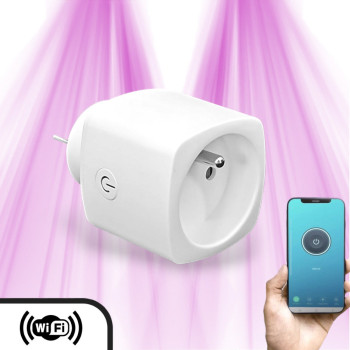
Install a mechanical or digital timer between your wall socket and your lamp. For growth, set it to 18 hours of light and 6 hours of darkness (18/6). Start the lighting around 6 AM to take advantage of off-peak hours if you have that rate. To trigger flowering, switch to 12/12: 12 hours of day, 12 hours of strict night. The darkness must be total during the 12 hours of night, not even a red LED. For 2m², a single lamp = a single timer, it's simple. Check that your timer supports the power of your lamp (minimum 660W for a 600W HPS with ballast).
Clean your reflector and glass every 2-3 weeks with isopropyl alcohol: dust can reduce efficiency by 20%. For LEDs, dust the heat sinks with a dry brush or compressed air every month. Change your HPS bulb every 3-4 cycles (it loses 20% intensity after 10,000 hours). Regularly check that your ballast is not overheating abnormally and that the connections are clean. On 2m², a poorly maintained lamp can create under-lit areas that directly impact your yields.
Available in 3 models
Available in 3 models
Help & advice
About 140cm x 140cm - 2m² — click a question to see the answer.
For a 140cm x 140cm (2m²) area, I generally recommend an LED power of 600 to 800 real watts. This ensures homogeneous light coverage and sufficient intensity for all growth phases of your plants, from germination to flowering. Too little power would lead to disappointing yields, while excessive power would be a waste of energy and could stress your crops.
The main difference, and what often makes me lean towards LED, is energy efficiency and thermal management. LEDs consume less electricity for the same amount of useful light (PPF) and generate much less heat than HPS, which greatly simplifies temperature control in your 2m² grow space. Furthermore, LEDs offer a more complete and often modulable light spectrum, which is a considerable advantage for adapting to the specific needs of your plants at each stage.
The ideal distance between your LED lamp and your plants over 2m² will depend heavily on the power of your fixture and the development stage of the plants. Generally, I start with a distance of about 50 to 70 cm for young seedlings and gradually reduce it to 30-40 cm during full flowering to maximize light intensity. It's crucial to observe your plants: if the leaves yellow or curl, the light may be too close; if they stretch, it's too far.
The most common mistake I see is underestimating the necessary power or mismanaging the distance, which leads to leggy or burnt plants. You must also avoid neglecting ventilation; even if LEDs generate less heat, good air exchange remains essential. Finally, not adapting the light spectrum to different growth and flowering phases is a missed opportunity to optimize your yields. Consider exploring options for other uses if you have specific needs like cultivating cuttings.
The light cycle depends on the growth phase of your plants. For the vegetative phase, I recommend a cycle of 18 hours of light and 6 hours of darkness. Once you switch to flowering, you need to reduce this cycle to 12 hours of light and 12 hours of darkness to stimulate flower production. Respecting these cycles is fundamental for the proper hormonal development of your crops.
Ideally, I recommend a full spectrum for the entire life of the plant, as it best mimics natural sunlight and contains all the necessary wavelengths. However, for optimization, you can favor a spectrum with more blue for growth and more red for flowering. Many modern LED fixtures offer adjustable spectra, which is a major asset for demanding growers on 2m².
Cannot find your answer? 01 88 33 45 52 or by message.


