




































































Athena
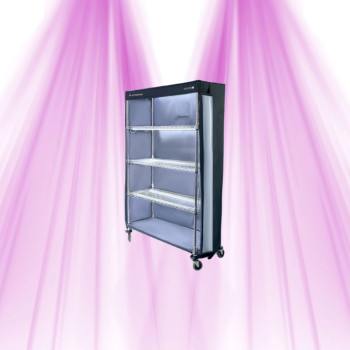
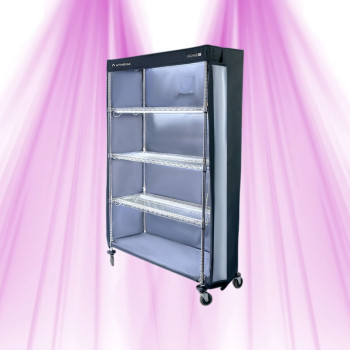
VP Dome Athena Cloning Rack Cover - Optimized Microclimate for Rapid Rooting
Ships within 2 weeks
177,52 € or 3× 59,17 €

Product successfully added to your shopping cart
Ça pousse dans le bon sens

4 products
A propagation rack or trolley is chosen on three figures: the number of standard trays it takes, the clear height between tiers, and the load rating per tier once the trays are saturated with water.
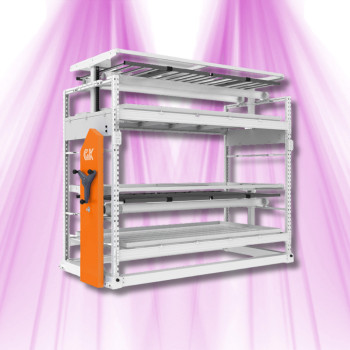
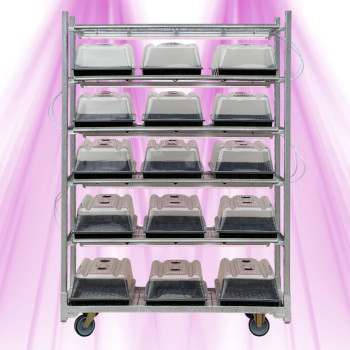
Four references appear here, and they do not form a homogeneous range: two propagation trolleys, a rack cover which is a microclimate accessory rather than a structure, and a complete shelf-growing system, listed by the supplier as available to order. The latter belongs to project work: budgets run from under one hundred and fifty euros excluding VAT for the dome to more than eight thousand.
Two points change a purchasing decision: both trolleys are unheated, bottom heat being handled by separate equipment; and these references are sourced to order, delivered on a pallet, with the lead time stated on the quotation.
Capacity is expressed in standard trays: five for the trolley with integrated lighting, sixteen for the enclosed mobile trolley as for the rack cover. That figure only means something in relation to the tray format actually used in the workshop: compatibility is verified before ordering.
Clear height between tiers is the trade-off between density and workability. A tight tier spacing maximises the number of trays per square metre of floor, but it prevents a gloved hand from passing under the tier above and brings the lighting closer to the canopy; a generous spacing makes the work easier and costs trays. The trade-off depends on how long batches stay in place.
A trolley is only mobile if the building allows it. The points to measure before ordering:
An open frame shares the room's climate: washable and easy to inspect, but it assumes a room whose humidity is already controlled. An enclosed structure, cover or dome, creates a local high-humidity microclimate around the trays and decouples rooting from the general climate; magnetic closures prevent the partial openings that ruin uniformity. In exchange, it has to be watched: with no air exchange, permanent humidity favours collar diseases, and an antimicrobial coating limits the risk without removing it.
Disinfection between batches therefore remains the decisive measure: it assumes a structure that comes apart or can be washed in place, with no inaccessible corners. What everyday language calls a growing shelf is sized here for repeated loading and repeated cleaning.
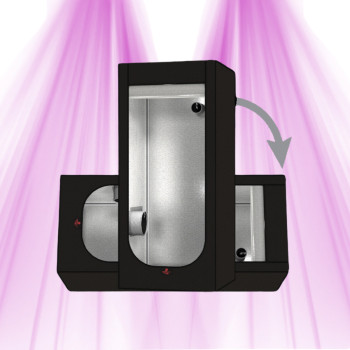
For non-professional use, Probox Propagator mini-greenhouses and trays, domes and propagation accessories are on an entirely different scale. On the lighting side, professional lighting is fitted to structures supplied without it. This section forms part of professional propagation.
Help & advice
About Propagation Racks & Trolleys — click a question to see the answer.
As an expert, I see indoor grow shelves as essential tools for optimizing space. They allow you to transform a horizontal growing surface into a vertical one, thereby multiplying the number of plants you can grow in the same volume. This is ideal for small grow rooms or for professionals looking to maximize their yield.
To choose a grow shelf, I advise you to consider several key factors. First, think about the size of your space and the available height. Then, the robustness of the materials is paramount to support the weight of pots, substrate, and water. I also recommend modular shelves for better adaptability and moisture-resistant materials.
The difference is fundamental: horizontal cultivation uses a single layer of plants on a flat surface, while vertical cultivation with shelves stacks multiple levels. This latter method is a significant space-saver, utilizing the height of your setup. However, it requires more precise management of lighting and ventilation for each level.
That's an excellent question, because lighting is crucial. I always combine shelves with LED bars or compact LED panels, adapted to the length and width of each level. The advantage of LEDs is their low heat output, which is perfect for confined spaces between shelves. It is essential to ensure the correct distance between the light source and the plants for optimal development.
The ideal height really depends on the plants you are growing and their growth stage. Generally, I aim to leave enough space for the vertical development of the plants and for the installation of LED lighting. For multi-level cultivation, I often recommend shelves with adjustable heights, which offers valuable flexibility to adapt to different growth phases. Don't forget to also allow space for air circulation.
Air circulation is paramount, especially in vertical cultivation. I recommend using clip-on fans or exhaust fans for each level or for the entire setup, depending on its size. The goal is to avoid stagnant air pockets that promote diseases and to ensure homogeneous CO2 distribution. Also, remember to space your plants sufficiently and not to overload the shelves to facilitate airflow.
The main mistake I see is neglecting ventilation and humidity, especially on the lower levels. Another common mistake is underestimating the total weight the shelves will need to support, which can lead to stability problems. Finally, not adapting the lighting to each level is a mistake that can compromise the growth of your plants. It is important to plan your installation well from the start to avoid these inconveniences.
Cannot find your answer? 01 88 33 45 52 or by message.