





































































GrowLED Essentials
Digital thermostat with remote probe - Large LCD screen
In stock · Shipped within 24 h
31,50 €

Product successfully added to your shopping cart
Ça pousse dans le bon sens

1 product
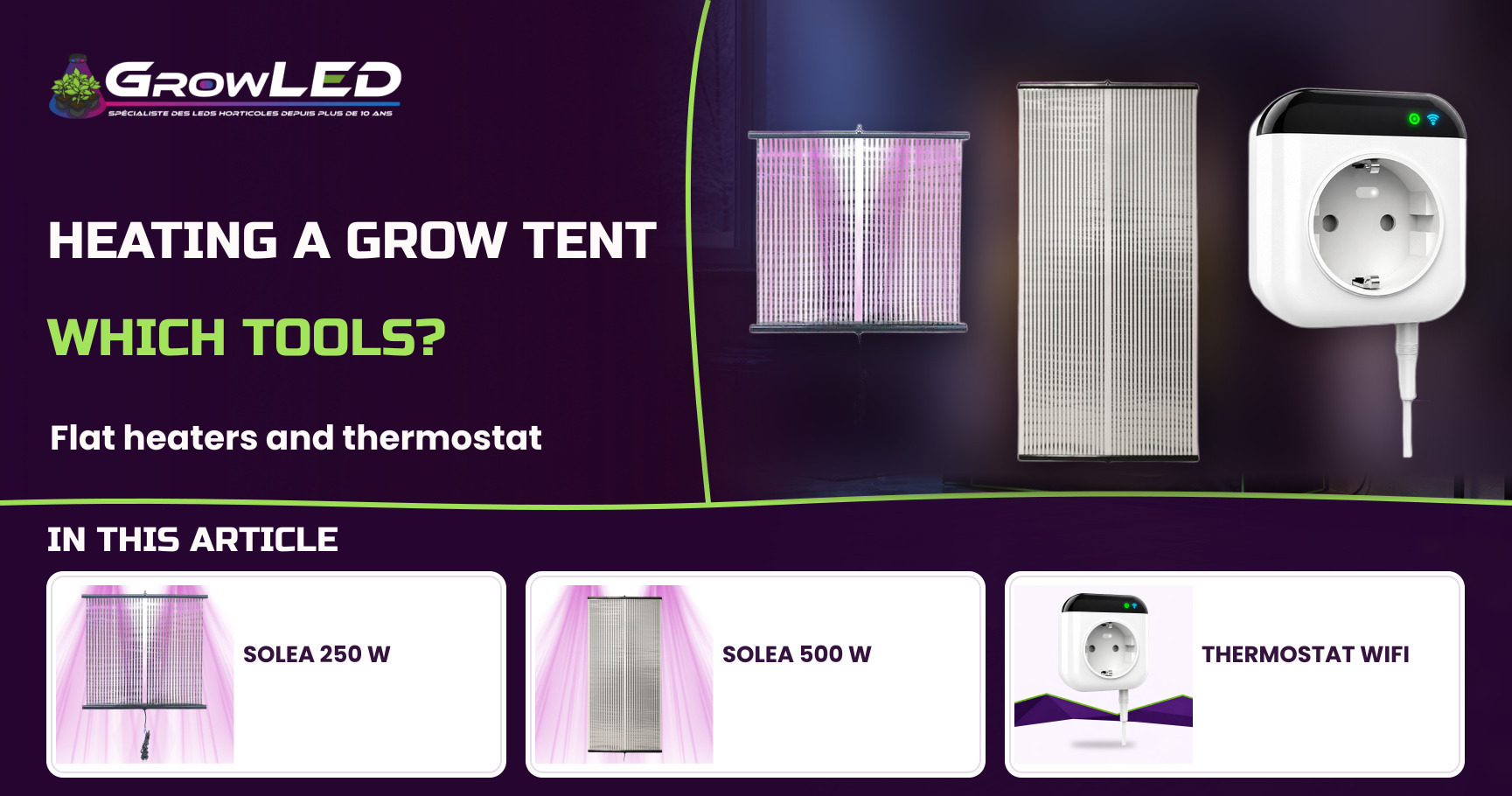
The ultra-flat heater revolutionizes thermal management in indoor growing thanks to its compact design and radiant technology. Unlike bulky traditional radiators, these heating panels, only a few centimeters thick, attach to the wall or ceiling to diffuse a gentle and homogeneous heat. Perfect for confined spaces like grow tents or converted closets.
The infrared radiant technology of these heaters offers decisive advantages over traditional convectors. First, they directly heat surfaces and plants without drying out the ambient air – a crucial point when maintaining 60-70% humidity. Second, their ultra-thin profile (generally 2 to 4 cm thick) frees up valuable space in your setup.
Wall mounting allows the heat source to be positioned higher up, creating natural thermal stratification. 250W models effectively cover an area of 2-3 m², while 400W versions can heat up to 5 m². The temperature rise is gradual and stable, avoiding thermal shocks detrimental to young plants.
In terms of consumption, these heaters boast an efficiency of nearly 100% with uniform heat distribution. No more cold spots in the corners of the tent! Regulation by an external thermostat allows for precise maintenance of 22-24°C during the day and 18-20°C at night.
Power calculation is the first step: allow approximately 80-100W per m² for a well-insulated tent, up to 120W/m² if the space is in a cold room. For a 90x90 cm tent (0.8 m²), a 250W model is more than sufficient. Larger areas require either a high-power model or the coupling of two units.
The IP rating determines moisture resistance. Opt for a minimum IP44 for a grow room, IP65 if you water generously or use a humidifier. Models with integrated thermostats simplify installation, but an external thermostat offers more precision.
Wall mounting must be solid: these panels generally weigh 3-5 kg. Check that the supplied brackets are suitable for your wall type. Some models also offer ceiling mounting, practical for low tents where every centimeter counts.
For a 90x90 cm tent (0.81 m²), a 250W ultra-flat heater is the optimal choice. This power corresponds to approximately 310W/m², which is largely sufficient even in a cold room. If your tent is in a heated room at 18-20°C, you can even reduce the power or use a thermostat to avoid overheating. 400W models would be oversized and risk creating hot spots.
Installation is ideally done 60-80 cm above the canopy, in a slightly inclined position to facilitate condensate drainage. It is essential to choose an IP44 or IP65 certified model to resist water splashes during watering. Securely fasten the wall mounts with anchors suitable for the weight (generally 3-5 kg). Avoid positioning the heater directly above watering points and ensure that the exhaust ventilation is working correctly to remove excessive humidity.
No, that's precisely the major advantage of infrared technology: it directly heats surfaces and objects without drying out the ambient air. Unlike convectors that circulate and heat the air (decreasing relative humidity), radiant panels emit infrared waves that pass through the air without altering it. Your humidity level remains stable around 60-70%, ideal for most crops. This feature avoids having to compensate with an additional humidifier.
Absolutely, it is even recommended for areas larger than 3 m². Two 250W panels controlled by an external thermostat offer more homogeneous thermal distribution than a single large model. Install them staggered to avoid thermal shadow zones and connect them in parallel to the thermostat. Pay attention to the total power: 500W requires a 16A power supply and a thermostat capable of handling this load. This configuration also provides valuable redundancy in case of a component failure.
Maintenance remains minimal but essential for longevity. Dust the radiant surface every 2-3 months with a dry cloth, never directly water the device even if it is waterproof. Periodically check the wall fixings, which can loosen with fan vibrations. Check the condition of the power cable, which is particularly vulnerable in the humid environment of a grow room. If you use phytosanitary products by spraying, temporarily protect the panel with plastic film to prevent fouling of the resistors.
Help & advice
About Ultra-flat heater — click a question to see the answer.
In indoor cultivation, an ultra-flat heater is essential for maintaining a stable and optimal temperature, especially during cold periods or at night. It helps prevent thermal shock that can stress your plants and slow their growth. What I often see is that without good temperature control, photosynthesis is less efficient and plant development is compromised.
To choose the power, I advise you to consider the size of your grow space, the ambient temperature of the room where the tent is located, and its insulation. Generally, it is estimated that about 50 to 100 watts per square meter is needed for good coverage. For example, for a 1m² tent, a 100W heater can be a good starting point. It's always better to have a thermostat for precise regulation.
The main difference lies in their size and heat diffusion method. An ultra-flat heater, as its name suggests, is very compact and can be mounted on the wall or ceiling, freeing up floor space. It diffuses gentle, homogeneous heat by radiation. A classic radiator is often bulkier, takes up space, and heats the air by convection, which can create hot and cold spots and dry out the air more quickly.
Installation is generally very simple. I recommend fixing it to a vertical wall or the ceiling of your grow room, ensuring it is at a safe distance from your plants to avoid any risk of direct burning. Make sure it is not obstructed for optimal heat diffusion. Most models come with a mounting kit, which greatly simplifies the process.
Absolutely! The ultra-flat heater is an excellent complement to LED lights. LEDs, although efficient, emit less heat than older HPS lamps, which can sometimes lead to excessively low temperatures, especially at night. The ultra-flat heater helps to compensate for this lack of heat and maintain a stable environment for your plants, without interfering with the light spectrum of your LEDs. I've already discussed the efficiency of LEDs in this article.
For optimal diffusion, I recommend placing the ultra-flat heater on a side wall or the ceiling of your grow tent. The idea is to diffuse heat homogeneously without it being directly aimed at a plant, which could stress it. Avoid placing it on the floor where the heat might be less evenly distributed and where it could be obstructed.
Electricity consumption depends directly on the heater's power and its duration of use. A 100W model, for example, will consume 0.1 kWh per hour. If I had to choose, I would always prioritize a model with a thermostat and, ideally, an external temperature controller to only operate it when necessary. This helps minimize consumption and achieve significant savings in the long run.
The most common mistake is not using a thermostat. Without it, the heater can run continuously and overheat your space, which is just as detrimental as cold for your plants. Another mistake is placing it too close to plants, risking burning them. Also, ensure the device is suitable for a humid environment, as humidity is common in indoor cultivation.
Cannot find your answer? 01 88 33 45 52 or by message.


