Aller au contenu principal
10 produits

Blumat Automatic watering

Blumat: the automatic watering system revolutionizing your indoor grow

Blumat automatic watering systems put an end to the daily watering struggles in indoor cultivation. These Austrian devices operate by capillarity and pressure, without electricity or complicated programming. The ceramic sensor detects the substrate's moisture and releases wa...

Blumat: the automatic watering system revolutionizing your indoor grow

Blumat automatic watering systems put an end to the daily watering struggles in indoor cultivation. These Austrian devices operate by capillarity and pressure, without electricity or complicated programming. The ceramic sensor detects the substrate's moisture and releases water only when the plant needs it.

Why choose a Blumat system for your growing space

Frankly, once you've tried Blumat, there's no going back. The principle is brilliant: the ceramic sensor soaks up water and maintains constant pressure. When the substrate dries, the pressure decreases, and water flows out automatically. No temperamental timers, no pumps failing at the wrong moment.

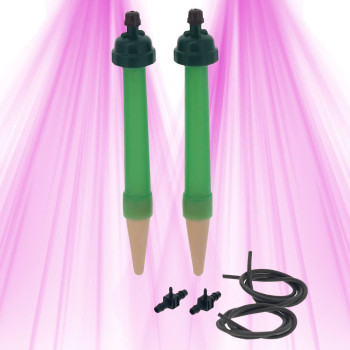
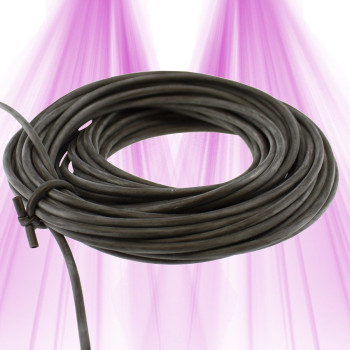
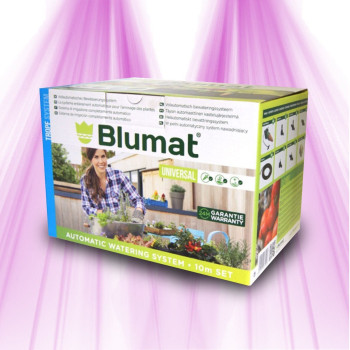
The BLUMAT Automatic Watering System - 40 Plants - 10M x 8mm can automate up to 40 pots with tool-free installation in less than an hour. Water savings are impressive: each plant receives exactly what it needs, no more, no less.

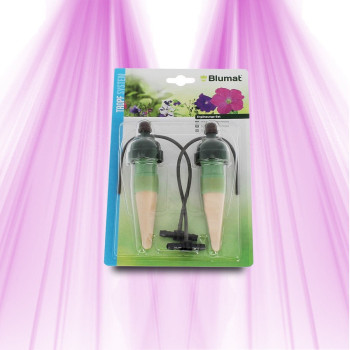
To expand an existing setup, the Blumat - Carrot Extension X2 for TROPF system integrate perfectly with all necessary fittings and hoses. Distribution remains uniform even over large areas.

How to choose your Blumat system

It all depends on your setup. For 1 to 6 plants, Classic kits with a gravity reservoir are more than sufficient. Beyond that, opt for Tropf systems, which support up to 40 watering points on a single line.

Pot size also matters: standard sensors are suitable for containers from 3 to 20 liters. For larger containers, XL versions with a range of 30-40 cm are more appropriate. The flow rate can be finely adjusted using the integrated adjustment screw.

In terms of pressure, Blumat operates between 0.1 and 4 bars. If you connect directly to the water supply (often 3-6 bars), a pressure reducer becomes essential to prevent overflows.

Frequently Asked Questions

How to choose between Blumat Classic and the XL version for my indoor plants?

The Classic effectively covers a 15-20 cm radius around the sensor, perfect for 3 to 15-liter pots. The XL version extends this range to 30-40 cm and is better suited for large containers of 20 liters and more. In indoor growing, the Classic is sufficient in 90% of cases because giant pots are rarely used. The XL becomes interesting for mother plants or coco setups with large volumes.

How to correctly install a Tropf-Blumat sensor in an indoor pot?

Plant the ceramic sensor in the center of the pot, halfway up the substrate, never against the sides. Fill it with water from the top until it overflows, then screw the cap on firmly. Wait 15-20 minutes for the ceramic to fully saturate before connecting the hose. Place the reservoir or water source 50 cm to 1 meter above the pot to create the necessary gravity pressure.

How to adjust the Blumat sensor to water just enough without overwatering?

Start by screwing the adjustment knob all the way in, then unscrew it a quarter turn. Observe for 24-48 hours: if the substrate remains too dry, unscrew another eighth of a turn. If there is overwatering, screw it in slightly. The perfect adjustment is achieved through small, successive adjustments. Once stable, the system automatically maintains optimal humidity without intervention.

Do I need a pressure reducer if I connect Blumat directly to a tap?

Absolutely, it's even crucial. Household water pressure varies between 3 and 6 bars, while Blumat operates between 0.1 and a maximum of 4 bars. Without a reducer, you risk constant overflows and improper sensor function. Invest in an adjustable 0-4 bar reducer; it costs 20-30€ and prevents many headaches. Some Blumat kits already include it.

How to maintain Blumat sensors so they last a long time in indoor growing?

Clean the ceramic sensors every 2-3 months with a soft brush and clear water to remove limescale deposits. Avoid chemical products that could clog the pores. Replace the water in the sensors regularly, especially if it stagnates for a long time. At the end of the cycle, disassemble everything, rinse thoroughly, and store dry. With this minimal maintenance, Blumat sensors easily last 3-5 years of intensive use.

Showing 1 - 10 of 10 items
How does the Blumat automatic watering system work?
   

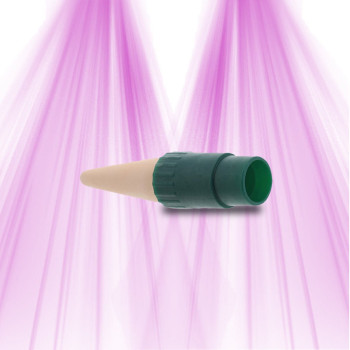
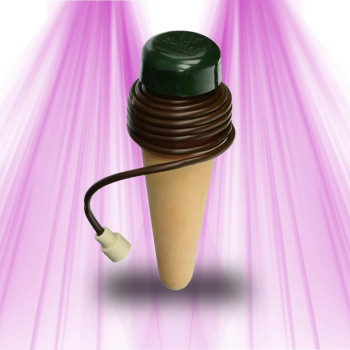
The Blumat principle is ingenious and relies on capillarity and differential pressure. Each Blumat sensor is equipped with a porous ceramic cone. When the substrate dries out, the sensor releases water by capillary action. This water loss creates a vacuum inside the sensor, which opens a valve and allows water from the reservoir or mains to drip to the plant. As soon as the substrate is sufficiently moist, the vacuum decreases, the valve closes, and watering stops. It's an autonomous system that reacts to the real needs of your plants.

How do I install a Blumat system?
   

Installing a Blumat system is relatively simple, although it requires a bit of method. I advise you to start by preparing your water reservoir, which should be positioned at a height to ensure sufficient pressure. Then, you connect the main hose to the reservoir, and then install the Blumat sensors in the substrate of each plant. Make sure the sensor is well inserted and in contact with the roots. Finally, you connect the drippers to the sensors and perform the initial adjustment. I always recommend doing a functional test after installation to ensure everything is in order.
How do I adjust Blumat sensors?
   

Adjusting Blumat sensors is a crucial step for the effectiveness of your system. Each sensor has an adjustment screw. I advise starting with a 'standard' initial setting, then carefully observing your plants and the moisture of your substrate for a few days. If the substrate is too dry, you can slightly loosen the screw to increase the flow; if it's too wet, tighten it. The goal is to find the perfect balance point for each plant based on its specific needs and the type of substrate used. Don't hesitate to adjust gradually.

What is the difference between Blumat Classic and Tropf-Blumat?
   

That's an excellent question I'm often asked! The Blumat Classic is a simpler system, often used for watering individual potted plants, such as houseplants or window boxes. It operates autonomously, drawing water from a nearby reservoir. Tropf-Blumat, on the other hand, is a more elaborate system, designed for larger and more complex installations, such as greenhouses or numerous indoor cultivated plants. It uses a pressurized main hose (coming from an elevated reservoir or the mains) and individual drippers connected to sensors. Tropf-Blumat offers finer and more centralized management of watering for multiple plants.

Is Blumat suitable for indoor growing?
   

Absolutely! I can assure you that Blumat is particularly well suited for indoor growing. Its autonomous operation, without electricity or complex programming, makes it an ideal solution for growing spaces where watering management can be restrictive. It allows for unparalleled watering precision, as each plant receives the water it needs, when it needs it, thus avoiding over-watering or under-watering, two common indoor problems. It's a considerable time-saver and a guarantee of health for your plants.

Can Blumat be used without electricity?
   

Yes, and that's one of the biggest advantages of Blumat systems! They are designed to operate entirely without electricity. The operating principle relies solely on water pressure and the capillarity of the ceramic sensor. This means you don't need nearby electrical outlets, programmers, or pumps. It's an ecological, economical, and very reliable solution, perfect for crops where access to electricity is limited or for those looking for a simple, autonomous solution.

Blog navigation

Latest posts

What Wattage LED Grow Light Should a Beginner Choose?

What wattage LED grow light should a beginner pick? Real watts, W/m², PPFD and a 60x60 setup explained in the GrowLED...

Read more
VIVOSUN Grow Cam 6mm 2K QHD WiFi Grow Camera

Tired of anxiety when you're away from your grow? The VIVOSUN Grow Cam 6mm 2K QHD WiFi Grow Camera lets you keep an...

Read more
STOP à la Tourbe ! Découvrez les 4 Meilleurs Substrats Écologiques pour une Culture Indoor Explosive

Le monde du jardinage connaît une transformation silencieuse mais profonde. Face à l'urgence climatique et à la prise...

Read more