




































































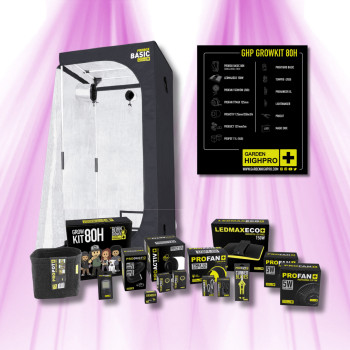

Channeled Pack
0 products
Items you may be interested in
Related posts
Help & advice
Frequently asked questions
About Channeled Pack — click a question to see the answer.
How to choose a Cannaled Pack for my indoor grow?
To choose your Cannaled Pack well, I advise you to start by evaluating the size of your grow space. This is the most important criterion because it will determine the necessary power of your lighting. Then, consider your budget and the specific features you are looking for, such as dimmability or the ability to control multiple panels. I always recommend planning for a little more power than the strict minimum to have some leeway.
What power Cannaled Pack should I choose based on the size of my grow space?
Generally, for indoor growing, I recommend aiming for approximately 300 to 500 watts per square meter for high-performance LEDs. For example, for a 1m x 1m grow tent, a 300W to 400W Cannaled Pack will be an excellent starting point. For smaller areas, like 60cm x 60cm, a 100W to 150W pack might suffice. Remember that optimal power also depends on the plants you are growing and your yield goals.
How to install a Cannaled Pack in my grow tent?
Installing a Cannaled Pack is generally very simple, which is one of their great advantages! I recommend starting by assembling the LED panel and its driver if it's not already done. Then, use the provided suspension systems to hang the panel from the ceiling of your grow tent. Make sure the panel is stable and level. Finally, connect everything to an electrical outlet. Don't forget to consult the specific manual for your pack for details, but generally, it's plug-and-play.
What is the difference between Cannaled packs and classic LED lamps?
The main difference, and what I particularly appreciate about Cannaled Packs, is their all-in-one approach. A classic LED lamp might just be the panel itself, leaving you to find the right driver, cables, and suspension systems. Cannaled Packs, on the other hand, bring together all these essential elements. This greatly simplifies purchasing and installation, especially for beginners, as I sometimes explain in discussions about complete grow packs.
What is a Cannaled Pack used for in indoor growing?
A Cannaled Pack is used to provide your plants with the optimal lighting necessary for their growth and flowering indoors. It's the heart of your indoor growing system! It replaces sunlight by emitting a light spectrum adapted to the needs of plants, promoting photosynthesis. In practice, this means healthier plants, faster growth, and potentially higher yields, all with controlled energy consumption thanks to LED technology.
What distance should I install between the Cannaled Pack and the plants?
The ideal distance between your Cannaled Pack and your plants depends on the power of your lighting and the development stage of your plants. For seedlings and young shoots, I generally recommend a greater distance (around 40-60 cm) to avoid stress. During the vegetative growth phase, you can bring the panel closer (30-40 cm), and during flowering, this is often when it's brought closest (20-30 cm), while carefully monitoring for signs of heat or light stress. The goal is to maximize light intensity without burning the leaves.
Is the Cannaled Pack suitable for the flowering phase?
Absolutely! Cannaled Packs are perfectly suited for all phases of cultivation, including flowering. Most modern LED panels, and this is the case for Cannaled, integrate a full light spectrum that contains the wavelengths necessary for abundant flowering. Some models even offer adjustable spectra or specific modes for flowering, which allows for even greater optimization of yields. I always advise checking the spectrum specifications of your pack to ensure this.
How to program lighting with a Cannaled Pack (18/6 or 12/12)?
To program the lighting of your Cannaled Pack, you will need an external timer, as the packs themselves generally do not have integrated programming functionality. For the vegetative growth phase, I recommend a cycle of 18 hours of light and 6 hours of darkness (18/6). To trigger and maintain flowering, you need to switch to a cycle of 12 hours of light and 12 hours of darkness (12/12). This is a crucial step for the proper development of your plants and good yields.
Cannot find your answer? 01 88 33 45 52 or by message.


