








































































Metrop
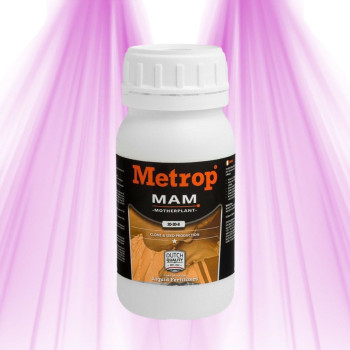
METROP Pack 250ml - Fertilizer for PRO TERRE and HYDRO growers
Ships within 2 weeks
91,76 € 96,59 € or 3× 30,59 €

Product successfully added to your shopping cart
Ça pousse dans le bon sens

8 products
Metrop fertilizers are revolutionizing plant nutrition with their ultra-concentrated formulas that completely change the game in indoor cultivation. This Dutch brand has developed liquid nutrients up to 5 times more concentrated than conventional fertilizers, drastically reducing long-term costs while optimizing nutrient assimilation.
The exceptional concentration of Metrop fertilizers is their main asset: where you would use 5ml of a classic fertilizer, 1ml of Metrop is enough. This approach changes everything in terms of economy and storage. The MR1 and MR2 formulas cover the entire growth cycle with remarkable precision. MR1 boosts vegetative growth with an optimized NPK ratio for root and foliar development, while MR2 supports flowering by prioritizing phosphorus and potassium.
Another strong point is pH stability. Metrop fertilizers naturally maintain a pH between 5.8 and 6.2, which avoids constant corrections and fluctuations that stress plants. In hydroponics, this is a huge time-saver.
The choice is mainly based on your growth phase and your system. For growth, MR1 is used at 0.5-1ml/L depending on the week of vegetation. During flowering, switch to MR2 with a dosage that gradually increases up to 1.5ml/L at the end of the cycle. The beauty of the Metrop system is its simplicity: no need to juggle with 10 different bottles.
For beginners, starting with the MR1+MR2 pack covers a complete cycle. Experienced growers can supplement with specific Metrop additives like CalMag or root stimulators, but frankly, the basic MR1/MR2 are already enough to achieve impressive results.
MR1 is formulated for the vegetative phase with an NPK ratio rich in nitrogen (around 7-3-6) that promotes stem and foliage development. MR2 takes over during flowering with less nitrogen and more phosphorus-potassium (4-5-7) to stimulate flower formation. You should use MR1 throughout growth until the photoperiod change, then switch to MR2 at the first signs of flowering. This transition is done gradually over 7-10 days to avoid any nutritional stress.
Always start with 0.5ml/L and gradually increase according to your plants' reaction. During growth, never exceed 1ml/L of MR1, and during flowering, gradually increase up to a maximum of 1.5ml/L of MR2. The EC of your solution should not exceed 1.8 in hydroponics and 2.0 in soil. Monitor the leaves: if they become dark green or the tips yellow, immediately reduce the dosage. Metrop's high concentration makes overdosing riskier than with conventional fertilizers.
Absolutely, the calculation is simple: one liter of MR1 or MR2 is equivalent to 5 liters of classic fertilizer thanks to the concentration. Over a complete grow, you use approximately 50-80ml of Metrop versus 250-400ml of standard fertilizer. The price per liter seems high, but the cost per grow becomes very advantageous. A 250ml bottle of Metrop can feed 15-20 plants over a complete cycle, where several liters of traditional fertilizers would be needed for the same result.
Yes, Metrop fertilizers adapt to all substrates without modifying the basic dosage. In soil, nutrient retention allows for less frequent fertilized waterings. In hydroponics, pH stability and the absence of residues prevent system blockages. In coco, rapid assimilation perfectly compensates for the substrate's inertia. Only precaution: in very rich soil, reduce the initial dosage to 0.3ml/L to avoid nutritional overload, especially if your potting soil already contains slow-release fertilizers.
High concentration offers several concrete advantages: reduced storage (one bottle replaces 5 bottles), easier transport, precise dosing to the nearest milliliter, and above all, optimized assimilation. Concentrated nutrients penetrate roots better because they require less transport water. This also reduces the risk of excessive dilution that weakens nutritional effectiveness. In indoor cultivation where every centimeter counts, being able to store 5 times less product while maintaining the same efficiency represents a huge advantage for organizing the growing space.

Help & advice
About Metrop — click a question to see the answer.
Metrop fertilizers are designed to maximize the growth and flowering of your plants in indoor cultivation. Their popularity comes from their ultra-concentrated formula which allows for optimal nutritional assimilation, even with reduced doses. In practice, this means more vigorous plants, increased yields, and better harvest quality.
For optimal use, I advise you to scrupulously follow the Metrop nutrient charts specific to each growth phase of your plants. Generally, you start with lower doses at the beginning of the cycle and gradually increase them. Don't forget to mix the products well in the water and check the pH of your nutrient solution.
The major difference lies in their exceptional concentration. Metrop fertilizers are up to 5 times more concentrated than conventional fertilizers. This means you use much less product for the same nutritional input, which significantly reduces your long-term costs and storage space. This is a significant advantage for indoor growers.
The most frequent mistake is overdosing, due to their high concentration. I advise always starting with slightly lower doses than recommended and observing your plants' reaction. Another mistake is not adjusting the pH of the nutrient solution, which can block nutrient assimilation. Proper pH management is crucial.
Yes, absolutely! Metrop fertilizers are perfectly suited for all indoor cultivation systems, whether soil, coco, or hydroponics. Their liquid formulation and high solubility make them ideal for hydroponic systems, where they are unlikely to clog drippers or pumps. This is what I often see with professional growers.
The precise dosage of Metrop fertilizers will depend on the growth phase of your plants and their specific needs. I strongly recommend that you rely on the official Metrop nutrient charts, available on their website or on our product sheets. They are designed to optimize nutrient intake without the risk of deficiency or excess.
To know if your plants need fertilizer, you need to carefully observe their foliage and growth. Yellowing leaves, slowed growth, or spots can indicate a deficiency. However, before adding Metrop fertilizers, I advise checking the pH of your substrate and water first, as an unbalanced pH can prevent nutrient assimilation even if they are present.
Cannot find your answer? 01 88 33 45 52 or by message.