



































































Want to know which lighting is truly best for your indoor plants? This guide walks you through the three key options - blue, red, and full spectrum - to create the optimal growing environment at home. Learn to choose the perfect light spectrum for plants for every stage of your plants' development.
Which light spectrum should you choose for your indoor plants
Light is much more than a simple source of illumination: it's the vital element that activates your plants' growth potential. Every wavelength sends a unique biological signal to your indoor plants, directly impacting foliage development as well as triggering flowering. The right lighting completely transforms the mood and health of your indoor garden.

Blue spectrum for vegetative growth
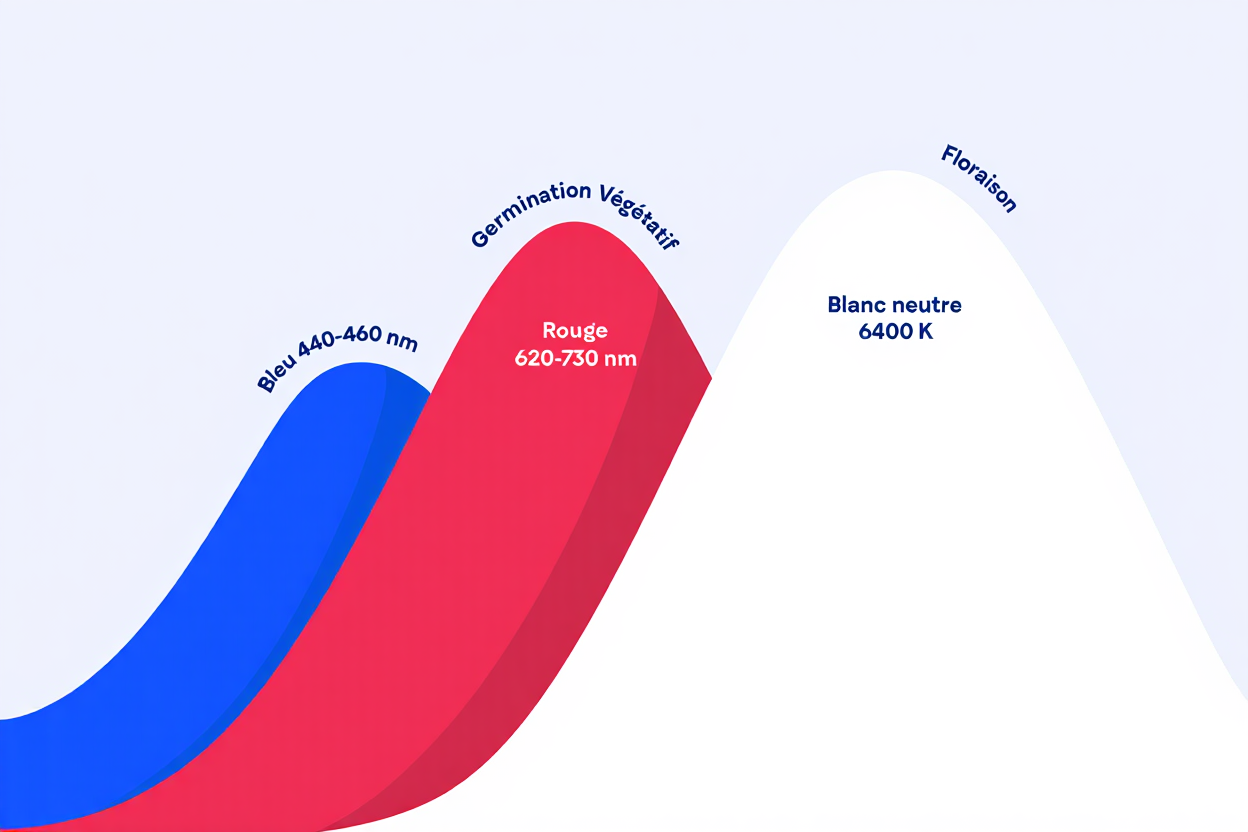
Blue light is ideal for getting abundant foliage and strong stems. Mainly absorbed by chlorophyll b, this part of the spectrum (400-500 nm) drives photosynthesis while encouraging a compact structure. The blue spectrum delivers exactly the expected result: sturdy seedlings and aromatic plants in peak condition.
- Optimal wavelengths: Peaks around 450 nm improve photosynthesis efficiency and boost chlorophyll production.
- Compact morphology: Reduces stem stretching and encourages dense, well-branched growth.
- Ideal for seedlings: Speeds up germination and produces vigorous young plants, ready for transplanting.
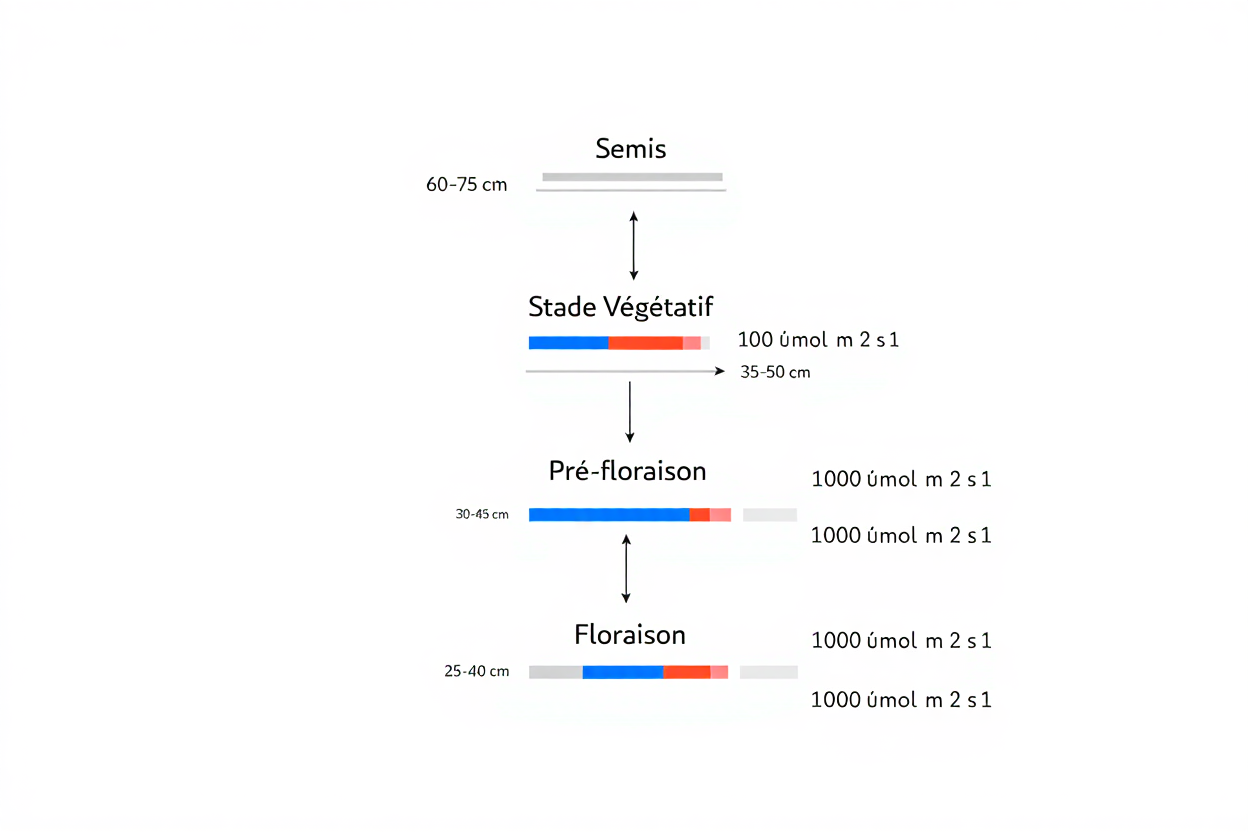
- Recommended ratio: About 70% blue and 30% red during the vegetative stage for optimal results.
Your young plants have a crucial need for this blue light to get off to a good start. Without it, stems tend to stretch excessively toward the light source, which can harm their health. Light rich in blue guarantees stocky, sturdy plants, perfectly prepared for the next stages.
Red spectrum for flowering and fruiting
Now let's move on to the red spectrum, the true trigger for flowering and fruiting. Absorbed by chlorophyll a, red light (620-680 nm) stimulates flower formation and helps the plant accumulate sugars. Using a grow light with a red-dominant spectrum gives your tomatoes or orchids a natural boost.
- Floral activation: Encourages bud development and increases the number of flowers on fruiting plants.
- Sugar accumulation: Helps store energy in the fruit, which improves their flavor.
- Absorption peaks: The peak around 660 nm is the most effective for maximizing yield during fruiting.
During the flowering stage, the proportions are reversed: about 30% blue to 70% red to boost bud formation. The process is scientific, but the results are immediately visible: your plants will cover themselves in flowers thanks to this careful balance.
Full spectrum: a versatile, natural solution
Looking for a simple, effective solution that suits the whole growing cycle? Full spectrum light (400-750 nm) reproduces natural sunlight, so you never have to swap bulbs between phases. It's a practical option, ideal for mixed crops where seedlings, foliage plants, and flowering species grow side by side.
Some systems offer this perfect balance, suited to orchids, cacti, and even carnivorous plants. A single light is enough, with no hassle: install it once and grow with total peace of mind. Full-spectrum light also makes it easier to check on your plants' health, since it clearly reveals what's happening beneath the foliage.
To grow indoor plants without access to natural light, you need a reliable, high-performing source of grow lighting. Today, LED grow lights dominate the indoor growing market thanks to their remarkable energy efficiency, adjustable spectrum, and outstanding longevity. To discover the solutions available to you, check out our guide to LED grow lights and turn your space into a true pocket laboratory.
Benefits of LED grow lights for indoor plants
Make way for modernity! The days of HID bulbs overheating rooms and inflating electricity bills are over. Today's LED grow light manages energy intelligently, gives off very little heat, and allows ultra-precise control of the light spectrum. It's without question the technical upgrade every passionate grower should make for their indoor garden.

Outstanding energy efficiency and durability
An LED grow light consumes about 40% less energy than an HID system of equivalent power, for similar photon output. In practice, a 600W LED system advantageously replaces a 1000W HID, offering the same coverage and the same light intensity. This translates into hundreds of euros saved every year, a budget you can reinvest in better nutrients or new equipment.
Its lifespan easily exceeds 100,000 hours, turning your purchase into a highly profitable long-term investment. While CFL or HID models need replacing after a few thousand hours, your LED equipment will run for years without failure. That's the guarantee of trouble-free growing, with no unexpected maintenance costs.
- Minimal heat output: Reduces the risk of leaf burn and simplifies climate management, especially in small spaces.
- Energy efficiency: Optimal conversion of watts into light, considerably lowering your electricity consumption.
- Outstanding longevity: Enjoy more than 100,000 hours of use without noticeable loss of performance or spectral quality.
In a confined space, like a converted closet, LED grow lighting reveals its full potential. There's no more need to install a powerful air conditioning system or worry about heat damaging your young seedlings. You maintain a stable, balanced ecosystem month after month, with no temperature concerns whatsoever.
Adjustable spectrum for every growth need
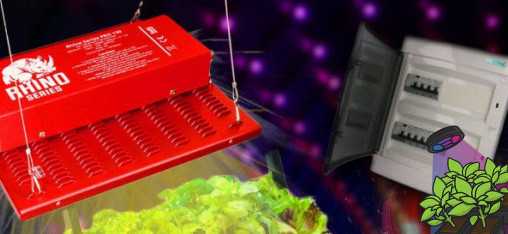
The real strength of this technology lies in the ability to adjust the light spectrum with professional precision. Some high-end models (such as the Rhino or Pure LED series) let you individually control the blue, red, UV, and IR channels via dedicated controllers. This smart grow light adapts perfectly to every stage of the plant's development.
- Remote control: Manage your setup from your smartphone and automate complex cycles via a Wi-Fi or DALI connection.
- Built-in dimmers: Gradually adjust power based on the size of your plants to save energy.
- Dedicated profiles: Switch from vegetative mode to flowering mode, or to a custom profile, in a single click.
Dimming functions, like those on the Ignitor HeroLED model, let you adjust light intensity without buying any external equipment. You can start gently to protect the most fragile seedlings, then increase power as they grow. It's the ideal way to save energy while avoiding stress on your crops.
LED, CFL, and HID compared
While each technology has its merits, LED is by far the top choice for home use compared to other light types. CFLs remain useful for the germination stage, while HIDs find their niche in very large, climate-controlled professional setups. Here are the key points for choosing the solution that best fits your needs:
Fluorescent lamps (CFL) offer an acceptable blue-red spectrum and give off little heat, making them ideal for a small garden on a windowsill. However, their light output is far below that of LEDs, and their lifespan generally doesn't exceed 15,000 hours. Metal halide (MH) HID lamps provide an excellent blue spectrum for the vegetative stage, but they are very energy-hungry and generate excessive heat. Finally, sodium (HPS) lamps perform well for flowering thanks to their red-orange spectrum, but their lack of blue often requires turning to a full-spectrum solution, like LED, to balance development.
| Lighting type | Power draw (W) | Heat output | Lifespan (h) | Spectrum | Best use |
| Full-spectrum LED | 300-1000W | Minimal | 100,000+ | 400-750 nm full | All cycles, home use |
| CFL (fluorescent) | 25-250W | Low | 10,000-15,000 | Moderate blue-red | Seedlings, small spaces |
| HID Metal Halide (MH) | 400-1000W | Very high | 1,000-2,000 | Blue-dominant | Pro vegetative stage, climate-controlled |
| HID Sodium (HPS) | 400-1000W | Very high | 1,000-2,000 | Red/orange | Pro flowering, climate-controlled |
Positioning your grow light correctly is a delicate balance between art and science. Distance, photoperiod, and PPFD are the key parameters for a successful crop. Let's master these concepts together to give your plants ideal conditions, without overwhelming you with technical details.
Optimal intensity and distance for your grow light
Want your plants thriving instead of just surviving? The key lies in precisely positioning your light source relative to the canopy. Mismanaging light intensity can hurt your results, since it drops off sharply with distance.
LED grow lights come in different spectrums suited to each growth stage: full-spectrum models work for every phase, while others specifically boost development. To get the best from your plants, choose an LED grow light whose power output matches your growing area. If your LED light is too high, your plants lack energy; too low, and you risk damaging the foliage.

Photoperiod suited to each growth stage
Photoperiod - the number of hours of light per day - acts as a biological clock for your indoor plants. During the vegetative stage, keep 16 to 18 hours of light to encourage foliage development. Then switch to 12 hours to trigger flowering.
Using automatic timers is strongly recommended to manage these cycles effortlessly. A timer guarantees perfect regularity, avoids stress, and ensures valuable stability. All you have to do is set the schedule for the current stage, then let the technology do its job while you watch your plants' progress.
- Vegetative stage: A 16-to-18-hour cycle encourages dense foliage and a sturdy structure.
- Flowering stage: A strict alternation of 12 hours of light and 12 hours of darkness triggers flowering.
- Dark period: Allow at least 6 hours of darkness during the vegetative stage, and a strict 12 hours during flowering.
- Timers: They keep the photoperiod stable and prevent oversights or manual mistakes.
For decorative indoor plants with no yield target, about 14 to 16 hours of light offers a good energy balance. This keeps your plants healthy and green without overstimulating their reproductive cycle. They'll stay beautiful with no special demands.
Positioning and PPFD based on LED power
PPFD is the amount of usable light your plants actually receive each second. For vegetative growth, aim for 200 to 400 µmol·m⁻²·s⁻¹, going up to 600 for generous flowering. It's the lamp distance that lets you adjust this value: the closer the fixture, the more concentrated the energy.
In practice, for seedlings or young plants, place a 150-to-300 W LED light about 30-45 cm away. For models above 600 W, a distance of 50 to 70 cm is generally needed to cover a large area. Adjust the height gradually each week as your plants grow.
To measure these values accurately, you can use a lux meter (with conversion) or a dedicated smartphone app. Once you've found the right setting, avoid changing it too often: plants appreciate stability. A constant light environment is often more beneficial than an endless quest for perfection.
Signs of too little or too much light
Your plants express their well-being silently; you just need to learn to read the signs. When light is lacking, stems stretch abnormally and new leaves are pale and fragile. If the grow light is too close, the foliage may curl up or show burns.
- Stretching (deficiency): Stems lengthen and lean toward the light; move the lamp 10 to 15 cm closer.
- Discolored leaves: Pale new growth signals a need for more light intensity; use the dimmer.
- Curled leaves (excess): Curling foliage signals too much light or heat; move the light source farther away.
- Dry brown spots: Localized burns mean you need to lower the power or improve ventilation.
Act quickly by adjusting the height or reducing power with a dimmer. Also remember to clean your LED modules regularly, since dust reduces performance. Above all, make these changes gradually to give your plants time to adapt.