



































































Looking for the best LED grow light for your indoor growing but torn between technical options? Our analysis points you toward the ideal solution by examining efficiency, power, and spectrum. Learn how to match the lighting to your grow space to get professional results. Ready to start?
Choosing the best LED grow light for indoor growing
Choosing an LED grow light becomes simple once you master three points: spectrum, energy efficiency, and actual coverage. This type of LED grow light, unlike standard bulbs, precisely targets plants' photosynthetic needs. It emits optimized wavelengths, between 400 and 700 nm, to support every stage of development.
The essential technical criteria of an LED grow light
To find the best LED grow light for indoor growing, photosynthetic efficiency is essential. PPFD must be matched to each stage: seedling, active vegetative stage, then intense flowering. A full spectrum ensures optimal plant development from start to finish.
- Energy efficiency: measures useful photons per watt consumed. Favor a model above 2.5 umol/J to limit your electricity bill.
- PPFD and coverage: check the photon density received across your entire grow space to avoid shadow areas.
- Lifespan: a quality LED grow light keeps its power even after 50,000 hours of use.
Be wary of brands that list "LED watts" instead of actual consumption. Always check this figure, as it directly affects your budget. Samsung or Osram components guarantee reliability and lasting performance.
LED grow light vs HPS lights: why choose LED?
Objectively, an LED grow light consumes almost half as much as an HPS light for equivalent output. Unlike older systems, modern lighting requires very little cooling. Over several years, these energy savings add up to thousands of euros.
Since it gives off much less heat, an LED grow light can be placed close to the plants without risking scorched foliage. Its full spectrum is perfectly suited, from vegetative stage to flowering. Its long lifespan also makes maintenance virtually nonexistent.
Leading brands and technologies
We recommend brands that have proven their reliability with demanding growers. SANlight stands out with its LED grow light bar, as quiet as it is efficient. Others like Lumatek or HLG excel with formidable energy efficiency.
High-end diodes ensure an ultra-precise spectrum and good thermal stability. An aluminum chassis dissipates heat well, extending lifespan. Built-in dimmers let you adjust intensity without extra equipment.
LED light power suited to your grow space
The grow space is the main factor for determining your lighting needs in indoor growing. A poor estimate can lead to leaf burn or pronounced stretching. By cross-referencing area and PPFD, you can easily find the right power.
Comparison table of power, area, and recommended models
To properly choose an LED grow light, first measure your space and match the PPFD to the vegetative and flowering stages. Plan for around 100 to 150 W for a 60x60 cm space, while you'll need to aim for 300 W and above for an area exceeding 1 m2. This approach simplifies sizing your LED grow light.
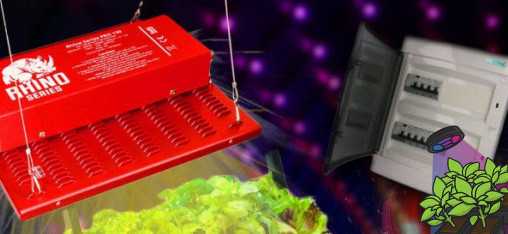
- 60x60 cm areas: 100-150 W, PPFD between 500 and 700 umol/m2/s. The Rhino 130W PRO offers a particularly high-performing spectrum.
- 80x100 cm areas: 200-250 W, PPFD between 600 and 800 umol/m2/s. A 200W LED grow light with a full spectrum will be ideal.
- 100x120 cm areas: 300-450 W, PPFD of 700 to 900 umol/m2/s. Choosing 400W guarantees remarkable energy efficiency.
- 150x150 cm areas and above: 650-1000 W and beyond, PPFD between 900 and 1200 umol/m2/s. The AIR GROW PRO III system easily covers 150-180 cm.
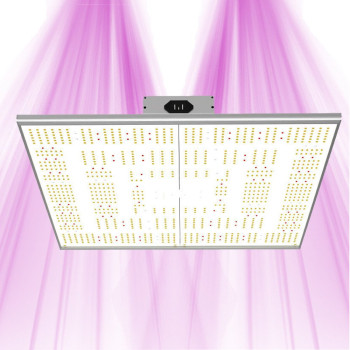
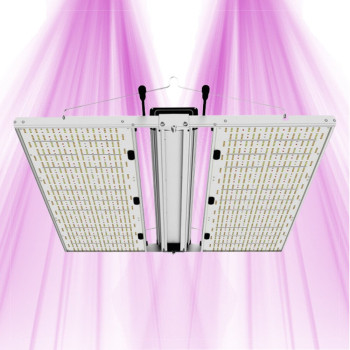
A quality LED grow light panel keeps around 90% of its power after 50,000 hours of use, which makes investing in an LED grow light bar very cost-effective. For small spaces, the SANlight Stixx 50W delivers 150 umol/s and features a precise dimming system. Check out this model here: LED light for indoor growing.
| Area (cm2) | Recommended power (W) | Target PPFD (umol/m2/s) | Recommended model | Efficiency (umol/J) |
| 60x60 | 100-150 | 500-700 | Rhino 130W PRO | 2.70-2.77 |
| 80x100 | 200-250 | 600-800 | PureLED Q240 | 2.75-2.80 |
| 100x120 | 300-450 | 700-900 | 400W LED light | 2.77-2.85 |
| 120x120 | 480-650 | 800-1000 | SpectraWILD M500 PRO | 2.80-2.90 |
| 150x150 | 650-1000 | 900-1200+ | AIR GROW PRO III HYPER RED | 2.95 |
Small spaces: compact, high-performing solutions
In a 60x60 cm tent, choosing a light that's too powerful brings no benefit. A modest power, between 50 and 150 W, is enough to get excellent PPFD without wasting energy. The goal is to maximize efficiency and make the most of every photon emitted.
LED bars of 30 to 50 W offer great flexibility thanks to their adjustable placement above the foliage. A classic LED grow light bulb in E27 format is also a very good alternative for small spaces. The choice between an LED grow light bulb and an LED panel mainly depends on your initial setup.
These compact systems give off very little heat, which allows them to be placed close to the plants from the seedling stage. This thermal advantage avoids the need for noisy, energy-hungry ventilation. To get started, a 130 W LED grow light system fitted with a dimmer makes an ideal compromise.
Large spaces: 600W, 1000W LED lights and beyond
From 120x120 cm onward, it becomes necessary to install equipment delivering at least 500 to 650 W. At this level of performance, light quality directly affects your monthly electricity bill. Recent models offer adjustable settings to support plant growth without stress.
For areas larger than 150x150 cm, setups reaching 800 W quickly become necessary. The AIR GROW PRO III system ensures high output while limiting overall consumption. A 400 W version is also an excellent option for a 120 cm area.
Recommended products


Optimal LED grow light spectrum for the vegetative stage and flowering
The light spectrum is like your plants' native language. Giving them a full spectrum at the right time considerably improves their development. A poor choice slows their growth, making this parameter as decisive as your LED light's power.
Blue, red, UV/IR: what spectrum for each stage?
During the vegetative stage, blue wavelengths, between 400 and 500 nm, are essential. They prevent stretching and help produce compact plants with sturdy stems. A balanced blue-red ratio allows for vigorous development.
- Vegetative stage (blue-dominant): for compact development and good rooting, aim for a blue-red ratio of 1:1 to 1.5:1.
- Flowering stage (red-dominant): boosts flower and terpene production with a ratio of 1:2 to 1:3.
- UV/IR boosters (specialized): they maximize resin and active compounds; consider the Rhino 130W PRO or the SpectraWILD M500 PRO.
During flowering, red and far-red wavelengths prove decisive. They trigger flowering and stimulate resin synthesis. Adding UV/IR at the end of the cycle boosts flower density.
Full spectrum and full-cycle technology in indoor growing
In indoor growing, using a full spectrum effectively mimics sunlight. This approach simplifies life for growers with limited space. A single LED light is then enough, guiding the plant from seed to harvest.
Modern LED grow lights often come with dimmers to adjust the light at each stage. The AIR GROW PRO III HYPER RED, for example, guarantees a smooth transition thanks to its efficiency. You can gradually adjust its intensity, from germination to maturation.
It's best to avoid lights with an incomplete spectrum: green light is essential for penetrating the foliage and feeding the plant deeply. For autoflowering varieties, simply keep 18 to 20 hours of light per day. Models like the PureLED Q240 make this easier with their adjustable spectrum.
Distance and intensity settings for optimal LED lighting
Quality LED lighting loses its value if poorly positioned. Distance and intensity are parameters just as decisive as the choice of light itself. Too close, your plants risk burning; too far, they stretch.

Recommended distances by development stage
During germination, gentle light is needed: keep a distance of 60 to 75 cm, with power set between 10 and 25%. This moderate intensity ensures enough photosynthesis without stressing young seedlings.
- Seedlings and germination: Distance of 60 to 75 cm, intensity between 10 and 25%, ideal for preventing stretching and burns.
- Vegetative stage (growth): Distance of 40 to 60 cm, intensity at 50-75% for vigorous growth and optimal branching.
- Flowering stage: Distance of 20 to 45 cm, full power of 80-100%, this proximity promotes flower production.
During the vegetative stage, reduce the distance to 40-60 cm and increase the intensity up to 75%. Plants then need a substantial energy input to develop, without risk of burning. A multi-level dimmer makes these adjustments much easier.
At the flowering stage, light efficiency must be at its maximum. By setting the light at 20-45 cm with 100% power, you optimize light exposure, which is essential for resin production.
For precise measurements, using a PAR meter is recommended. This device measures the amount of light actually absorbed by the plants, making it possible to adjust settings without risk of under- or over-exposure. This method is especially useful in a grow with varying plant heights.
Dimmer and intensity dimming for each stage
Dimmers have greatly simplified lighting management. Favor a model offering several adjustment levels: it will cover every growth stage without complication. Adjusting power then becomes intuitive, even automatic.
Adjusting the lighting always relies on the combination of distance and intensity. If your plants show abnormally stretched growth, you must either bring them closer to the light source or increase its power. At the end of the cycle, a setting of 100% and 30 cm distance often offers the best balance between light input and heat management.
Recognizing signs of light stress and responding
It's crucial to know how to read the signals given off by plants. Yellowed leaves or leaves with spots generally indicate light that's too intense or placed too close. Conversely, thin stems and slowed growth reveal a light deficiency or an unsuitable spectrum.
The appearance of mild burns should trigger an immediate response: measure the light intensity and reduce it by about 20%. This simple precaution can preserve the integrity of your grow cycle.
Faced with stretching with no burn symptoms, gradually increase the power, in steps spaced two days apart, to avoid thermal or light shock. Also favor LED lighting fitted with a passive cooling system: it guarantees better longevity and avoids the risk of overheating.
Selection of the best LED grow lights 2026 by budget
Here's a practical guide to choosing the ideal LED light based on your budget and the size of your space. We've tested the models on the market to point you toward the most cost-effective investments, from entry-level to high-end.
Entry-level models and recommended budget prices
To get started in indoor growing without spending a fortune, we recommend the SANlight Stixx 50 or the Rhino 130W PRO. For under 200 euros, you get a reliable, effective LED grow light, perfect for a 60 to 80 cm space.
These models come with a dimmer and a solid warranty, ideal for hobbyist use. The SpectraBULB X30 bulb remains an ultra-affordable option for very small spaces or simple supplemental lighting.
Best value for money in the mid-range
The 150-350 euro range brings together the models in our 2026 selection that offer the best value for money. It includes premium components, precision dimmers, and warranties of up to 5 years.
They provide a full spectrum that supports both the vegetative stage and flowering. They maximize photosynthesis while giving off very little heat, a clear advantage for your indoor growing space.
Their long lifespan reduces replacements and they're suited to spaces of 60 to 80 cm. Check out our models via this link: 200W LED light.
- Rhino 130W PRO: At around 150-200 euros, it delivers a genuine 130W with a spectrum including UV and infrared. Its built-in dimmer is perfect for a 60 x 80 cm space.
- PureLED Q240: For 250-300 euros, you get a genuine 240W and coverage of up to 1 meter. Excellent performance-to-price ratio, backed by a long 5-year warranty.
- SpectraWILD M500 PRO: From 350 euros, this versatile 500W panel covers up to 120 cm. It includes a UV/IR booster and a mobile control app.
Our top pick is the Rhino 130W PRO in terms of value for money. For under 200 euros, this LED grow light includes a UV/IR booster ideal for flowering.
The PureLED Q240, for its part, offers a spectrum suited from germination to harvest. It ensures a smooth transition between cycles with no stress for the plants.
This model easily rivals much more expensive equipment. Its simplified design allows for savings without sacrificing efficiency.
Premium solutions for demanding growers and large spaces
Above 400 euros, you enter the premium category with advanced technologies: ultra-flat, sealed panels, remarkable energy efficiency, multiple settings, and control from a smartphone.
GrowLED backs every light in its range with an exclusive warranty and fast delivery.
Designed to maximize yields, this range replicates natural light thanks to its full spectrum. It ensures vigorous growth and dense flowering, with an extended lifespan.
Thanks to its modular panels, the installation easily adapts to your space. Find them here: 400W LED light.
For large spaces, the AIR GROW PRO III HYPER RED stands out as the reference. Its cost is high, but the energy savings achieved quickly pay back the investment.
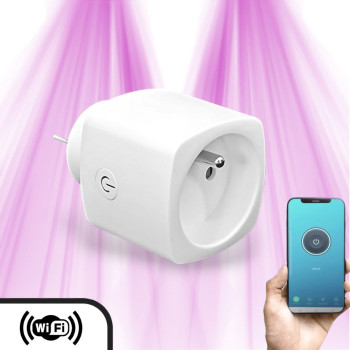
If you prefer remote control, the SpectraWILD M500 PRO offers remarkable flexibility: adjust intensity and spectrum directly from your smartphone.
This system enables automated cycles and sends notifications in case of an anomaly. A very handy tool for managing your indoor growing with peace of mind.
Before buying, always check the actual consumption, the spectrum's efficiency, and the warranty duration. Every LED light tested by GrowLED is certified and delivered quickly.