


































































Heating Mat or Heated Propagator for Seeds and Cuttings: What Temperature, What Wattage, Do You Need a Thermostat?
For most seeds and cuttings the growing medium should sit between 20 and 25 °C, a little warmer for tomatoes, peppers and aubergines. This guide covers the mat wattage to plan for, what a thermostat does and when a heated propagator is the easier choice.
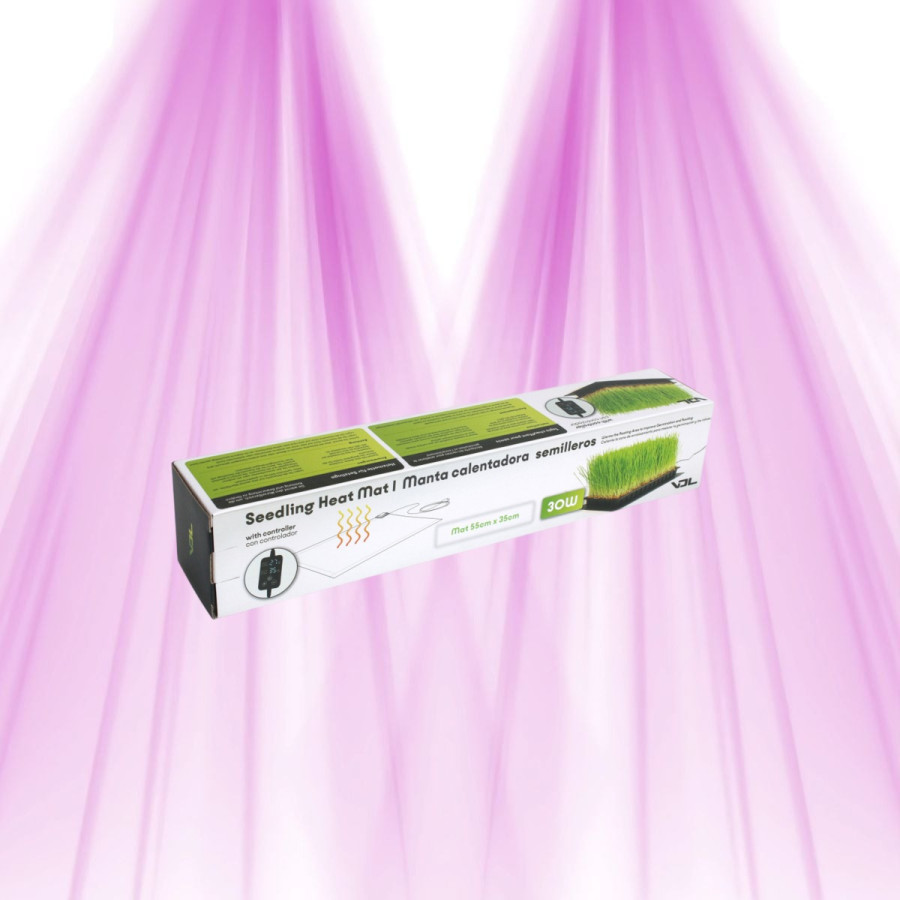
Short answer. General benchmark: 20 to 25 °C in the growing medium for most seeds, including 21 to 24 °C for lettuce, spinach, parsley and onion. The exception is warm-season vegetables (tomatoes, peppers, chillies, aubergines): 24 to 29 °C. Allow 22 to 25 °C for cuttings, always measured at root level. Pick a mat that covers the whole tray: for a 38 × 24 cm tray, the 20 W mat (25 × 53 cm) fits. A thermostat with its probe in the medium keeps the temperature steady when the room cools down or warms up. A heated propagator combines heat, a lid and, depending on the model, temperature control in one unit.
Why heat the growing medium rather than the room?
A seed germinates according to the temperature of the medium around it more than that of the air. For each species, Oregon State University Extension publishes a minimum temperature, an optimum range and an optimum. Its table of days to emergence shows the effect: the colder the medium, the longer seedlings take to appear, until tomatoes and peppers barely germinate at all. A heating mat warms only the root zone, without heating the whole room.
It does not add a fixed number of degrees. The result depends on the room temperature, the insulation under the tray and the lid. That is why you measure at root level, not in the air.
What temperature should you aim for with seeds and cuttings?
The table uses the optimum germination ranges published by Oregon State University Extension, based on J. F. Harrington (University of California, Davis), converted to degrees Celsius. The last column gives the medium temperature we suggest as a setting.
| Crop | Optimum range | Optimum | Suggested medium setting |
|---|---|---|---|
| Tomato | 16 to 29 °C | 29 °C | 24 to 29 °C |
| Pepper, chilli | 18 to 35 °C | 29 °C | 24 to 29 °C |
| Aubergine (eggplant) | 24 to 32 °C | 29 °C | 24 to 29 °C |
| Lettuce | 4 to 27 °C | 24 °C | 21 to 24 °C |
| Spinach | 7 to 24 °C | 21 °C | 21 to 24 °C |
| Parsley | 10 to 29 °C | 24 °C | 21 to 24 °C |
| Onion | 10 to 35 °C | 24 °C | 21 to 24 °C |
| Houseplant cuttings | not applicable | not applicable | 22 to 25 °C (air: 18 to 24 °C) |
For a crop that is not in the table, the source gives no figure: follow the guidance on the seed packet or from the seed company.
For cuttings, Iowa State University Extension recommends an air temperature of 18 to 24 °C. It suggests a heating mat to bring the medium to 24 to 27 °C; we stay at 22 to 25 °C to be on the safe side. Most houseplant cuttings root in 3 to 6 weeks. Humidity should stay high, under a lid or bag that is not sealed tight.
What heating mat wattage do you need?
Choose a mat by its surface first: it must cover the whole footprint of the tray. Divided by their surface, the mats in our heating mat range deliver roughly 150 to 215 W per m², so power follows size. The table also shows the maximum consumption, with the mat on 24 hours a day for 30 days, at €0.18/kWh (the rate we use for our examples).
| Power | Size (cm) | Surface (m²) | W per m² | kWh per month | Maximum cost per month |
|---|---|---|---|---|---|
| 15 W | 35 × 20 | 0.07 | 214 | 10.8 | €1.94 |
| 20 W | 25 × 53 | 0.1325 | 151 | 14.4 | €2.59 |
| 30 W | 55 × 35 | 0.1925 | 156 | 21.6 | €3.89 |
| 40 W | 51 × 53 | 0.2703 | 148 | 28.8 | €5.18 |
| 105 W | 120 × 53 | 0.636 | 165 | 75.6 | €13.61 |
Step-by-step method
- Measure the footprint of your trays (length × width) and add them up if they sit side by side.
- Convert to m²: cm × cm ÷ 10,000.
- Take the smallest mat whose surface is at least as large and whose sides cover the tray.
- Work out maximum consumption: W × 24 h × 30 days ÷ 1,000 = kWh per month, then × €0.18.
Worked example. A 38 × 24 cm tray covers 912 cm², or 0.0912 m². The 15 W mat (35 × 20 cm, 0.07 m²) is too small. The 20 W mat (25 × 53 cm, 0.1325 m²) covers the tray: 38 cm along the 53 cm length, 24 cm across the 25 cm width. Maximum consumption: 20 × 24 × 30 ÷ 1,000 = 14.4 kWh, so 14.4 × 0.18 = €2.59 per month. With two trays side by side (38 × 48 cm, 0.1824 m²), you need the 40 W mat (51 × 53 cm): 28.8 kWh, or at most €5.18 per month. A thermostat switches the heat off once the set temperature is reached, so the real bill stays lower.
Do you need a thermostat?
It is not compulsory, but it is recommended. Without control, the medium temperature follows the room: it climbs in the afternoon and drops at night. The dial found on some mats adjusts the heat produced; without a probe in the medium, it does not measure the temperature at the roots, so check it with a thermometer pushed into the medium.
A probe thermostat plugs in between the socket and the mat, and switches the power on and off to hold the setting you chose from the table. Place the probe in the medium, or between the mat and the pot, never in the air. It then measures what the roots actually experience.
Heating mat or heated propagator?
Both heat from below. The propagator adds a tray, a lid and, depending on the model, built-in control. Power and capacity figures below come from our product pages; for the propagator, they are those of the two models presented further down.
| Criterion | Heating mat | Heated propagator |
|---|---|---|
| What you buy | A heated surface to put under a tray or an unheated propagator | A tray, a clear lid and built-in heating |
| Power | 15 to 105 W depending on size | 12 W (Neptune, 38 × 24 × 19 cm) or 50 W (Garland, 59 × 41 × 26.5 cm) |
| Control | Depending on the model: built-in digital control, a dial, or a probe thermostat to add | Adjustable from 5 to 30 °C with a 2 m probe on the Garland model |
| Capacity | That of the surface you choose, several trays possible | Up to 60 seedlings or cuttings (Garland model) |
| Humidity | A lid or dome to add | Clear lid supplied; four ventilation flaps on the Neptune model |
| Maximum electricity cost per month | €1.94 (15 W) to €13.61 (105 W) | €1.56 (Neptune, 12 W) or €6.48 (Garland, 50 W) |
Choose the mat if you already have trays or a propagator, or want to heat several trays. Choose the propagator for a first set-up or for cuttings, which need high humidity under a lid. To complete your starter equipment list, see our first grow checklist.
Setting up the mat, step by step
- Lay the mat flat on a dry surface, ideally on an insulating base, so the heat rises towards the tray.
- Put the tray or propagator on the mat, without folding or covering the mat.
- Push the thermostat probe into the medium and set the temperature from the table.
- Let the temperature settle, then check it with a thermometer in the medium before sowing.
- Cover without sealing the lid, and ventilate every day.
- As soon as seedlings emerge, add light. Without added CO2, Lumatek recommends 100 to 300 µmol/m²/s for seedlings and 75 to 150 for cuttings, with 18 hours of light a day, and round-the-clock light for seedlings until the seed leaves (cotyledons) open (LED Grow Light Strategies, 2022). For seedlings, we stay between 100 and 200 to be on the safe side. Distances and durations are covered in our guide to lighting seedlings indoors.
Common mistakes: no insulation under the mat, the probe in the air, a waterlogged medium, a lid that is always closed. Not every mat is waterproof, so check the product page before watering near it. If the room air is too dry or too damp, our guide to humidity in your tent helps. To heat a whole growing space, read how to heat an indoor growing space properly.
Which equipment should you choose?
- Heating mat for seedlings and cuttings: two sizes (15 W at 35 × 20 cm and 30 W at 55 × 35 cm), without a built-in thermostat. This is the entry-level option, to pair with a thermostat.
- Digital heating mat by VDL: the same sizes (15 W and 30 W), with digital temperature control.
- Digital thermostat with remote probe: large screen, external probe, up to 2,900 W. It goes between the socket and a mat with no built-in control.
- Garland heated propagator: 59 × 41 × 26.5 cm, 50 W, adjustable from 5 to 30 °C, 2 m probe, up to 60 seedlings or cuttings.
- Neptune Hydroponics heated propagator: 38 × 24 × 19 cm, built-in 12 W heating, two perforated trays and four ventilation flaps.
Browse every model in the heating mat range, the greenhouses range and the grow tents for seedlings, cuttings and germination.
Frequently asked questions
What temperature should a seed heating mat reach?
Aim for 20 to 25 °C in the medium for most seeds. Go up to 24 to 29 °C for tomatoes, peppers, chillies and aubergines. Always measure at root level.
Do you need a thermostat with a heating mat?
It is not compulsory, but it holds the set temperature when the room temperature changes. Without one, check the medium temperature with a thermometer.
What heating mat wattage does a seed tray need?
Take the mat whose surface covers the tray. For a 38 × 24 cm tray, the 20 W mat (25 × 53 cm) fits. Divided by their surface, our mats deliver roughly 150 to 215 W per m².
How much electricity does a heating mat use?
At most, with the mat on all the time, €3.89 per month for a 30 W mat and €1.94 for a 15 W mat, at €0.18/kWh (the rate we use for our examples). With a thermostat, the real bill is lower.
Can you root cuttings on a heating mat without a propagator?
Yes, as long as you cover the cuttings. They need high humidity under a lid that is not airtight. Ventilate every day.
Where should the thermostat probe go?
In the medium, or between the mat and the pot. A probe in the air measures the room, not the roots.
Sources: Oregon State University Extension, J. F. Harrington (UC Davis), "Soil temperature conditions for vegetable seed germination", 2013, revised 2024; Iowa State University Extension and Outreach, A. Steil, "How to Propagate Houseplants by Stem Tip Cuttings", 2025; Lumatek, "LED Grow Light Strategies", 2022; our product pages (power, sizes, capacities); electricity rate used for our examples: €0.18/kWh.