










































































Extractor accessories
14 products
Air Extractor Accessories: Optimize Your Indoor Ventilation System
Air extractor accessories are essential components that transform a simple fan into an efficient extraction system. Ducting, silencers, protective grilles, connectors, and reducers allow you to perfectly adapt your installation to the constraints of your grow space. Without these components, it's impossible to achieve optimal and silent airflow.
Why Invest in Quality Extractor Accessories
The difference between an extraction that works and an extraction that works well lies in the details. Rigid or flexible ducting determines the pressure drop of your system: a poorly chosen 125mm duct can cause your extractor to lose up to 30% of its airflow. Silencers reduce noise by 15 to 25 dB depending on the model, transforming a noisy extractor into a discreet whisper. Grilles and backdraft dampers prevent air reflux that disrupts circulation. Each accessory plays a role in overall efficiency.
Connectors and reducers allow you to adapt different diameters without compromising airtightness. A well-designed 150/125mm reducer maintains laminar flow, whereas a makeshift solution with tape creates turbulence that reduces performance. Clamps ensure airtight connections that won't loosen with vibrations.
How to Choose Your Extraction Accessories
Diameter is the number one criterion: strictly adhere to your extractor's diameter. A 125mm extractor with a 100mm duct loses 40% of its airflow. For ducting, opt for insulated models if you have thermal constraints, and simple aluminum ducts for short, straight runs.
For silencers, check the length: a 50cm silencer reduces noise more than a 25cm model, but increases pressure drop. Expect a 5 to 10% airflow loss per silencer. Models with internal acoustic foam are more effective than simple perforated tubes.
Grilles are chosen based on exposure: metal grilles for outdoors, plastic for indoors. Backdraft dampers are essential if you have multiple extraction points or prevailing winds that can create back pressure.
Frequently Asked Questions
What ducting diameter should I choose for my indoor grow air extractor?
The ducting diameter must absolutely match that of your extractor, without reduction. A 125mm extractor requires a 125mm duct throughout its entire length. Reducing the diameter, even locally, creates significant pressure drops: going from 125mm to 100mm reduces airflow by 35 to 40%. If you absolutely must adapt, use a progressive reducer and keep the reduced section as short as possible. For flexible ducts, avoid tight bends that create turbulence.
How do I install a silencer on my extractor without losing airflow?
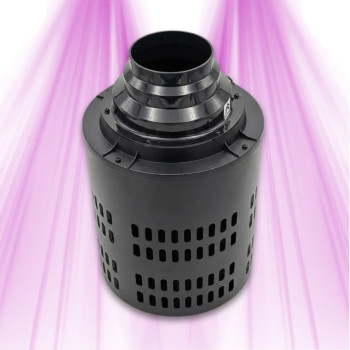
Place the silencer at the extractor outlet rather than at the intake to limit pressure drops. Use airtight clamps and ensure the silencer has the same diameter as your extractor. A 50cm silencer reduces noise by 20-25 dB but causes an 8 to 12% airflow loss. Shorter models (25cm) lose less airflow but are less acoustically effective. Avoid chaining multiple silencers: a single long model is better than a series of short ones.
Should a carbon filter be more powerful than the extractor for extraction?
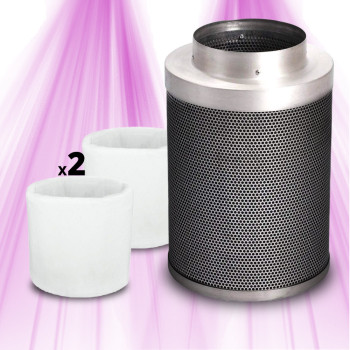
No, it's the opposite: the carbon filter's airflow capacity must be greater than that of the extractor to prevent saturation. A 280 m³/h extractor works perfectly with a 360 m³/h filter. This margin compensates for the filter's pressure drops and ensures sufficient contact time between the air and the activated carbon. An undersized filter saturates quickly and loses its effectiveness. Replace the carbon every 12 to 18 months depending on usage.
Where should the extractor be placed relative to the grow tent, inside or outside?
The extractor is ideally placed outside the tent for several reasons: less noise inside, less heat dissipated into the grow space, and easier maintenance. Connect it via a short, rigid duct to limit pressure drops. If you must place it inside, suspend it with elastic bungee cords to reduce vibrations transmitted to the structure. In all cases, the carbon filter remains inside, at the top of the tent where hot air accumulates.
How do I regularly clean accessories like grilles and extractor ducts?
Grilles should be cleaned monthly with a soft brush and soapy water, then thoroughly dried before reassembly. For aluminum ducts, wipe the inside with a dry cloth every 3 months to remove dust that reduces airflow. Flexible ducts are usually replaced rather than cleaned: their rough surface retains too many particles. Silencers with internal foam require foam replacement every 2 years. Regular maintenance maintains performance and extends the lifespan of the entire extraction system.


