



































































The Pure Factory
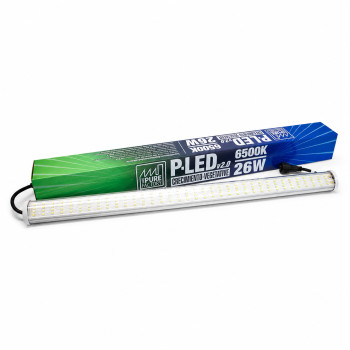
PureLED P-LED BLOOM 26 W 55 cm – LED bar for cuttings
Available in 2 models
Ships within 2 weeks
47,92 € 59,90 €

Product successfully added to your shopping cart
Ça pousse dans le bon sens

3 products
P-LED lights from Pure LED represent the pinnacle of LED lighting for indoor cultivation. These panels combine remarkable energy efficiency with an optimized light spectrum to support your plants from germination to harvest. With their latest-generation LED technology, P-LEDs offer a formidable alternative to traditional HPS systems.
P-LED technology stands out for its exceptional luminous efficacy, often exceeding 2.5 µmol/J. Unlike HPS lamps which generate a lot of heat, P-LEDs maintain a low operating temperature, drastically reducing your ventilation needs. The full-spectrum integrates all necessary wavelengths: from blue (400-500nm) for vegetative growth to deep red (660-730nm) for flowering. This versatility means you don't have to change lighting according to cultivation phases.
The economic advantage is undeniable. A 300W P-LED easily replaces a 600W HPS while consuming half the electricity. The lifespan far exceeds 50,000 hours, which is more than 10 years of intensive use. No more frequent bulb changes and yield losses due to light degradation.
Power is calculated according to your growing area. Allow approximately 30-40W per square foot for optimal coverage. For a 1m² tent, a 150-200W P-LED will be more than sufficient. More powerful models (400W and up) are suitable for spaces of 1.5m² and larger. Always check the PPFD (photosynthetic photon flux density): it should reach 800-1000 µmol/m²/s at canopy level for optimal flowering.
The light spectrum is a crucial criterion. Modern P-LEDs often offer adjustable spectra or pre-programmed modes (growth/flowering). Prioritize models with Samsung LM301B LEDs or equivalent, renowned for their efficiency and longevity. The presence of UV (365-400nm) and infrared (730nm+) boosts resin production and improves light penetration.
Don't forget heat dissipation. Quality P-LEDs incorporate aluminum heatsinks and silent fans. A good cooling system ensures stable performance and extends component lifespan.
For a 1m² tent in flowering, opt for a 150-200W P-LED with a spectrum rich in red (660nm) and deep red (730nm). The PPFD should reach 800-1000 µmol/m²/s at 30-40cm height. Models with dimmers allow you to adjust the intensity according to the flowering progress. Avoid excessive power which would create light stress and waste energy.
The optimal distance varies depending on the power and development stage. During growth, maintain 40-60cm between the P-LED and the canopy. During flowering, you can lower it to 30-40cm to maximize PPFD. Monitor for signs of light stress: yellowing leaves, burnt edges, or stunted growth. Use a lux meter or a smartphone app to measure light intensity and precisely adjust the height.
Absolutely, P-LEDs significantly outperform HPS in several aspects. Energy efficiency is 2 to 3 times higher: a 300W P-LED produces as much as a 600-750W HPS. The heat generated is minimal, reducing ventilation and air conditioning costs. The full-spectrum of P-LEDs is better suited to plant needs than the orange-red spectrum of HPS. The only drawback: a higher initial investment, quickly recouped by electricity savings.
During the growth phase, favor a spectrum rich in blue (400-500nm) and cool white (5000-6500K) to promote foliar development and limit stretching. If your P-LED has separate channels, activate blue and white LEDs at 100%, and reduce red to 30-50%. Some models offer a pre-programmed "Veg" mode that automatically optimizes these settings. Overall intensity can be reduced to 60-80% of maximum power during this phase.
Regular maintenance significantly extends the lifespan of your P-LED. Clean the lenses every 2-3 months with a slightly damp microfiber cloth to remove dust and residue. Check that the fans rotate freely and dust the heatsinks with a brush or compressed air. Avoid water splashes and maintain an ambient temperature below 35°C. A clean and well-ventilated environment guarantees stable performance for over 10 years of intensive use.
Available in 2 models
Available in 2 models
Help & advice
About P-LED — click a question to see the answer.
To choose your P-LED lamp, I advise you to first consider the surface area of your grow space. Then, think about the types of plants you are growing and their specific light needs. Finally, evaluate your budget, as P-LEDs are an investment, but their efficiency quickly pays off.
As a general rule, I recommend approximately 300 to 400 actual watts per square meter for high-performance indoor growing with P-LEDs. For smaller areas, for example 60x60 cm, a 100 to 150W model may suffice, while for 120x120 cm, I would aim for 600 to 800W. This is an estimate, but it gives you a good baseline.
The main difference is energy efficiency and light spectrum. P-LEDs consume much less electricity for the same light intensity and emit less heat, which simplifies climate management. Furthermore, their spectrum is optimized for plant growth, unlike HPS which have a broader and less targeted spectrum. In practice, I often find that P-LEDs offer better yields for lower consumption.
The ideal distance depends on the power of your P-LED and the growth stage of your plants. Generally, I advise starting at about 40 to 60 cm from young seedlings and gradually reducing this distance to 30-40 cm during the flowering phase. Observing your plants is crucial: if the leaves yellow or burn, raise the lamp a little.
The most common mistake is not adjusting the lamp height. A P-LED too close can burn plants; too far, it will be ineffective. Another mistake is neglecting ventilation; even though P-LEDs generate less heat, good air circulation remains essential. Finally, remember that the light spectrum is powerful, protect your eyes with appropriate glasses.
Pure LED P-LEDs are designed with a full and balanced spectrum, meaning they are suitable for all phases, from germination to flowering. This is one of their great advantages. If I had to choose, I would say their spectrum is particularly effective at stimulating flowering thanks to a good proportion of red and far-red, while ensuring robust vegetative growth.
Absolutely! P-LEDs are perfectly suited for indoor growing. Their low heat emission, energy efficiency, and optimized spectrum make them an ideal choice for growers concerned with performance and environmental control. This is what I consistently recommend for professional results.
Cannot find your answer? 01 88 33 45 52 or by message.