


































































Horticulture Lighting Group
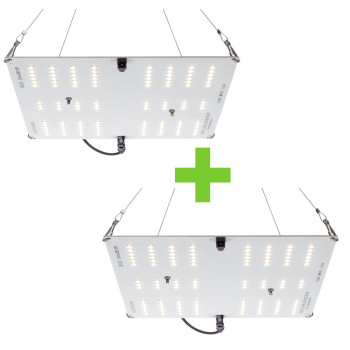
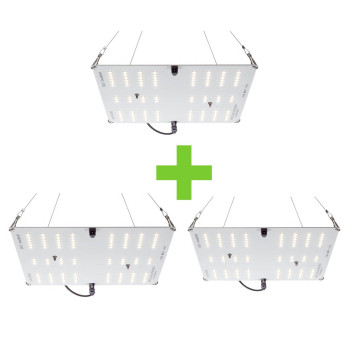
HLG 65 V2 x3 – pack of 3 LED grow lights
Available in 2 models
In stock · Shipped within 24 h
502,40 € 528,84 € or 3× 167,47 €

Product successfully added to your shopping cart
Ça pousse dans le bon sens

2 products
Horticulture Lighting Group Packs represent the best in LED lighting for indoor cultivation. This American brand has established itself as the absolute benchmark thanks to its Samsung LM301B and LM301H diodes, which deliver exceptional luminous efficacy of 2.7 µmol/J. When it comes to yield and spectral quality, HLG is high-end that makes a difference to your harvests.
HLG's strength is first and foremost its astonishing energy efficiency. Their quantum boards consume 40% less than an equivalent HPS while producing more useful light for plants. We're talking about latest-generation Samsung diodes mounted on aluminum heat sinks that perfectly dissipate heat. The result: no forced ventilation needed and a lifespan exceeding 50,000 hours.
HLG's full spectrum perfectly covers plant needs from germination to harvest. With a peak at 660nm (deep red) and a solid base at 450nm (blue), their LEDs stimulate both photosynthesis and secondary metabolite production. It's this scientific approach that has led HLG to equip the largest American vertical farms today.
To choose the right HLG model, it all starts with your growing area. Allow approximately 35-40W per square foot (0.09m²) for optimal lighting. An HLG 100 perfectly covers 60x60cm, while an HLG 320 can illuminate up to 120x120cm during flowering. The height of your space also matters: HLG quantum boards have a diffusion angle of 120°, which requires a minimum of 40cm of height for homogeneous distribution.
In terms of budget, HLGs are a long-term investment. While more expensive to purchase than an HPS, they quickly pay for themselves through electricity savings and the absence of bulb changes. Not to mention that reduced heat saves you on air conditioning in summer. For beginners, the 100-135W series models are perfect, while experienced growers opt for 320W and above.
For leafy greens like lettuce and spinach, an HLG 100 or 135 is more than sufficient with its blue-rich spectrum that promotes vegetative growth. Aromatic herbs like basil or mint love the full spectrum of HLGs, particularly effective for developing essential oils. For decorative houseplants, a more compact model like the HLG 65 provides just enough light without glare. Tomatoes, peppers, and other fruits require more power: aim for at least an HLG 240 to have enough deep red during flowering.
HLG models differ mainly in their power and format. HLG 100-135W are compact quantum boards perfect for 60x60cm, while HLG 240-320W use multiple boards to cover 90x90 to 120x120cm. "V2" models incorporate the latest Samsung LM301H diodes, which are more efficient than the LM301B of earlier generations. To calculate, allow a minimum of 35W per square foot during flowering: a 100x100cm space (approximately 11 square feet) therefore requires a minimum of 385W, i.e., an HLG 400 or two HLG 200.
Installing an HLG requires respecting recommended distances: 45-60cm during growth, 30-45cm during flowering depending on power. Always start higher and gradually move closer, monitoring for signs of light stress (leaves turning white or curling). HLGs are dimmable, so start at 50% power for the first few days then gradually increase. Use a lux meter or, better yet, a PAR meter: aim for 200-400 PPFD during growth, 600-900 PPFD during flowering. The beauty of quantum boards is their homogeneous diffusion, which avoids hot spots unlike COBs.
With 2.7 µmol/J, HLGs are among the most efficient LEDs on the market, ahead of most Chinese brands which top out at 2.0-2.3 µmol/J. Concretely, an HLG 320W replaces a 600W HPS while consuming 47% less. For 12 hours/day of cultivation, this represents 1000 kWh saved per year, or approximately €150-200 depending on your electricity rate. Add in air conditioning savings (less heat to dissipate) and the absence of bulb changes, and your HLG pays for itself in 18-24 months maximum. After that, it's pure profit for at least 8-10 years.
Recent HLGs offer a fixed full spectrum optimized for all phases, but some models have separate UV/IR or deep red channels. During growth, use the full spectrum at moderate intensity (50-70% power) to promote compact and vigorous development. During flowering, push to 100% and activate red/IR channels if available to stimulate resin production and maturation. The HLG secret is that even their "white" spectrum already contains enough deep red (660nm) for optimal flowering, unlike classic white LEDs that are too poor in this crucial area.
Available in 2 models
Available in 2 models
Help & advice
About Horticulture Lighting Group Pack — click a question to see the answer.
The choice of wattage primarily depends on the surface area of your grow space and the specific needs of your plants. For HLG Packs, I recommend aiming for approximately 30 to 40 watts per square foot (0.09 m²) for optimal growth. For example, for a 1m x 1m space, a 300 to 400W HLG would be an excellent choice. Don't hesitate to consult the product sheets; they often indicate the ideal coverage area.
Installing an HLG Pack is generally very simple. I advise suspending it securely above your plants using the provided cables and hooks. Ensure that the power supply is properly connected and that the device is plugged into a secure outlet. For more powerful models like the HLG 550 V2, I explain the specific installation details in this article.
Distance is crucial to avoid light stress or insufficient intensity. Generally, I start by placing my HLG Pack about 45-60 cm from young seedlings and adjust it as they grow. For flowering phases, you can often move it closer, around 30-40 cm, depending on the wattage and the plants' reaction. Observing your plants is your best indicator!
The difference is significant! HLG Packs, thanks to their Samsung diodes, offer much higher energy efficiency than HPS, which means less power consumption and less heat generated. Furthermore, HLG LEDs provide an optimized light spectrum for each plant phase, unlike HPS which has a more limited spectrum. In practice, I often see improved yields and better harvest quality with LEDs.
A full spectrum, like that of HLG Packs, means that the emitted light contains all the wavelengths necessary for photosynthesis and optimal plant development, from deep blue to far red. It's a bit like replicating sunlight. I find it essential for vigorous growth and abundant flowering, as it allows plants to capture light energy very efficiently at every stage of their cycle.
To choose the ideal HLG Pack, I advise you to consider several factors: the size of your grow space, the type of plants you are growing, and your budget. Models like the HLG 100 V2 are perfect for small spaces or as supplemental lighting, as I discuss in this article. For larger areas, the HLG 300 or 550 will be more suitable. Also consider luminous efficacy, a strong point of HLGs.
PPFD (Photosynthetic Photon Flux Density) is a key indicator. For vegetative growth, I recommend aiming for a PPFD of approximately 300-600 µmol/m²/s. During the flowering phase, plants need more intensity, and a PPFD of 600 to 1000 µmol/m²/s is often optimal for HLG Packs. Don't forget that good air circulation and adequate nutrient management are also essential for your plants to make the most of this intense light.
Yes, absolutely! Thanks to their full spectrum and exceptional luminous efficacy, HLG Packs are perfectly suited for indoor cultivation of a wide variety of plants. Whether you are growing vegetables, herbs, flowers, or other species, you will achieve excellent results. This is what I regularly observe from my customers' feedback and my own experiences.
Cannot find your answer? 01 88 33 45 52 or by message.