




































































GrowLED Essentials
Clamp 25 - 175mm - Ideal for air extractor
Available in 3 models
In stock · Shipped within 24 h
3,19 €

Product successfully added to your shopping cart
Ça pousse dans le bon sens

12 products
Odor management accessories are those small pieces of equipment that make all the difference in your setup. Pre-filters, replacement filters, mounting brackets, connectors... all these elements help optimize the efficiency of your odor control system and extend its lifespan. Frankly, it's often these details that determine the success of a quiet and discreet installation.
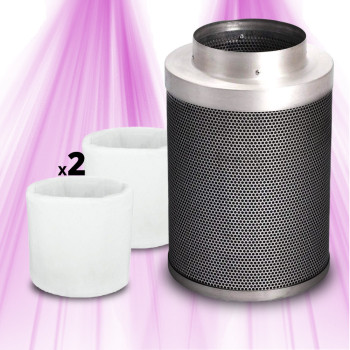
A filtration system is like a chain: one weak link is enough for everything to fall apart. Pre-filters, for example, protect your main filter from large particles and can double its lifespan. The 125 - 250mm Pre-filter for Prima Klima 360m3/h carbon filter effectively captures dust and debris before they clog the activated carbon. It's an investment that pays for itself quickly.
Replacement filters are also crucial. Rather than buying a complete new system, you can simply replace the used filter element. The Replacement filter for herbdryer 30cm allows you to maintain the efficiency of your drying net without changing everything. It's economical and ecological.
Diameter is the first criterion: your accessories must exactly match the dimensions of your setup. A 125mm pre-filter will not fit a 150mm extractor. Also check compatibility with your filter brand – some accessories are specific to Prima Klima, others are universal.
For replacement filters, look at the density of the activated carbon (expressed in g/m³) and the type of granules used. Australian or European carbon generally offers better longevity than low-grade Asian carbon. The replacement frequency varies depending on the intensity of use: expect 6 to 12 months for intensive use.
For a 1m² tent, a 125mm extractor with a carbon filter is usually sufficient. Add a pre-filter to protect the activated carbon from particles. If you have residual odors, a small ionizer or an Ona Block neutralizing gel can complement the setup. The important thing is to create a slight negative pressure in the tent to prevent odorous air leaks.
Airtightness is crucial for efficiency. Use metal hose clamps, not tape that eventually fails. Check that all connections are snug – a faulty seal can reduce efficiency by 50%. Place the filter inside the tent if possible, as warm air improves carbon adsorption. Test with a lighter: the flame should be drawn towards the air intake grilles.
Ona gels chemically neutralize odorous molecules through direct contact; they are very effective on persistent odors in enclosed spaces. Ionizers work differently by electrically charging particles to make them precipitate. For light residual odors, an Ona gel is often more practical and doesn't consume electricity. Ionizers are more suitable for larger volumes and continuous air treatment.
A clean pre-filter is essential – wash it every 3-4 weeks with lukewarm water. Avoid excessive humidity, which degrades activated carbon. If your humidity exceeds 70%, install a dehumidifier. You can partially "regenerate" a used filter by placing it in the sun for a few hours, but this doesn't replace a full replacement. A well-maintained filter lasts 8-12 months depending on use.
For ionizers, continuous operation is recommended as they maintain a constant level of ions in the air. Ona gels act passively, no need to "turn them on." However, be careful with overdosing, which can create a detectable artificial smell. Start with small amounts and adjust according to the results. During flowering, extraction should run continuously; neutralizers are a supplement, not a replacement.
Available in 3 models
Available in 5 models
Available in 5 models
Available in 5 models
Available in 2 models
Available in 5 models
Available in 5 models
Help & advice
About Accessories — click a question to see the answer.
To choose the right accessory, I advise you to start by identifying the type of your existing odor control system: is it a carbon filter, an ozonator, or a diffuser? Then, I look at the specifics of your setup, such as the diameter of your ducts if you're using a carbon filter, or the size of the space to be treated. Each accessory is designed for a specific use, so compatibility is key.
A pre-filter is an essential component, especially if you are using an activated carbon filter. Its role is to capture larger particles, such as dust, hair, or plant debris, before they reach the carbon. In practice, this significantly extends the lifespan of your main filter by preventing it from clogging too quickly. It's a small investment that makes a big difference in the long run.
Correct installation is paramount for effectiveness. I always recommend strictly following the manufacturer's instructions for each accessory. Generally, for filters and pre-filters, you need to ensure a perfect seal to prevent unfiltered air from leaking. For diffusers, positioning is important for homogeneous diffusion. Don't hesitate to consult guides or tutorials if you have doubts, as improper installation can render your system ineffective.
The choice of replacement filter depends directly on the model and brand of your main filter. It is crucial to select a filter of the same size and with the same technical specifications to ensure perfect compatibility and optimal efficiency. If you have a carbon filter, I advise you to check the quality of the activated carbon (often virgin coconut carbon) for better odor absorption. This is a point I discuss in more detail in this article on odor management.
The lifespan varies greatly depending on the accessory and its use. A pre-filter may require cleaning or replacement every 1 to 3 months, depending on clogging. An activated carbon filter, on the other hand, has an average lifespan of 12 to 18 months in continuous use, but this can be less if humidity is high or odors are very intense. Deodorizing wicks or diffuser cartridges have lifespans indicated by the manufacturer, often from a few weeks to a few months. My advice is to monitor effectiveness: if odors reappear, it's a sign that it's time to replace.
Compatibility is essential. I always recommend checking the technical specifications of your current accessories and the new ones you wish to acquire. For ducts and filters, you need to ensure that the diameters match. For diffusion systems, the brand and model are often key indicators. If in doubt, do not hesitate to consult product sheets or ask for advice. This is what I often see, and it avoids many disappointments.
The most common mistake I encounter is a lack of airtightness, especially with carbon filters. Air leaks around the filter or unsealed ducts allow odors to escape. Another mistake is to neglect the pre-filter, which drastically reduces the lifespan of the main filter. Finally, I advise avoiding placing diffusers in areas with strong drafts that would disperse the product too quickly without effectively treating the space. Good odor management is a whole, as I discuss in this article.
Cannot find your answer? 01 88 33 45 52 or by message.


