




































































HomeBox
HomeBox Vista Medium – grow tent 125x65x120 cm
Available in 3 models
In stock · Shipped within 24 h
269,00 € or 3× 89,67 €

Product successfully added to your shopping cart
Ça pousse dans le bon sens

3 products
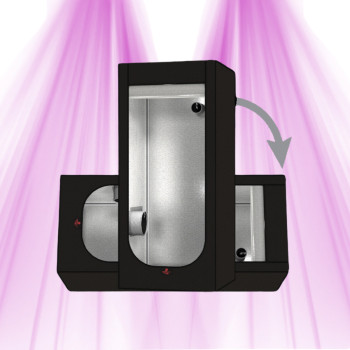
Double-tier grow tents are revolutionizing indoor cultivation by allowing you to grow on two distinct levels within the same space. This ingenious configuration offers you the possibility of simultaneously managing two grow cycles: vegetative growth on the upper level and flowering on the lower level, or two different varieties with their own lighting needs. No more wasted time between cycles; your production becomes continuous.
These vertical setups prove particularly effective for growers with limited floor space but sufficient ceiling height. With typical dimensions of 90x60x160cm or 150x80x200cm, they literally double your growing area without encroaching further on your room.
The main advantage lies in optimizing vertical space. Where a classic tent limits you to a single growing level, the double-tier system intelligently exploits the available height. Each compartment has its own ventilation and hanging points for lighting, creating two completely independent growing environments.
Productivity is significantly improved. While your plants finish flowering on the lower level, you can already prepare the next generation for vegetative growth on the upper level. This permanent rotation eliminates downtime and maintains a regular harvest flow. Experienced growers particularly appreciate this continuity, which optimizes the return on investment of their setup.
The physical separation of the two levels also offers significant health benefits. In case of a problem on one level (pests, disease), the other level remains protected by the intermediate partition. This isolation limits the spread of problems and facilitates targeted treatments.
Dimension is the first selection criterion. 90x60cm models are perfect for confined spaces and allow you to grow 2-4 plants per level depending on the technique used. 150x80cm versions offer more space for 4-6 plants per level and facilitate handling inside the tent.
The height of each compartment determines your growing possibilities. Allow at least 80cm of net height per level for proper plant development, deducting the space occupied by lighting and ventilation. Check that your room's ceiling height allows for the complete installation of the structure.
The quality of the reflective fabric plays a crucial role in light efficiency. Opt for Mylar or diamond fabrics with a reflection rate greater than 95%. The fabric thickness (minimum 210D) ensures durability and light impermeability between the two levels.
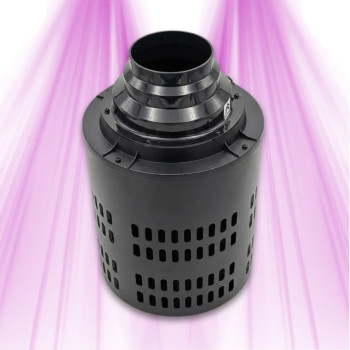
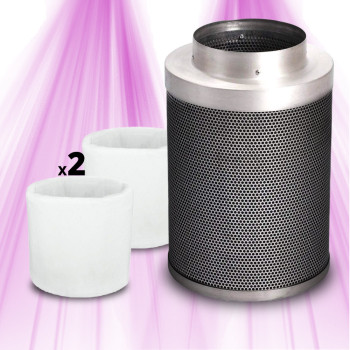
Ventilation systems must be adapted to the double volume. Each level requires its own extraction, generally with 100mm or 125mm ducts depending on the dimensions. Plan for extractors of at least 200m³/h per level to ensure sufficient air exchange.
The choice depends on your available space and production goals. The 90x60cm requires only 0.54m² of floor space and is suitable for 2-3 plants per level in pots up to 11L. It fits perfectly in closets or small rooms. The 150x80cm occupies 1.2m² but allows for 4-6 plants per level in 18L pots, offering a higher yield. Also, check that your ceiling height accommodates the 200cm of the larger version compared to 160cm for the compact one.
The upper level is generally intended for vegetative growth with 18/6 lighting (CFL or low-power LED), while the lower level accommodates flowering at 12/12 with more powerful lighting. Install separate extractors for each level with independent exhaust ducts to the outside. The intermediate partition ensures light impermeability, crucial for respecting photoperiods. Use distinct timers to manage the lighting cycles of each compartment without interference.
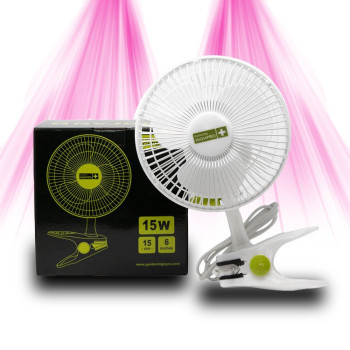
Each level requires its own extraction system with a minimum flow rate of 200m³/h for a 90x60 and 300m³/h for a 150x80. Install an extractor at the top of each compartment with an independent exhaust duct. Add oscillating fans (15cm clip-fan) in each level to homogenize the air. Passive intake through the lower openings is usually sufficient, but monitor humidity, which should not exceed 60% during flowering. A compact dehumidifier may be necessary depending on your local climate.
Assembly alone is possible but requires more time and attention. The metal structure is easy to assemble by following the instructions, but installing the fabric and especially the intermediate partition is more delicate for one person. Allow 3-4 hours alone versus 2 hours with two people. The most critical part concerns securing the central shelf, which supports the weight of the upper level. Make sure all tubes are properly fitted and tightened before stretching the fabric. A second person greatly facilitates handling large fabrics without creasing them.
Partially disassemble the fabric to access all corners of each level. First, vacuum plant debris and dust, then clean the surfaces with a solution of water and black soap. Then disinfect with 70% alcohol or a diluted bleach solution (1%), focusing on corners and fasteners where moisture can accumulate. Allow to dry completely before reassembling the fabric. Take advantage of this cleaning to check the condition of zippers and seams, which are sensitive points on this type of installation. Rigorous maintenance after each cycle prevents the accumulation of pathogens between levels.
Available in 3 models
Available in 4 models
Available in 4 models
Help & advice
About Double-story grow box — click a question to see the answer.
A double-tier grow tent, as its name suggests, is designed to maximize growing space by allowing cultivation on two distinct levels. In practice, this means you can simultaneously manage two different growth phases, for example, young plants in vegetative growth on the upper tier and flowering plants on the lower tier, or two varieties with specific needs. It's an ideal solution for growers looking to optimize their yield in a limited space.
The main difference lies in capacity and versatility. A single-tier tent offers one growing space, while a double-tier tent vertically divides that space into two distinct compartments. This allows you to manage different life cycles for your plants or cultivate varieties with varied light and climate requirements at the same time, which is impossible with a single-tier tent. I find this to be a major asset for experienced growers or those who want continuous production.
The ideal size will depend primarily on the space available to you and the number of plants you wish to cultivate. If you're a beginner or have limited space, a compact tent (e.g., 60x60x120 cm) can be an excellent starting point. For larger productions, I recommend aiming for larger dimensions, such as 120x60x180 cm or more. Don't forget to consider the headroom for each tier, especially if you're growing plants that stretch a lot during flowering.
The number of plants will depend mainly on the size of each compartment and the growing method you use. Generally, for the vegetative tier, you can accommodate more young plants than for the flowering tier where plants are larger and require more space. For example, in a 60x60 cm compartment, I would say 1 to 4 flowering plants are feasible, while the same space in vegetative growth could accommodate 4 to 9 young plants. The important thing is not to overcrowd to ensure good air circulation and sufficient light access for each plant.
Shelf configuration is crucial for the efficiency of your tent. I recommend positioning the shelf to leave enough headroom for flowering at the bottom, as this is where plants reach their maximum size. The upper tier, often used for vegetative growth or clones, can have a reduced height. Make sure the shelf is sturdy and does not obstruct access to plants or the installation of your lighting and ventilation. The flexibility of height adjustment is a real plus.
Cannot find your answer? 01 88 33 45 52 or by message.


