



































































Want to finally understand exactly what the light spectrum produced by your LED grow lights is? This guide simplifies how to choose a grow light with the right spectrum for your plants. We cover wavelengths, essential colors, and each growth stage so you can practice indoor growing like an expert.
What Is the Light Spectrum of an LED Grow Light
The light spectrum refers to all the wavelengths emitted by a light source, measured in nanometers. The more complete this spectrum is, the more the plant benefits from a range of colors covering every stage of its development, from germination to flowering. Lights therefore offer distinct light bands (blue, red, white, ultraviolet, infrared) that are genuinely effective for indoor growing.

Definition and Wavelength Ranges Useful to Plants
In grow lighting, the main focus is on PAR light (400-700 nm), since it directly fuels photosynthesis. Full-spectrum LED grow lights often go beyond this range to activate other physiological mechanisms, optimizing both the vegetative stage and the flowering stage.
- Blue (400-500 nm): Stimulates chlorophyll production, promotes dense foliage, and controls stem stretching.
- Green (500-600 nm): Often underrated, it penetrates leaf layers better and contributes to overall photosynthesis.
- Red (620-680 nm): Induces flowering, improves bud development, and supports fruiting.
- UV and infrared: Enhance aromas, pigments, and flower density at the end of the cycle.
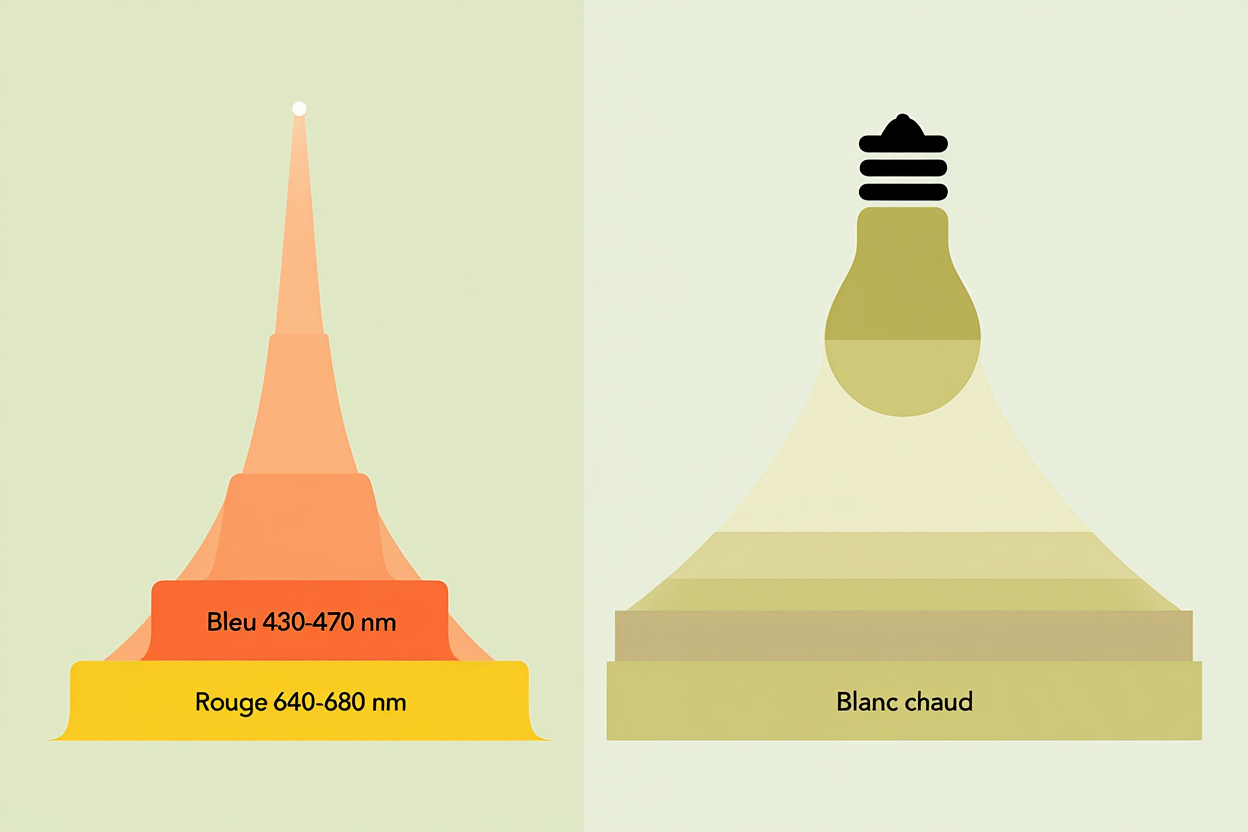
Blue wavelengths around 450-470 nm help achieve a compact structure, while red near 660 nm makes the transition to flowering easier without causing stress. Checking these characteristics before buying your equipment is essential for optimal results in indoor growing.
The Role of Colors: Blue, Red, UV, and Infrared
Each color sends a specific signal to the plant: blue encourages a compact habit, red triggers flowering, and infrared improves flower density. Mastering this interaction lets you precisely fine-tune the light to your crops' needs, to maximize their health and yield.
UV-A (365-400 nm) stimulates natural defenses and coloring, perfect for ornamental plants. Far infrared (>730 nm) influences phytochrome, which regulates stem elongation and flowering. Used in moderation, these spectra turn simple lighting into a precision tool for grow lighting.
| Color / Range | Wavelength (nm) | Main effect on the plant | Ideal stage |
| Ultraviolet | 280-400 | Boosts pigments, terpenes, defenses | Late flowering |
| Blue | 450-470 | Photosynthesis, compaction, dense foliage | Germination, vegetative stage |
| Green | 500-600 | Deep penetration, photosynthesis | All stages |
| Red | 630-660 | Flowering, buds, fruiting | Flowering stage |
| Infrared | >730 | Elongation, flower density | Late flowering |
Benefits of Full Spectrum for Indoor Growing
A full spectrum lets you use the same light from seedling to harvest. No more swapping fixtures or constant adjustments. These LED grow lights mimic natural sunlight, creating an ideal environment for the plant in indoor growing, all with controlled energy consumption.
The SpectraB.2.G X45, often mentioned as a benchmark, is a perfect example of this versatility. This 45W LED bar covers an area of 80 × 40 cm during the vegetative stage and 60 × 30 cm during flowering. Discover all its detailed specs on our LED grow light page. Ideal for completing a setup or running on its own, it's used in indoor growing silently and without an external driver.
Adapting the Light Spectrum to Growth Stages
A plant's light needs change throughout its life. Understanding this evolution is essential for optimizing every growth stage. From germination to final flowering, adjusting the light spectrum maximizes plant growth, reduces stress, and improves yields. The following paragraphs explain how to use grow lighting systems to precisely meet these needs.

Germination and Vegetative Stage: Favoring Blue and White
During germination and the vegetative stage, a spectrum rich in blue (450-470 nm) promotes a compact structure, while cool white (5000-6400 K) mimics natural spring light. It's best to start with moderate intensity, then gradually increase it to avoid any shock and encourage robust rooting. Position your grow light at 40-50 cm, set the blue channel to 80% and white to 20% for even, vigorous development.
- Blue 450-470 nm: Speeds up seedling emergence and prevents stretching.
- Cool white 5000-6400 K: Stimulates photosynthesis and improves foliage density.
- Progressive intensity: Start at 30% power, then increase it slowly.
- Optimal distance: Keep 40-50 cm for effective grow lighting without any risk of burning.
Modern LED grow lights, especially those with adjustable spectrums, make these settings easier thanks to independent channels. This lets you customize your LED grow lighting for every growth stage and ensure an optimal growing environment.
Flowering and Fruiting: Increasing Red and Infrared
When switching to flowering, you need to lower blue and strongly boost red to trigger the production of flowering hormones. A mix of around 70% red, 20% infrared (>730 nm), and 10% white encourages dense bud development and increases final weight. You can add 5 to 10% UV during the last two weeks to intensify aromas and pigments, without harming the plant's health.
Infrared acts as a natural metabolic accelerator, improving nutrient circulation and shortening maturation time. The precise settings offered by grow lighting systems allow you to perfectly control this spectral transition, crucial to the success of any grow light.
Practical Settings with Adjustable-Spectrum Lights
Adjustable LED grow lights are often equipped with dedicated dimmers (blue, white, red, UV, IR). Set an 18-hour light / 6-hour dark cycle for the vegetative stage (80% blue, 20% white, minimal red), then switch to a 12/12-hour cycle for flowering (70% red, 20% infrared, 10% white) to ensure a smooth transition. Some growers apply a 100% blue "growth boost" for two weeks, followed by an IR-rich "flowering boost" between weeks 6 and 8.
- 18h/6h cycle: A blue-dominant spectrum ensures maximum foliage density.
- 12h/12h cycle: Red and infrared promote the development of resinous buds.
- Adding UV: Only 5-10% at the end of the cycle to avoid any risk of phototoxicity.
High-end models, such as the Ti PRO or the L900 PRO, even offer a mobile app to automate grow lighting. This fine control lets you optimize every stage and maintain an ideal growing environment without daily manual intervention. For a complete kit including bulb, grow tent, and Plug & Play wiring, check out the LED grow light spectrum kit, a practical solution to get started or fine-tune your LED grow lighting setup.
Choosing Your Full-Spectrum LED Grow Light
Let's move from theory to practice: choosing an effective LED grow light requires carefully checking its power, PPFD, coverage, and diode quality. At GrowLED, we prioritize reliability to ensure steady plant growth in indoor growing. Let's look at what sets truly good LED grow lights apart from simple household lighting.

Key Criteria: Power, PPFD, and Light Coverage
Before investing in your LED grow light, determine the area to cover, the power actually required, and the desired PPFD level. These three factors are decisive for succeeding at the vegetative stage and then flowering, since a full spectrum is only beneficial if the light intensity is sufficient.
- Power suited to the area: 320W covers 0.6-1 m²; 650W for 1.5-2.2 m²; 900W lights up to 4 m² depending on the model's efficiency.
- Target PPFD: aim for 200-400 µmol·m⁻²·s⁻¹ during the vegetative stage and 600-800 µmol·m⁻²·s⁻¹ during flowering.
- Light-to-canopy distance: maintain a distance of 30-45 cm for a good balance between light intensity and heat management.
PPFD measures the number of photons actually received by the plant; it therefore reflects the real performance of a lighting system. So a 30W light delivering 600 µmol·m⁻²·s⁻¹ outperforms a 50W light providing only 400, especially when it's equipped with Samsung or OSRAM diodes, as is the case at GrowLED.
Our Best Lights for an Optimized Spectrum
The SpectraBULB X30 (30W) is perfect for small spaces and offers a genuine full spectrum: blue 460 nm, red 660 nm, and cool white 6400 K. At a distance of 30 cm, it reaches around 600 µmol·m⁻²·s⁻¹, covering an area of 40×40 cm during flowering and 50×50 cm during the vegetative stage.
The SpectraB.2.G X45 (45W) offers five distinct spectral bands to support the entire plant growth cycle, from germination to harvest. It lights an area of 80×40 cm during the vegetative stage and 60×30 cm during flowering, making it an ideal choice for scalable indoor growing.
For larger areas, the SpectraWILD S320, Ti PRO 670W, or L900 PRO 900W models feature separate dimmers, smartphone control, and precise lighting programs. These high-end LED grow lights guarantee a stable growing environment and reproducible results.
Installation and Optimizing the Growing Environment
Once your light is installed, make the most of every photon by using a PAR+ tent offering 95% reflectivity; this way you can gain up to 30% efficiency with no extra power consumption. Position the light at 30-40 cm during the vegetative stage, then move it further away to 40-50 cm during flowering to let the buds develop properly.
Two SpectraB.2.G X45 bars spaced 20 cm apart perfectly cover a 60×60 cm area, eliminating hot spots and shaded zones. Keep the canopy temperature below 30 °C with continuous ventilation to preserve the spectral stability and lifespan of your LED grow light.
Heat management is crucial: aluminum heat sinks and cooling fans allow a lifespan of up to 50,000 hours. A climate controller will help you regulate temperature, humidity, and photoperiod, ensuring an optimal growing environment. GrowLED supports you with 24-hour delivery, a premium warranty, and 7-day support, so you can practice indoor growing with total peace of mind.