



































































Extractor fan with a built-in thermostat or a separate controller: which one for a grow tent or greenhouse, and how to set the target temperature?
A fan with a built-in thermostat plugs in and adjusts on its own, while a separate controller goes wherever you need it. Here is how to choose, which target temperature to aim for and how to set it.

For a standard grow tent, a fan with a built-in thermostat is the simplest choice: one unit to plug in, already adjustable. A separate controller is better when you want to place the probe at plant height, set a precise minimum speed, or drive a fan you already own, especially an EC-motor fan. Either way, set the target temperature inside the 21 to 27 °C air range, then fine-tune it with a min/max thermometer. The airflow calculation is covered in our article Sizing your extractor fan properly, so we do not repeat it here.
How does a temperature-controlled extractor fan work?
Four terms are enough to understand every model:
- The target temperature: the air temperature above which the fan speeds up.
- The probe: the sensor that measures that temperature, built into the unit or placed at the end of a cable.
- The minimum speed: the speed at which the fan runs when it is cooler than the target. The air keeps being renewed, even in a cool tent.
- The hysteresis: the temperature gap that stops the fan from starting and stopping all the time. According to its product sheet, the Cli-mate Smart controller has a 3 °C hysteresis: fan speed rises gradually with the gap and reaches its maximum 3 °C above the target.
Built-in thermostat or separate controller: what is the difference?
| Criterion | Built-in thermostat | Separate controller |
|---|---|---|
| Installation | One unit, ready to plug in (PK-TC sheets: Plug & Play). | Two units: the fan plugs into the controller, the controller into the wall socket. |
| Probe position | Set by the manufacturer: see the manual. | Your choice: the Cli-mate Smart has a probe on a 5 m cable, to place at plant height. |
| Settings | Depends on the model: target temperature and speed, sometimes only one of them. See the manual. | Target temperature and minimum speed on the controller: two rotary knobs on the Cli-mate Smart, a display on the ECTC 1M Digital. |
| Compatible motors | Nothing to check: fan and thermostat are designed as one unit. | AC motor: standard controller. EC motor: dedicated controller, never one that lowers the voltage. |
| Upgrading | If you change the fan, the thermostat goes with it. | The controller stays when you change the fan, as long as the new fan stays within its current rating. |
| To check | The diameter and airflow of the model. | The controller's maximum current, to compare with the fan's: 6.5 A for the Cli-mate Smart. For reference, the PK100-TC and PK125-TC sheets state 0.18 A and 0.26 A. |
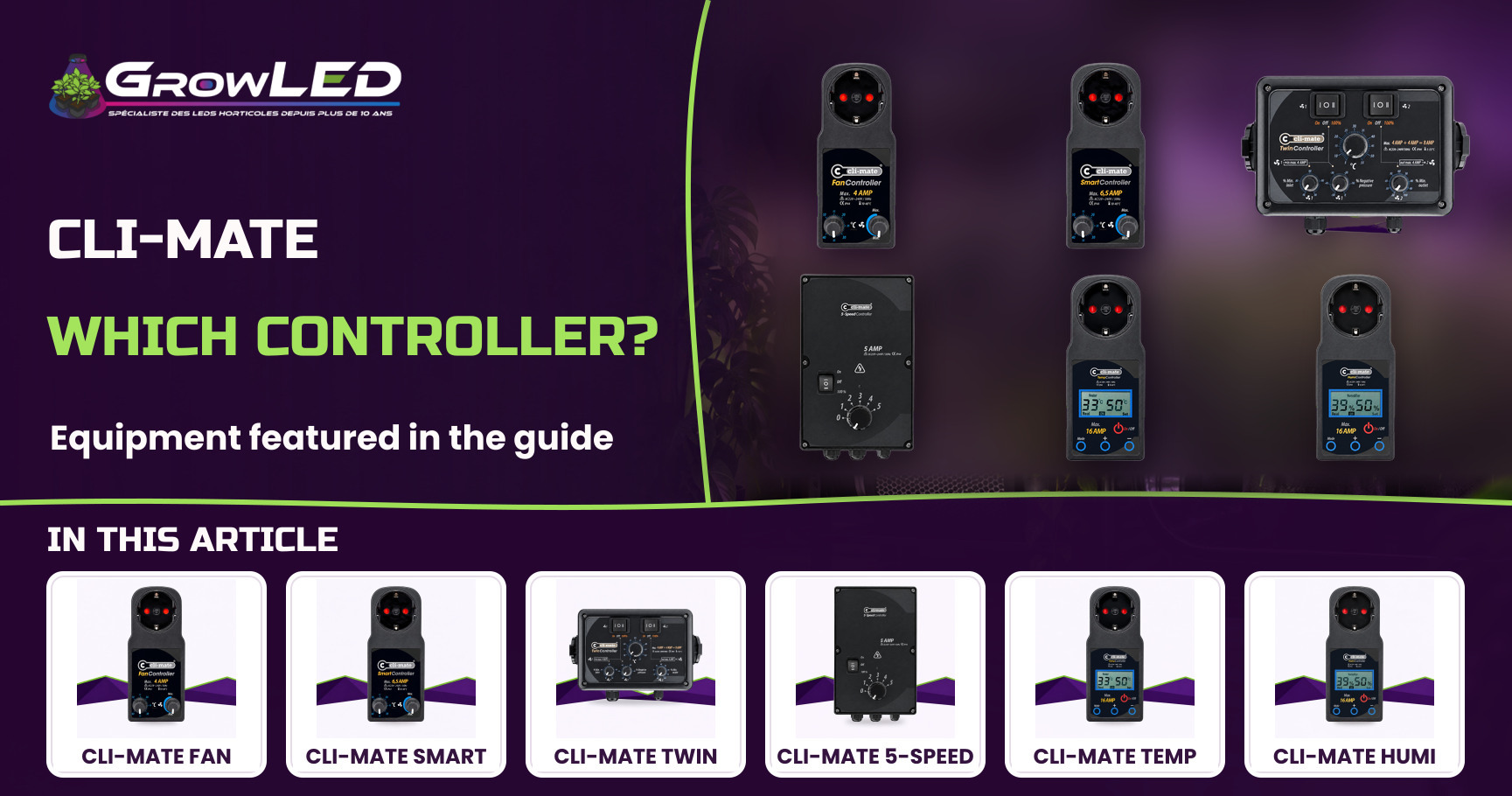
For an EC motor (ECblue, WHSP EC and EC-TC models), our rule is simple: use a controller designed for it, such as the Prima Klima ECTC 1M Digital. Its product sheet lists the compatible Prima Klima models: check that yours is on it. Controllers for AC-motor fans are covered in our article Cli-mate: which fan controller should you choose?, and full tent automation in Automating your grow tent.
In a greenhouse the logic is the same, and a separate controller is handier when the probe has to sit far from the fan. We have no numerical reference grid for greenhouses: volume, sunshine and vents all change the calculation, so ask us for advice before you buy.
Which equipment should you choose for your grow tent size?
The table lists the airflow targets calculated in the sizing article, for the hottest case (60 air changes per hour, with a carbon filter and ducting). The model airflows are the maximums stated on their product sheets.
| Tent (cm) | Volume | Airflow target | Typical diameter | Fan with built-in thermostat |
|---|---|---|---|---|
| 60 × 60 × 160 | 0.58 m³ | 52 m³/h | 100 mm | PK100-TC, 280 m³/h |
| 80 × 80 × 180 | 1.15 m³ | 104 m³/h | 100 mm | PK100-TC, 280 m³/h |
| 100 × 100 × 200 | 2.0 m³ | 180 m³/h | 100 mm | PK100-TC, 280 m³/h |
| 120 × 120 × 200 | 2.88 m³ | 259 m³/h | 125 mm | PK125-TC, 400 m³/h |
| 150 × 150 × 200 | 4.5 m³ | 405 m³/h | 125 or 150 mm | PK150-TC, 760 m³/h (the PK125-TC stops at 400 m³/h) |
The models to consider:
- Prima Klima PK100-TC: Ø 100 mm, 280 m³/h, 40 W, built-in thermostat. For small tents.
- Prima Klima PK125-TC: Ø 125 mm, 400 m³/h, 60 W, same principle for a medium tent.
- Prima Klima PK150-TC: Ø 150 mm, 760 m³/h, 110 W, for large tents.
- Cli-mate Smart: separate controller, 5 m remote probe, 3 °C hysteresis, 6.5 A, for an AC-motor fan.
- Prima Klima ECTC 1M Digital: two-channel separate controller for EC fans, with temperature, minimum and maximum speeds, and an external probe.
Browse the full range in the air extractors with temperature management and climate management systems categories. If you add a carbon filter, see the carbon filters category and our article the key role of the carbon filter.
How do you set the target temperature step by step?
A complete example: an 80 × 80 × 180 cm tent in the vegetative stage (airflow target: 104 m³/h from the table), with a PK100-TC or an AC-motor fan driven by a Cli-mate Smart.
- Measure first. Let a full cycle run, light on then off, with a min/max thermometer at plant height. Note the highest and lowest temperatures.
- Pick a target inside the air range. AC Infinity's VPD guide gives 21 to 27 °C for the air at every stage (table below). Aim for the fan to reach full speed before the tent goes above 27 °C. According to its product sheet, the Cli-mate Smart reaches its maximum 3 °C above the target, so set it to 24 °C (27 °C minus 3 °C). With a built-in thermostat, the manual explains how the unit speeds up: start near the top of the range, then adjust from your readings.
- Set the minimum speed, if your unit allows it. On the Cli-mate Smart it is one of the two knobs; for a built-in thermostat, the manual tells you whether this setting exists. Keep the lowest value that keeps the air moving and still pulls air through the carbon filter, then judge the noise by ear. If you need this setting and your fan does not offer it, that is a reason to choose a separate controller.
- Check over 48 hours. Record temperature and humidity, and compare them with the table below. If humidity falls below the range for the stage, the fan may be running too much: raise the target slightly or lower the minimum speed, while keeping the air temperature within range.
- Correct in small steps. Change one setting at a time, then wait for another cycle before judging.
| Stage | Relative humidity | Air temperature |
|---|---|---|
| Germination | 70 to 80% | 21 to 27 °C |
| Seedlings | 60 to 70% | 21 to 27 °C |
| Vegetative | 50 to 70% | 21 to 27 °C |
| Flowering | 40 to 60% | 21 to 27 °C |
Which mistakes should you avoid?
- Probe under the light. Lit up, it reads too hot and the fan runs flat out for nothing. Place it at plant height, in the shade of the foliage and away from the extracted air stream.
- Target set too low in summer. If the incoming air is warmer than the target, the fan stays at full speed all the time: more noise, and humidity that can fall below the range for the stage.
- A voltage-lowering speed controller on an EC motor. These motors carry their own electronics: they need a controller designed for them.
- A tight bend in the duct. According to AC Infinity, a 90° bend loses up to 60% of the airflow: remove it rather than compensate for it.
Frequently asked questions
Does a fan with a thermostat replace a thermometer?
No. It reacts to a single measurement at a single spot. A min/max thermometer at plant height shows what the crop really experiences, and lets you check your settings.
What target temperature should I set in a grow tent?
A target inside the 21 to 27 °C air range, whatever the stage. Set it so that the fan reaches full speed before 27 °C: 24 °C with the Cli-mate Smart, which reaches its maximum 3 °C above the target. Then adjust from your readings.
Where should I place the controller probe?
At plant height, out of the lamp's beam and away from the extracted air stream. A controller with a remote probe, such as the Cli-mate Smart with its 5 m cable, lets you choose that spot.
Can I connect a separate controller to any extractor fan?
No. Check the motor type: AC with a standard controller, EC with a dedicated controller. Also check that the controller's maximum current is above the fan's current draw, which is stated on its product sheet.
Does the fan run all the time?
It runs at the minimum speed you set while the tent is below the target, and speeds up above it. The exact behaviour depends on the model: read your unit's manual.
How much does it cost to run?
At €0.18/kWh (the rate we use for our examples), a 40 W fan running 24 hours a day at full speed uses 40 × 24 × 30 ÷ 1,000 = 28.8 kWh over a 30-day month, or €5.18. For 60 W, it is 43.2 kWh, or €7.78; for 110 W, 79.2 kWh, or €14.26. That is a ceiling: a controlled fan usually runs slower.
Do I need a different fan if I add a carbon filter?
Not necessarily, but you must redo the calculation: our grid adds 25% for the filter and 20% for the ducting, multiplied together. The details are in the sizing article.
Sources: AC Infinity, "VPD Chart: What It Is, How to Read It, and How to Use It" (humidity and temperature by stage); AC Infinity, "How to Calculate Required CFM for a Grow Tent" (ducting margin, losses in bends); Prima Klima and Cli-mate product sheets from the shop; shop rules (sizing and Cli-mate controller articles).