



































































Are you starting out in indoor growing and want to choose your LED light without getting lost in technical data? µmol/s (micromoles per second) is the key unit that reveals the real power of your grow light. This guide will walk you simply through how to interpret this measurement, compare the efficiency of different models, and properly size your setup to avoid unnecessary expense.
What is µmol/s in horticultural lighting?
When you check the specs of a grow light on GrowLED, you'll often see values like "1380 µmol/s." This is the photosynthetic photon flux (PPF), which indicates how many photosynthetic photons are emitted every second within the PAR spectrum (400-700 nm) - the range of wavelengths your plants use for photosynthesis. The higher this number, the more your lighting produces useful light for their growth.
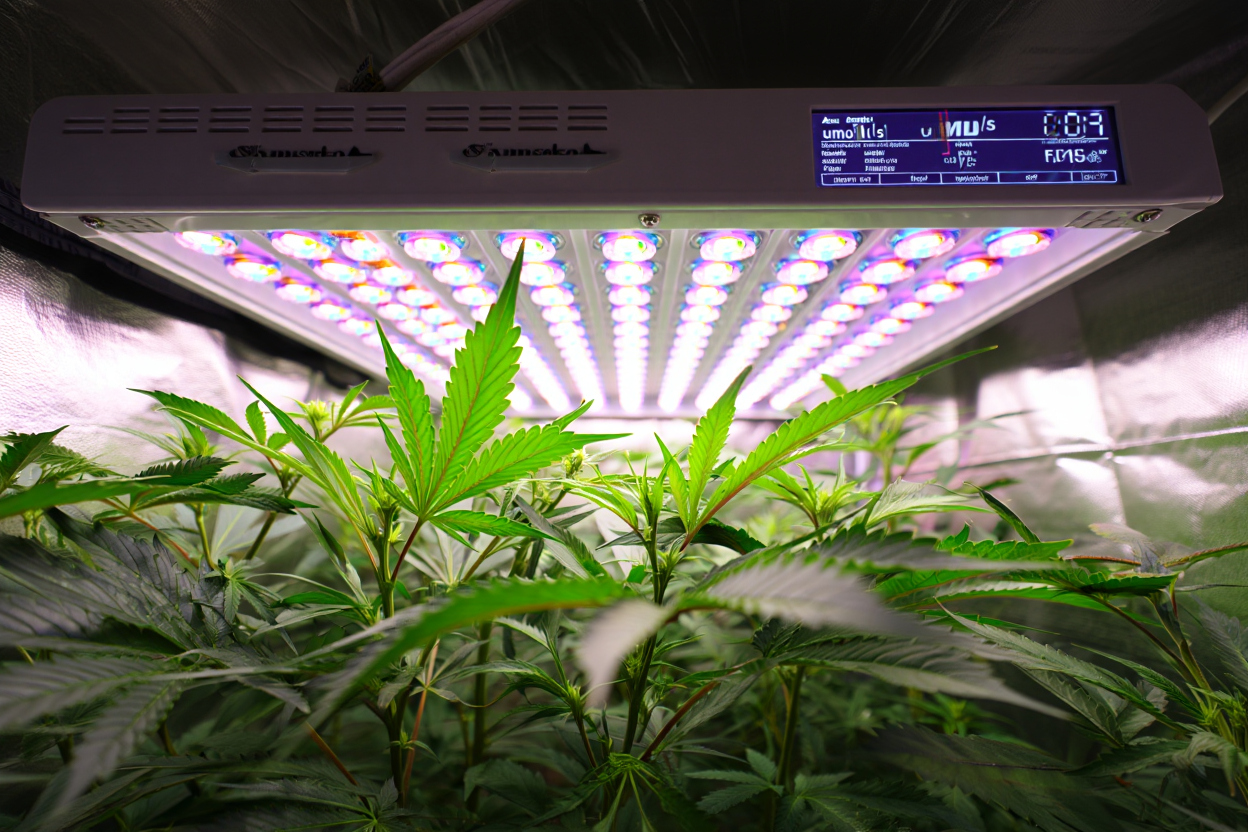
Technical definition of micromoles per second (PPF)
In concrete terms, the µmol/s definition corresponds to the number of micromoles per second of photons emitted within the photosynthetically active spectrum. Did you know a micromole represents about 602,200,000,000,000,000 photons? So a 1100 µmol/s light sends an astronomical quantity of light particles toward your crops every second! This measurement is a far better way to objectively evaluate a horticultural fixture than watts.
- Reliable measurement: Photon flux is measured in a lab using an integrating sphere that captures all the photons emitted by the light.
- Don't confuse the two: PPF (µmol/s) indicates what the light emits, while PPFD (µmol/m²/s) measures what a given area of your crop actually receives.
- Objective comparison: PPF lets you directly compare the photon output of horticultural LEDs, regardless of how they're installed.
At GrowLED, we select manufacturers who certify their PPF measurements in a lab. For example, the HLG 200 RSPEC offers a verified PPF of 495 µmol/s, ideal for a 60×60 cm micro-grow.
To assess energy efficiency, use this simple formula: efficiency (µmol/J) = PPF (µmol/s) ÷ electrical power (W). A light producing 2000 µmol/s for 800 W thus reaches 2.5 µmol/J, optimizing both output and consumption.
Difference between µmol/s (PPF) and other light units
Unlike lumens, which are designed for the human eye, PPF in µmol/s focuses solely on the wavelengths beneficial to plants. That's why a standard 3000-lumen bulb will never compete with a genuine LED grow light, even at equal power.
- PAR vs. human vision: Radiation in the PAR range (400-700 nm) differs from the human visible spectrum (380-750 nm), notably in that it isn't weighted for sensitivity to green.
- Approximate conversions: Lux/PPFD conversion coefficients vary depending on the light spectrum, making any estimate imprecise - it's better to measure directly in µmol.
- Mark of quality: Listing PPF on a spec sheet proves manufacturer transparency, unlike vague claims such as "600W HPS equivalent."
Our professional ranges (Lumatek, SANlight, HLG) always display their certified PPF, guaranteeing that their photonic performance exactly matches the stated figures.
Why PPF is essential for indoor growing
PPF is essential for designing an optimal setup: it defines the total amount of light available to your plants. Without this reference, there's no way to know whether your lighting will reach the recommended levels (400-600 µmol/m²/s during the vegetative stage, 600-950 during flowering).
Knowing the PPF and your grow area, you can estimate the average density: PPFD ≈ PPF ÷ given area (m²). For example, a Lumatek Zeus 600W (1380 µmol/s) covering 1 m² will deliver around 800-1000 µmol/m²/s - perfect for abundant flowering under an LED grow light.
How to evaluate the efficiency of a grow light
When choosing a grow light, energy efficiency matters just as much as total PPF. This figure, expressed in µmol/J, reveals how much photosynthetically active light is produced per watt consumed. The higher this value, the more efficiently the light converts electricity into photons useful to your plants, while generating less wasted heat.
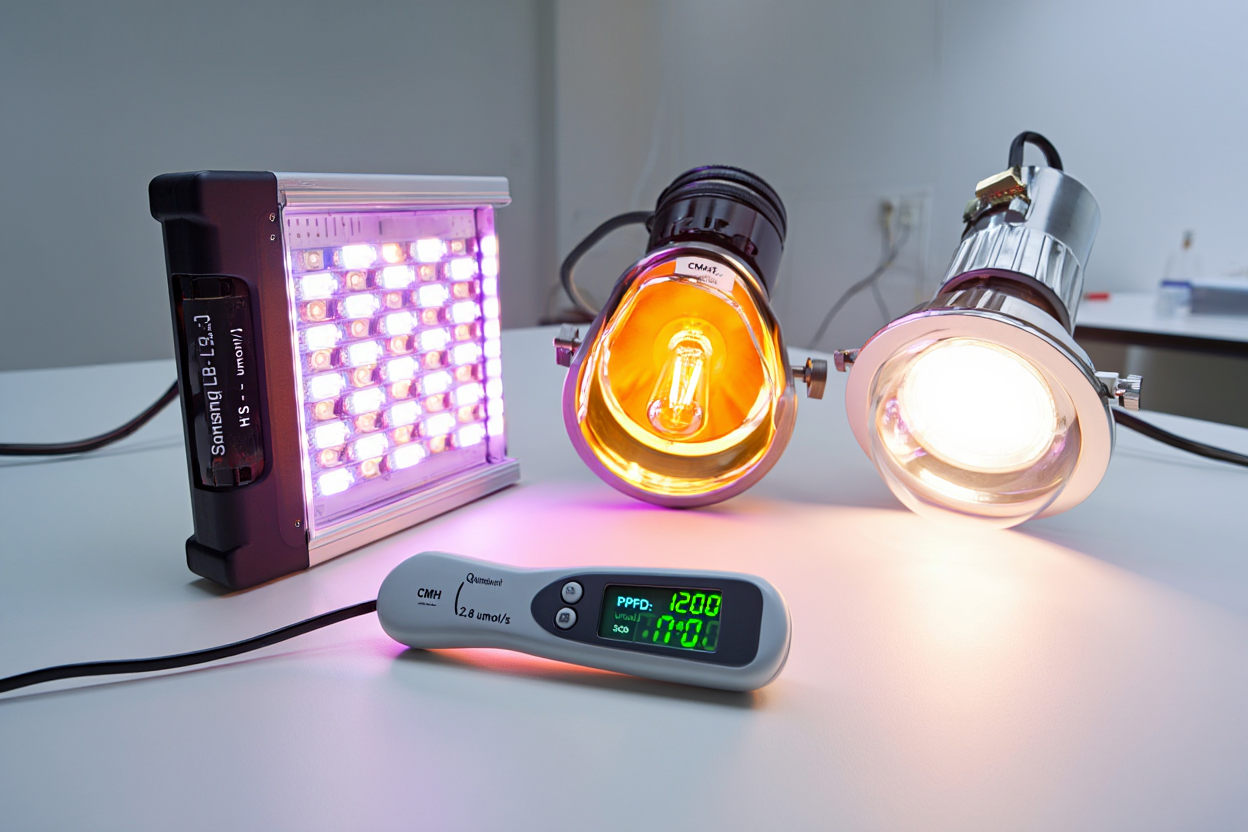
µmol/J: a key indicator of energy performance
µmol/J efficiency precisely measures the number of photons in the PAR range your system produces per joule of energy. For example, a value of 2.7 µmol/J means your lighting generates 2.7 micromoles of active photons for photosynthesis per joule spent. These figures directly help you optimize your energy costs and manage the temperature in your grow space.
To link PPF and efficiency, use this simple formula: PPF (µmol/s) = efficiency (µmol/J) × power (W). Take the Lumatek Zeus 600 W PRO: 2.7 µmol/J × 600 W = about 1620 µmol/s. This calculation tool is handy for quickly estimating a light's performance or sizing your setup.
| Technology | Typical efficiency (µmol/J) | Power for 1000 µmol/s | Advantages |
| LED Samsung LM301H | 2.5–3.1 | 323–400 W | Best efficiency, 50,000 h lifespan, adjustable spectrum |
| CMH (Ceramic Metal Halide) | 1.9–2.0 | 500–526 W | Natural spectrum, good canopy penetration |
| HPS (High Pressure Sodium) | 1.7–1.8 | 556–588 W | Attractive price, ideal for flowering |
| MH (Metal Halide) | 1.2–1.3 | 769–833 W | Spectrum suited to the vegetative stage |
Relationship between PPF, electrical power, and output
The influence of light on plants is determined by two factors: the available photon flux and the composition of the spectrum. Our tests show that increasing efficiency from 2.3 to 2.8 µmol/J boosts photon flux by 22% without touching electrical consumption. You can then either light a larger given area or intensify the PPFD to further stimulate photosynthesis.
Careful: the overall efficiency of a system combines several elements. It's calculated as follows: efficiency (system) = efficiency (LEDs) × driver efficiency × efficiency (optics). Take a Lumatek panel with high-end components as an example: 2.5 µmol/J × 0.94 × 0.90 ≈ 2.11 µmol/J of real-world output.
Current settings also greatly influence performance. A Samsung LM301H LED delivers close to 3.0 µmol/J at 350 mA, but only 2.3 µmol/J when pushed to 1050 mA. That's why our fixtures run at moderate currents, guaranteeing both excellent efficiency (>2.5 µmol/J) and an exceptional lifespan (50,000 hours).
Comparing LED, HPS, CMH, and MH technologies
Modern horticultural LEDs (2.3–3.1 µmol/J) use 40 to 70% less energy than HPS/MH solutions. Producing 1000 µmol/s takes about 400 W with LED versus 556 W with HPS. These savings become substantial after just a few grow cycles, not to mention the reduced cooling needs.
- Monochromatic vs. full-spectrum LEDs: Monochromatic LEDs maximize efficiency by targeting specific wavelengths. Full-spectrum versions, while still very high-performing (>2.5 µmol/J), offer more versatility.
- CMH, a balanced alternative: With 1.9–2.0 µmol/J and a spectrum close to natural light, it's a good compromise for demanding growers.
- HPS, the safe bet: Even at 1.7–1.8 µmol/J, its red-rich spectrum gives excellent flowering results, but it requires a powerful ventilation system.
- Unmatched lifespan: LEDs last 50,000 hours, several times longer than other technologies, cutting down on replacement costs.
In concrete terms, an HLG 200 RSPEC (495 µmol/s at 2.52 µmol/J) perfectly lights a 60×60 cm space. The Lumatek Zeus 600 W PRO 3.1 (1990 µmol/s at 3.1 µmol/J) covers 1.2 m² during flowering with a PPFD of 800–950 µmol/m²/s. To better understand how performance has evolved across the different Zeus versions, check out our detailed analysis comparing the µmol/s of each model.
Sizing your LED lighting to optimize growth
To convert theoretical PPF into PPFD actually absorbed by your plants, you need to understand how photon flux spreads across the given area of your grow space. Several factors affect light intensity: the distance between the light and the plants, the angle of the LED diodes, and the presence of reflective surfaces. Our GrowLED lighting solutions let you precisely hit the recommended PPFD levels for each stage of plant growth.
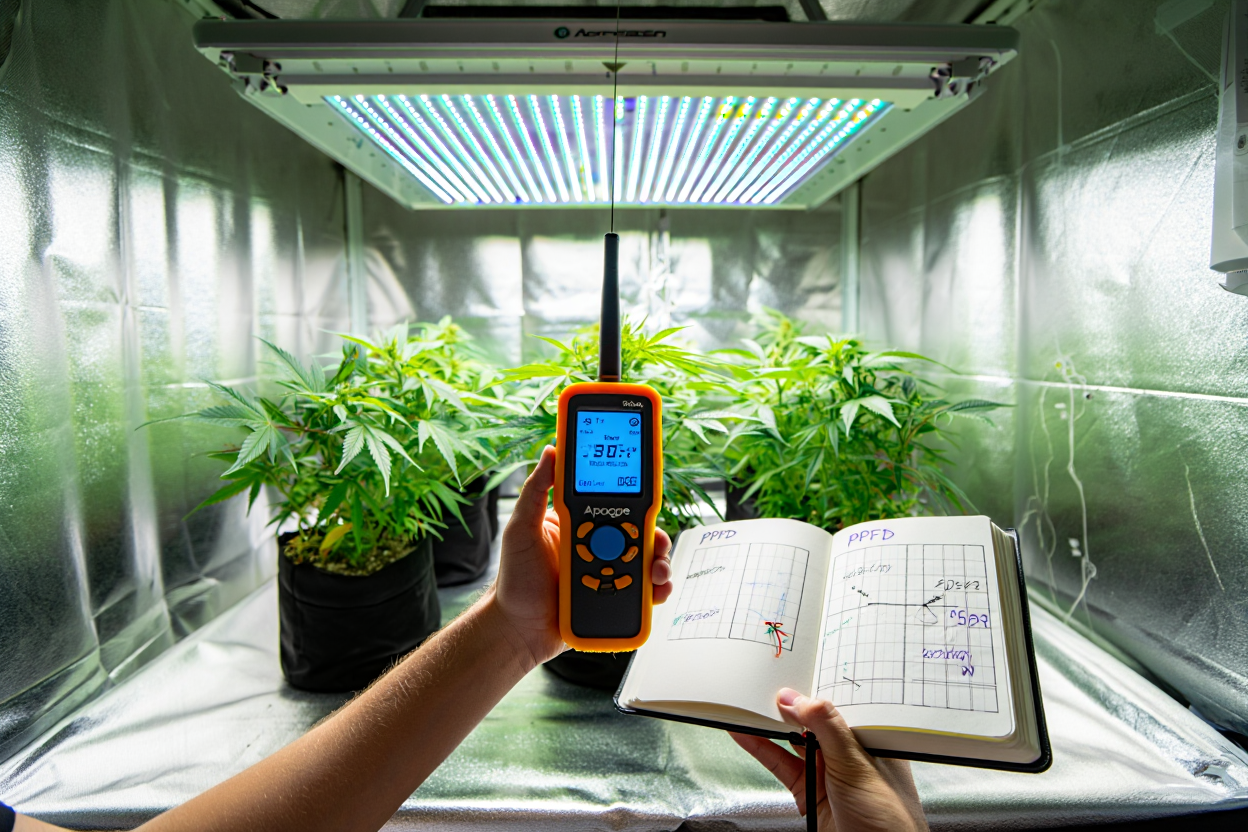
From PPF to PPFD: calculating the light intensity received
Unlike PPF, which measures the total photon flux emitted, PPFD quantifies the amount of photons actually received by the canopy. While in theory PPFD = PPF ÷ area, in reality losses occur (absorption, reflection...). Depending on your setup, the utilization coefficient of a natural or artificial light source varies between 0.5 and 0.9 - a key parameter for accurate calculations.
- Practical formula: real PPFD ≈ (PPF × utilization coefficient) ÷ area. Example: our Lumatek light shows ~1012 µmol/m²/s of average PPFD after correction.
- Ideal distance: The farther away your LED grow light is, the wider the coverage area, but the intensity at the center drops. We recommend 45-75 cm depending on the model.
- Precise measurements: Use a quantum meter every 30 cm to map the light distribution and adjust the height.
- Optimization: Reflective surfaces such as Mylar can increase the coefficient up to 0.8 by redirecting photons back onto the plants.
Take the HLG 200 RSPEC as an example: positioned at 45-60 cm, it delivers 400-600 µmol/m²/s of average PPFD over 0.36 m² with uniformity above 85%. For a larger given area, favor several lights rather than a single one for even lighting.
PPFD targets by plant growth stage
The effect of light on plant growth varies with each development phase: young seedlings need 200-400 µmol/m²/s, while flowering thrives between 600-950 µmol/m²/s. Be careful, though: beyond 1000 µmol/m²/s without added CO₂, you risk photosynthetic saturation and unnecessary stress.
- Start-up: 200-400 µmol/m²/s - keep the light at 75-90 cm to protect the fragile photosynthetic activity.
- Vegetative stage: 400-600 µmol/m²/s with a dominant blue spectrum to thicken the structure (position at 60-75 cm).
- Flowering: 600-950 µmol/m²/s with red dominance - keep the light at 45-60 cm while monitoring temperature.
Our full-spectrum GrowLED lights combine high efficiency (2.5-3.1 µmol/J) with full spectrum coverage (400-750 nm). This technology recreates an optimal natural and artificial light source that stimulates photosynthesis while simplifying your setup (no need to swap lights between phases).
A practical method for choosing your grow lights
To choose well, start by calculating the PPF you need: PPF ≈ (target PPFD × area) ÷ 0.7 (average coefficient). Example: getting 600 µmol/m²/s over 1 m² requires about 857 µmol/s. Then compare the efficiency of different models to optimize electricity use and heat management.
Real-world examples:
- For a 60×60 cm space targeting 700 µmol/m²/s: an HLG 200 RSPEC (495 µmol/s) is more than enough.
- Over 1.2 m² at 800 µmol/m²/s: choose the Lumatek Zeus 600W (1380 µmol/s) or the PRO 3.1 for extra headroom.