





































































Looking to give your indoor alocasias the perfect lighting so they can reveal their full potential? This guide reveals the recommended PPFD values suited to each growth stage, along with the essential lighting settings for lush leaves, vibrant colors, and dynamic growth.
What PPFD Values for Your Alocasia
Unlike tropical plants used to full sun, alocasias prefer soft but consistent light. The most common varieties thrive perfectly with a PPFD between 100 and 300 μmol·m⁻²·s⁻¹ - an intensity similar to that of a forest clearing.
PPFD by Alocasia Growth Stage
Each stage of development requires a specific PPFD to avoid light stress while encouraging deep rooting. Young shoots (0-3 months) develop best between 80 and 150 μmol·m⁻²·s⁻¹, allowing for harmonious, gradual growth.
- Baby plants (0-3 months) : 80-150 μmol·m⁻²·s⁻¹ for 12-14 hours daily for a gentle start without light stress.
- Active growth phase (3-12 months) : 200-350 μmol·m⁻²·s⁻¹ over 14-16 h/day, perfect for foliage development and stem elongation.
- Adult plants (>1 year) : 300-500 μmol·m⁻²·s⁻¹ for 12-14 h to maintain optimal photosynthesis and a compact structure.
- Dormancy period : 80-120 μmol·m⁻²·s⁻¹ over 8-10 h to support natural winter slowdown.
To stimulate the emergence of new leaves, you can temporarily increase the PPFD to 350 μmol·m⁻²·s⁻¹ for 15-20 days, then return to 200-250 μmol·m⁻²·s⁻¹ once the young shoots are well formed.
Optimal Values for Mature Plants and Young Plants
The ideal range for an adult alocasia is between 250 and 350 μmol·m⁻²·s⁻¹ - a perfect compromise between vigorous growth and energy savings. These recommended PPFD values ensure spectacular foliage, intense coloring, and overall robustness without excess light.
Above 500 μmol·m⁻²·s⁻¹, your alocasias won't get any benefit and risk visible burns (brownish edges, necrotic spots). Conversely, below 50 μmol·m⁻²·s⁻¹, you'll see stem stretching, yellowing foliage, and poor growth.
For cuttings, start at 50 μmol·m⁻²·s⁻¹ and gradually increase by 25 μmol·m⁻²·s⁻¹ each week until reaching adult values - this gentle progression protects fragile roots and accustoms the plant to stronger intensities without shock.
PPFD Suited to Each Alocasia Variety
Different alocasia varieties have unique light requirements. Species with large, dense foliage generally need a higher PPFD than those with smaller, more compact leaves. Adjust your lighting accordingly to provide optimal conditions without excess.
Specific Needs of Alocasia Frydek and Cuprea
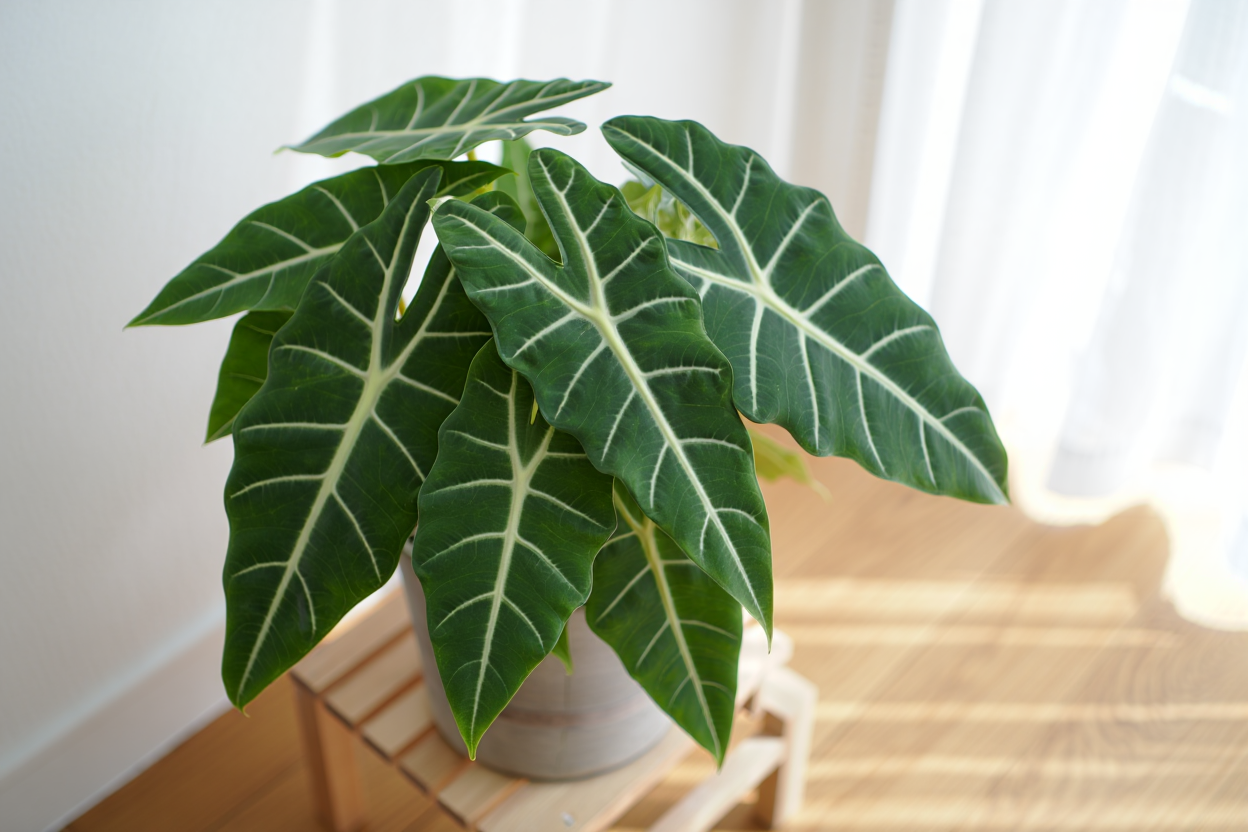
The alocasia frydek, recognizable by its superb dark green velvety foliage streaked with white veins, is satisfied with a moderate PPFD (50-150 μmol·m⁻²·s⁻¹). This plant particularly enjoys the soft light of east- or west-facing exposures.
More compact, the alocasia cuprea with its magnificent metallic sheen needs about 80 μmol·m⁻²·s⁻¹, while the imposing macrorrhiza requires up to 300 μmol·m⁻²·s⁻¹ to develop its giant leaves.
| Alocasia Variety | Recommended PPFD (μmol·m⁻²·s⁻¹) | Lighting Duration | Notes |
| Alocasia Frydek | 50-150 | 10-12 h/day | Delicate foliage, enjoys bright shade |
| Alocasia cuprea | 80-120 | 10-12 h/day | Characteristic coppery sheen |
| Alocasia macrorrhiza | 250-300 | 12-14 h/day | High light requirement |
| Alocasia zebrina | 150-250 | 12-14 h/day | Unique zebra-striped petioles |
| Alocasia velvet (Black Velvet) | 80-150 | 10-12 h/day | Black velvety leaves, gentle light |
Optimal Placement Based on Available Indoor Space
For an alocasia frydek, a spot 1 meter from an east- or west-facing window naturally provides the lighting needed. In a dimmer space, a 30W LED grow light placed 35cm away will compensate perfectly.
- Bright living room : Position the plant 1-1.5m from windows to naturally get 80-120 μmol·m⁻²·s⁻¹.
- Dim space : Supplement with a 20W full-spectrum LED placed 30cm away.
- Windowless room : Choose a more powerful LED system (50-100W) at a distance of 40-50cm.
- Bright bathroom : The humidity combined with a 30W grow light creates an ideal environment.
During winter, compensate for the lack of natural light with 6 extra hours of artificial lighting (about 60 μmol·m⁻²·s⁻¹). To encourage flowering in rare varieties, a temporary light boost of 350-450 μmol·m⁻²·s⁻¹ for two weeks can prove effective.
LED Equipment and PPFD Settings for Alocasia
Choosing high-performance LED lighting and properly adjusting the distance between the lamp and the plant can completely transform their indoor growth. At GrowLED, we offer grow panels specially designed for shade-loving tropical plants like alocasia frydek, ppfd anthurium, and monstera ppfd.
Professional LED Panels Suited to Aroids
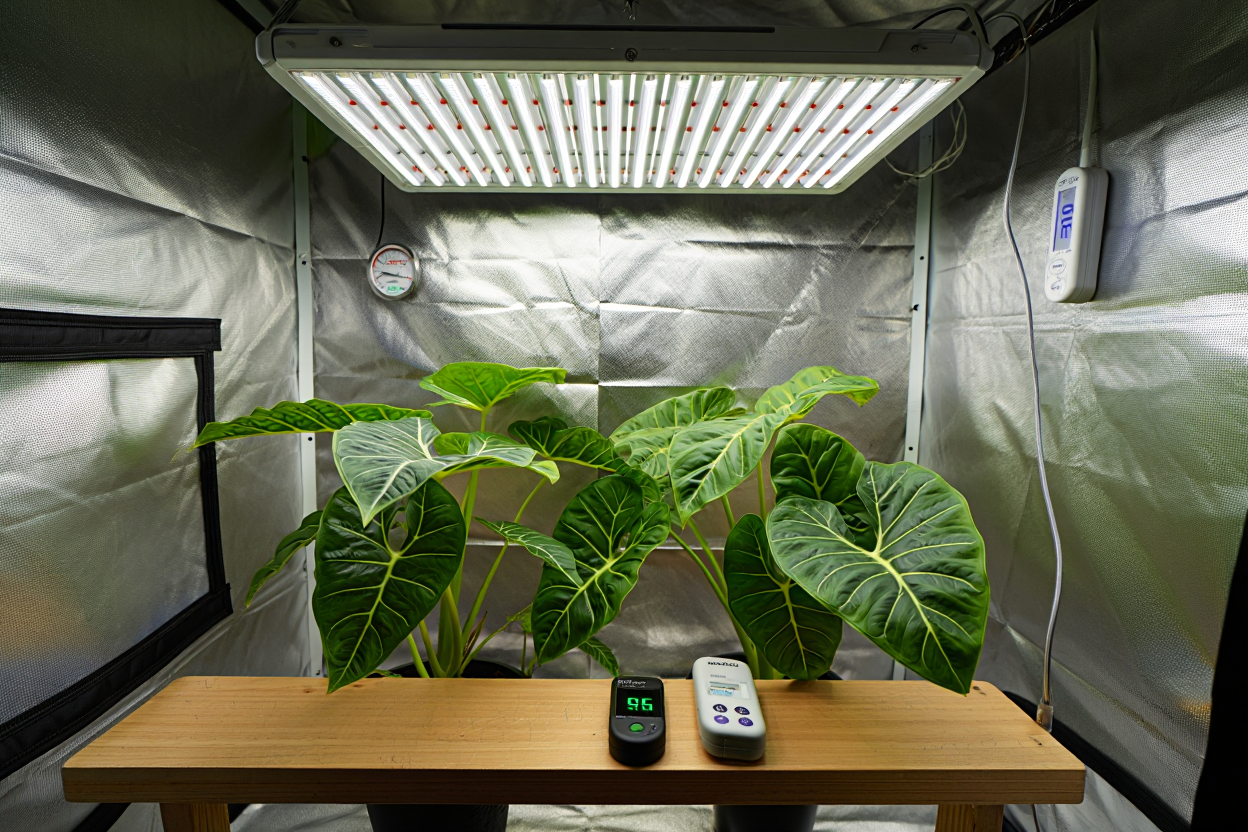
Our ATS 200W PRO model delivers about 180 μmol·m⁻²·s⁻¹ at 30 cm over an area of 0.4 m² - ideal for two or three plants. At 45 cm, the intensity drops to 120 μmol·m⁻²·s⁻¹, which suits species like alocasia frydek or ppfd anthurium that prefer soft light.
To cover 1 m², two Zeus 465 PRO panels installed at 35 cm produce about 250 μmol·m⁻²·s⁻¹, lighting suited to alocasia macrorrhiza and mixed collections. Their full spectrum (400-700 nm) offers excellent energy efficiency (2.0-2.5 µmol·J⁻¹) while effectively driving photosynthesis.
- ATS 200W PRO : 180 μmol·m⁻²·s⁻¹ at 30 cm, 120 μmol·m⁻²·s⁻¹ at 45 cm, covers 0.4 m², 0-100% dimmer.
- Zeus 465 PRO (x2) : 250 μmol·m⁻²·s⁻¹ at 35 cm, covers 1 m², spectrum optimized for growth.
- Lumatek 100W bars : Side lighting 20 cm from the foliage, adds 20-30 μmol·m⁻²·s⁻¹ in shaded areas.
- 20-30W full-spectrum LED : Compact solution for small spaces (≤10 m²), 80 μmol·m⁻²·s⁻¹ at 30-40 cm without overheating.
Thanks to the dimmer, you can reduce the intensity to 40% in winter (60-80 μmol·m⁻²·s⁻¹) during the dormancy period, then gradually increase to 80-100% in spring to restart growth. These handy settings avoid having to constantly move the lamps.
Distance and Positioning of Grow Lights
On average, hang your LEDs 30-45 cm from the foliage to get 250-300 μmol·m⁻²·s⁻¹. Moving them closer increases the PPFD, but pay attention to the specific needs of your monstera ppfd or alocasia to avoid light stress.
- 30 cm : About 400 μmol·m⁻²·s⁻¹ - reserved for large species like alocasia macrorrhiza.
- 45 cm : About 200 μmol·m⁻²·s⁻¹ - perfect for maintaining intermediate varieties.
- 60 cm : 120-150 μmol·m⁻²·s⁻¹ - ideal for young plants or sensitive species like alocasia frydek.
Install a matte white reflector behind your LEDs to gain 15-20% more PPFD through reflection. In a small space (≤10 m²), a simple 20W full-spectrum LED at 35 cm provides about 80 μmol·m⁻²·s⁻¹, without risk of overheating or excessive power consumption.
Comparison with Anthurium and Monstera in PPFD
Alocasias generally need 20-30% less PPFD than monstera and anthurium to grow well. While an adult monstera deliciosa enjoys 300-400 μmol·m⁻²·s⁻¹, an alocasia of similar size is satisfied with 200-300 μmol·m⁻²·s⁻¹. For uniform lighting, place your alocasia slightly farther away than your monstera under the same lighting setup.
Measuring and Adjusting the PPFD of Your Alocasia
Regularly monitoring light intensity is essential to effectively adjust lighting based on your plant's response. A well-tuned setup promotes faster growth and denser, more colorful foliage within just a few weeks.
PPFD Measurement Tools and DLI Calculation
For an accurate PPFD measurement, use a calibrated PAR meter such as the Apogee MQ-200. Position it at the level of the upper leaves and take readings at the center, at the edges, and in shaded areas to check for even distribution (±10% maximum).
- Professional PAR meter : Apogee MQ-200 or equivalent, ±5% accuracy, direct readout in μmol·m⁻²·s⁻¹
- Smartphone app : Photone (iOS/Android) configured for your LED type, ±15% error tolerance for amateur use
- Weekly check : Measure systematically during the first 4 months to account for gradual diode degradation
The DLI calculation uses the formula: DLI = (average PPFD × lighting duration) / 1000 in mol·m⁻²·day⁻¹. For example, a PPFD of 250 μmol·m⁻²·s⁻¹ for 12 hours gives a DLI of 10.8 mol·m⁻²·day⁻¹, perfect for an alocasia in the active growth phase.
If your DLI is below 8 mol·m⁻²·day⁻¹, increase the PPFD by 20-30 μmol·m⁻²·s⁻¹ by moving the lamp 5 cm closer, or extend the lighting duration by 2 hours. Then set a cycle of 12-14 hours of light at the desired intensity followed by 10-12 hours of complete darkness to avoid any light stress.
Visual Signs of Too Much or Too Little Light
Your plant communicates through its foliage - learn to read these signals to adjust the PPFD calculation before the damage becomes irreversible. Quick action can often fix the problem in just a few days.
- Lack of light : Small, discolored leaves, slowed growth, stems stretching abnormally toward the light source
- Excess light : Browned leaf edges, leaves curling downward, yellowed tips, appearance of brown spots
- Brown spots + dry substrate : Reduce the intensity or lighting duration by 20% and keep the temperature below 28°C
- Vigorous new growth but yellowed leaves : Gradually increase the PPFD by 10-15 μmol·m⁻²·s⁻¹ over 7 days
If the upper leaves are declining despite adequate watering, first increase the PPFD by 10-15% or move the lamp 5 cm closer, then observe the change over a week. Above 28°C, reduce the intensity by 10% or move the light source slightly farther away.
Seasonal Adjustments and Acclimation Protocol
Light needs vary with the seasons: plan for 100-130 μmol·m⁻²·s⁻¹ over 12-14h in spring/summer, then gradually reduce to 70-90 μmol·m⁻²·s⁻¹ over 8-10h in autumn to prepare for the dormancy period.
In winter, maintain 50-70 μmol·m⁻²·s⁻¹ over 6-8h, unless you want continuous growth (in that case keep 100-120 μmol·m⁻²·s⁻¹ with a stable temperature of 22-24°C). Always adjust the intensity in steps of 20% maximum per day to avoid stress. Clean your LEDs regularly (10-15% loss of output after 6 months) and watch for annual aging (5-8% decrease) to maintain optimal PPFD, 60-80% humidity, and a temperature of 22-27°C.