



































































Do you want to know which light color is best suited to get your seedlings off to a strong start? This question comes up often when growing indoors: should you favor blue light, red, or a full spectrum? We'll break down each part of the light spectrum for seedlings and give you our tips for optimal lighting that will guarantee sturdy, well-developed seedlings.
Lamp and spectrum for indoor seedlings
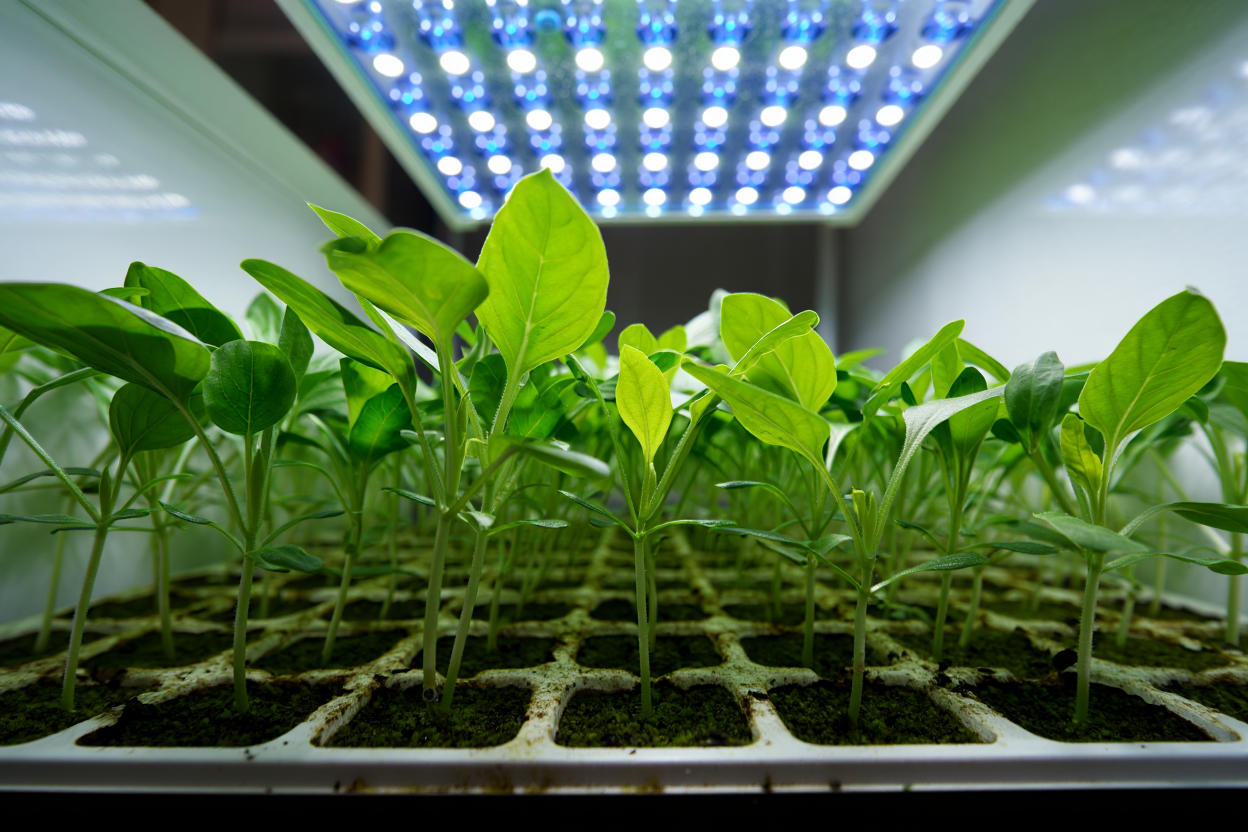
For young shoots, the light spectrum must avoid stretching and promote sturdy stems. A dominant blue light (400-500 nm) is ideal because it activates chlorophyll production and stimulates compact growth. This type of lighting, close to natural morning light, encourages seedlings to develop dense foliage rather than stretching excessively.
Which light color to choose
To succeed with your seedlings, it's crucial to adapt the light spectrum to each growth phase. During the first few days, blue light (400-500 nm) is essential. A cool white (5000-6500 K) naturally offers a good proportion of blue while staying gentle. This spectrum strengthens chlorophyll, stimulates rooting and prepares sturdy stems for vigorous growth.
- Blue spectrum (400-500 nm): speeds up germination, limits stretching and promotes dark green foliage. Should be favored during the first two weeks.
- Cool white spectrum (5000-6500 K): reproduces balanced natural light with blue, green and red. Perfect for continuous growing.
- Red spectrum (620-660 nm): useful after the first week to stimulate cell elongation. Should be introduced gradually to avoid too rapid growth.
- Ideal blue/red ratio: start with 70% blue and 30% red, then adjust toward 1:2 (red/blue) during early growth.
This dosage ensures solid root development while avoiding premature bolting. Adapt the distance and intensity based on how your plants react: pale leaves? Bring the lamp closer. Burnt edges? Move it slightly further away. Watch your seedlings closely and fine-tune your settings over the following days.
Recommended duration and intensity
For optimal germination and start-up, expose your seedlings to 16-18 hours of blue light per day, followed by 6-8 hours of darkness. This cycle reproduces the long days of spring and boosts the energy production (ATP) needed by young roots. For intensity, aim for 100-200 µmol·m⁻²·s⁻¹ (up to 300 µmol for demanding species) and use a programmable lamp for consistent exposure.
Lamp distance and signs of stress
Place the lamp 20-30 cm above the seeds at first, then adjust based on the plants' growth. Distance affects light intensity (PPFD): the closer the lamp, the more blue light dominates and the higher the intensity. Watch your seedlings closely to detect and quickly correct any sign of light stress.
Pale or yellowish leaves? The intensity is too low: bring the lamp closer in 5 cm steps and check the progress after 48h.
Burnt edges or discoloration? A sign the light is too intense: move the lamp further away or reduce its intensity by 10-20%.
Overly thin stems indicate a lack of blue light, while compact seedlings with short internodes confirm a good setting. Keep a daytime temperature of 22-24°C to limit the water stress increased by blue light.
Spectrum and purple light in indoor growing
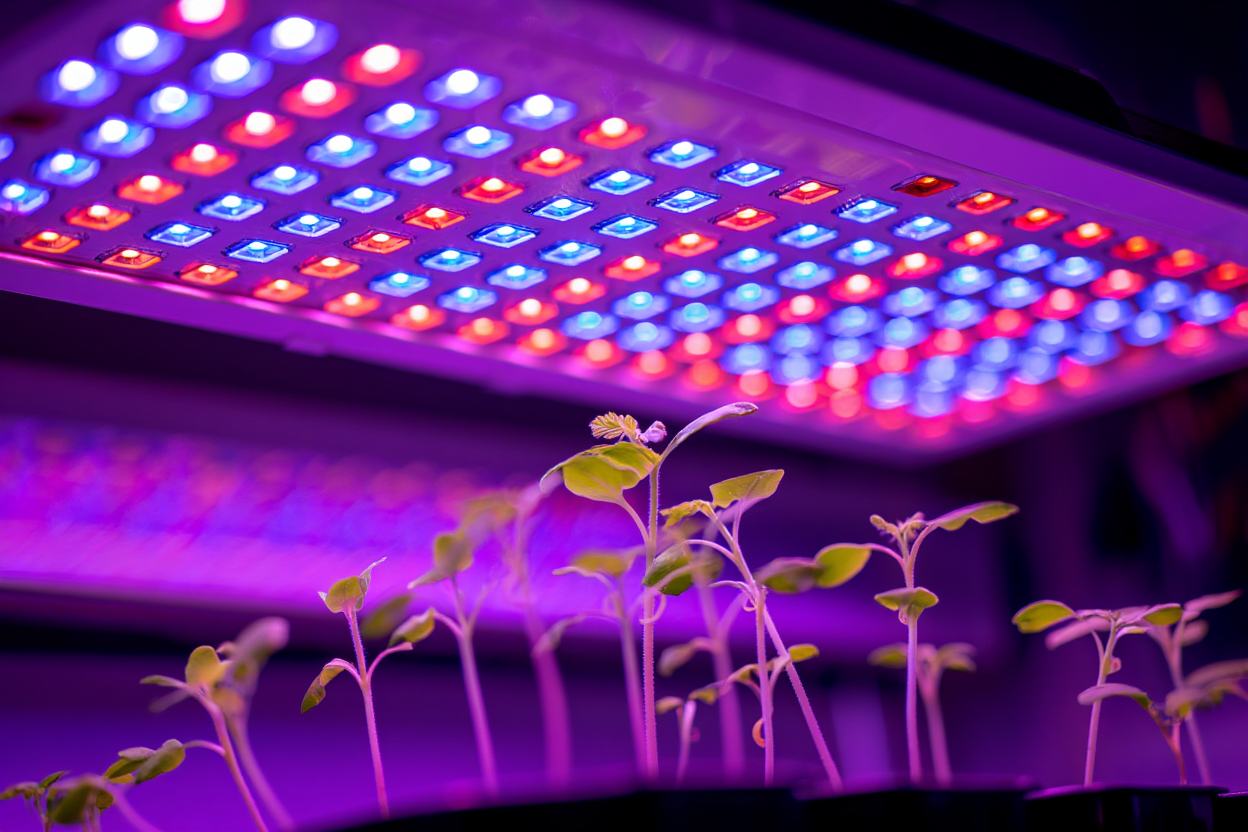
Have you ever noticed that strange purple light given off by some grow lights? This characteristic hue comes from a clever mix of blue and red diodes, perfectly matched to chlorophyll's absorption peaks. Although artificial in appearance, this combination offers remarkable photosynthetic efficiency when properly dosed. Let's find out when to boost the red and compare this targeted spectrum with full-spectrum white light for your seedlings.
When to add red
Red, located between 620 and 660 nm, plays a secondary role during germination but becomes crucial as soon as the first true leaves appear. This is when the plant strengthens its stem, develops its roots and prepares for vegetative growth. Adding red then optimizes growth significantly. The purple light you observe results precisely from this clever dosage between blue and red, adjusted week after week to support the plant's development.
- Days 1 to 7: Favor a blue-dominated spectrum (70-80%) to avoid stretching and promote dense foliage, with red being optional at this stage.
- Days 8 to 14: Start gradually introducing red until you reach a ratio of 30% red to 70% blue, which strengthens the stems and activates root development.
- From week 3 onward: Gradually increase the proportion of red (40-50%) while keeping enough blue to limit excessive elongation.
- Practical case: Adding a 5W red diode at 660nm for 4 hours a day starting on day 10 can increase tomato seedling biomass by up to 20%, while maintaining good compactness.
This gradual transition between the different wavelengths lets you perfectly adapt the light to the plant's changing needs and ideally prepares for future flowering. Watch the leaf color and the spacing between nodes closely to precisely adjust the ratio between blue and red.
Daylight white vs. grow-light purple
Full-spectrum white light (5000-6500K) covers the entire range of wavelengths (400-700 nm) including green, which improves light penetration into the foliage. This versatile solution avoids having to change lamps between the different growth phases, making it an ideal choice for beginner growers. In contrast, LED grow lights producing mostly purple light specifically target chlorophyll's absorption peaks, offering maximum efficiency but requiring more precise adjustment of the blue/red ratio.
For seedlings, white light is generally still recommended because it provides enough blue for germination, an appropriate dose of red for early growth, and a touch of green that's beneficial for internal communication within plant tissues. You can then switch to a more specialized spectrum (purple) around the third week if your goal is to optimize growth and then flowering. For example, a 200W lamp at 5000K placed 45 cm away will deliver around 200 µmol·m⁻²·s⁻¹, perfectly suited to a 60 x 60 cm tray with no noticeable shaded area.
White light also has the advantage of faithfully rendering the natural colors of plants, making it easier to diagnose deficiencies or stress. With full-spectrum LED grow lights, you get an ideal balance between red, blue and green, letting you grow from seedling to flowering indoors with no equipment changes or multiple setups.
Choosing your indoor grow light
Given the variety of models available (E27 bulbs, LED bars and dimmable panels), finding the best lamp for seedlings that suits your needs and budget isn't always easy. Each type of lighting covers specific dimensions, directly impacting light efficiency and your growing results. Let's look together at how to choose well to optimize the growth of your young plants, with practical tips and concrete examples.
Bulbs, bars or panels
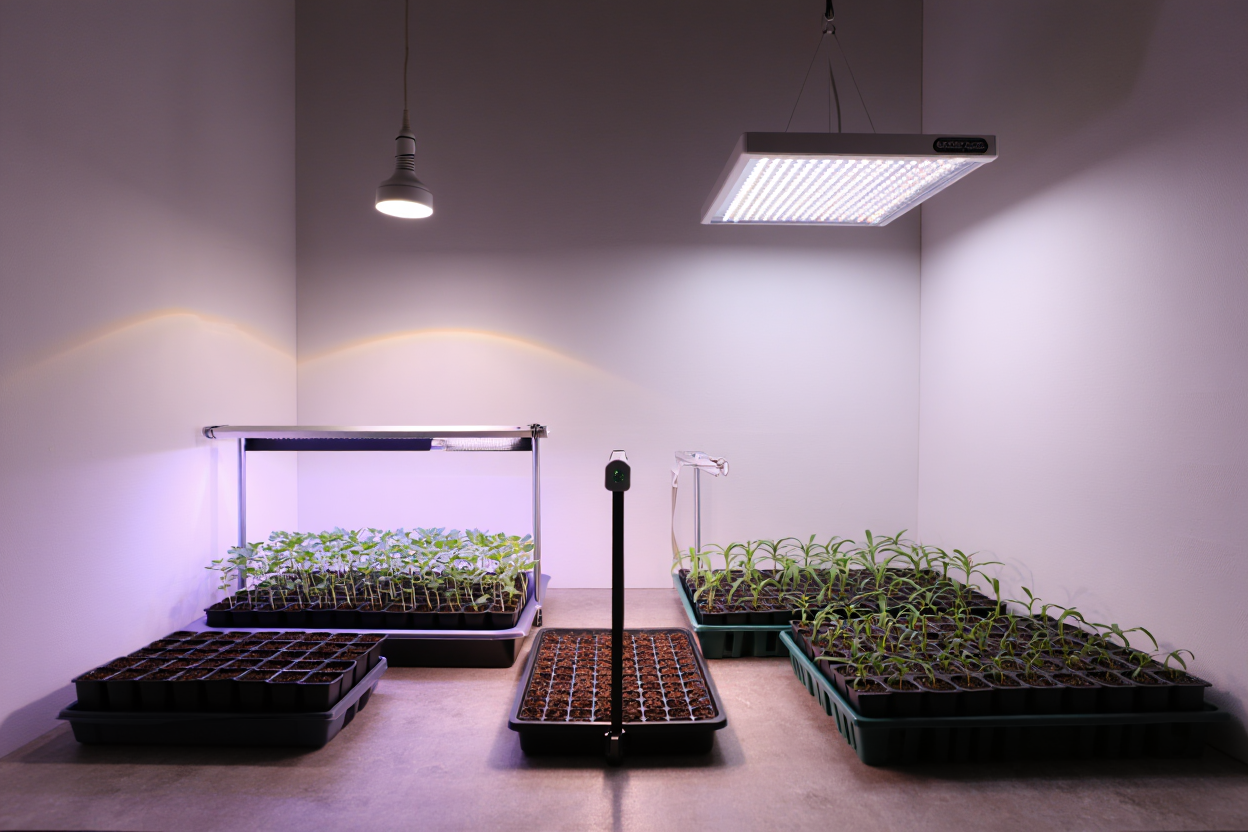
For a small space like a shelf or a 50 x 20 cm tray, a simple 20 W full-spectrum E27 LED bulb is often the best compromise, combining ease of installation with an affordable price. Fit it into a standard socket, position it between 20 and 30 cm above the seedlings, and program 16h of daily lighting: your seedlings will benefit from a good balance between red and white light, ideal for germination and the first growth stages.
6500 K LED bars (2000 lumens minimum) offer an economical solution for larger crops or plants reaching 30 cm. Place them 30-45 cm high for even lighting. As for full-spectrum dimmable LED panels, they're perfect for spaces up to 1 m²: you can adjust intensity (30-100%) and height in steps for a perfect fit to your indoor growing needs.
Distance and dimmer settings
To get the full benefit of your grow light, you need to match the power to your plants' development. Start with 30-40% intensity for the first few days, then gradually increase by 10% per week until reaching 80-100% before transplanting. This gentle progression, combined with a full spectrum, promotes solid rooting and vigorous foliage.
The distance between the light source and the plants is decisive: below 20 cm, risk of burns; beyond 40 cm, lack of light and stretching. Start at 20-30 cm, observe the reactions for two days, then fine-tune the position with small adjustments. A reflector helps even out the lighting, while a temperature of 20-25°C and 70-80% humidity reduce the effects of stress caused by blue lighting.
Indoor tomato seedlings
Although classed among fruiting vegetables that are demanding in terms of light, tomato requires precise lighting: 150-200 µmol/m²/s for 16h a day to develop sturdy stems. During the first few days, favor the blue spectrum (6500K) to avoid stretching, then gradually introduce red starting on day 10 to prepare for vegetative growth.
Place your lamp at 25-30 cm, with intensity starting at 40% the first week, then gradually increasing. Pale leaves? Move it 5 cm closer or slightly increase the power. Curling edges? Move it further away or reduce the intensity. A slight nighttime temperature drop (18-20°C) strengthens the tissues.
To optimize growth, add about 30% red to the spectrum as soon as the first two true leaves appear: this can boost biomass by 15-20% while keeping good compactness. Our gvline 14W solution, combining balanced white with red diodes and a built-in timer, is the best grow light for a standard tray: within three weeks at most, you'll get sturdy plants with dense foliage.
Lighting solutions for indoor growing
Now that we've covered spectrum and light intensity, let's see how to put them into practice with lamps tested under real conditions. Our GrowLED team tests every setup on different species to give you reliable advice that's easy to put into practice in your grow space.
Concrete settings with LED panels
The Quantum Max 150W panel, fitted with Samsung diodes, offers a full spectrum (400-700 nm) perfect for guiding your seedlings from germination to growth without changing lighting. Start with 30% power at 45 cm (about 200 µmol/m²/s), then gradually increase the light intensity while bringing the lamp closer to reach 400-500 µmol/m²/s after three weeks.
- Week 1: Power at 30%, distance 45 cm, PPFD 200 µmol/m²/s, 16h photoperiod - the dominant blue prevents stretching
- Week 2: Increase to 55%, distance 40 cm, PPFD 350 µmol/m²/s - gradual introduction of red to strengthen stems and roots
- Week 3: 80% power, 35 cm, PPFD 450 µmol/m²/s - red:blue ratio of 1:2 to prepare for vegetative growth
- Monitoring: Pale leaves → more intensity; burnt edges → move the lamp away; fragile stems → increase the blue
This gentle progression avoids stress and promotes the development of sturdy seedlings. The Quantum MAX 150W is particularly well suited to indoor growing thanks to its full spectrum and precise settings. Maintain a temperature of 22-26°C and 70-80% humidity to optimize photosynthesis.
Compact alternatives for small spaces
For small spaces, the GVLine bar combines white diodes and 660 nm red LED, covering the whole spectrum with a built-in timer (16h). Positioned at 20 cm, it delivers 300-350 µmol/m²/s over 50x20 cm; at 31 cm, the intensity drops to 200-250 µmol, ideal for germination.
The SpectraBULB X20 20W bulb (E27 base) offers full-spectrum artificial light perfect for around ten plants. Install it 25 cm away with 16h of growth lighting to get sturdy seedlings with no complex setup - an excellent solution for beginners.
Whatever your choice, favor the blue spectrum first for 7-10 days before gradually introducing red. Regularly adjust distance and light intensity, use reflectors to even out the lighting, and make sure to eliminate shaded areas all the way to flowering.
| Lamp type | Power | Initial distance | Recommended PPFD | Area covered | Ideal for |
| Full-spectrum E27 bulb | 20 W | 20-30 cm | 150-250 µmol/m²/s | 50 x 20 cm | Small spaces, shelves |
| 6500 K LED bar | 26 W | 30-45 cm | 200-300 µmol/m²/s | 60 x 30 cm | Medium trays, basil, lettuce |
| GVLine with timer | 14 W | 20-31 cm | 200-350 µmol/m²/s | 50 x 20 cm | Standalone germination, beginners |
| Quantum MAX 150W dimmable | 150 W | 35-50 cm | 200-500 µmol/m²/s | 60 x 60 cm | Seedling to flowering, advanced growing |