



































































You might be wondering what the best solution is for effectively lighting your indoor plants. The difference between a true LED grow light and a simple regular bulb is often much bigger than people think.
This article will explain all these aspects in detail: from how the light spectrum works to energy efficiency questions, including photon efficiency. Let's explore these concepts together, simply and without complication!
Why the Light Spectrum Differs Between LED Grow Lights and Regular Bulbs
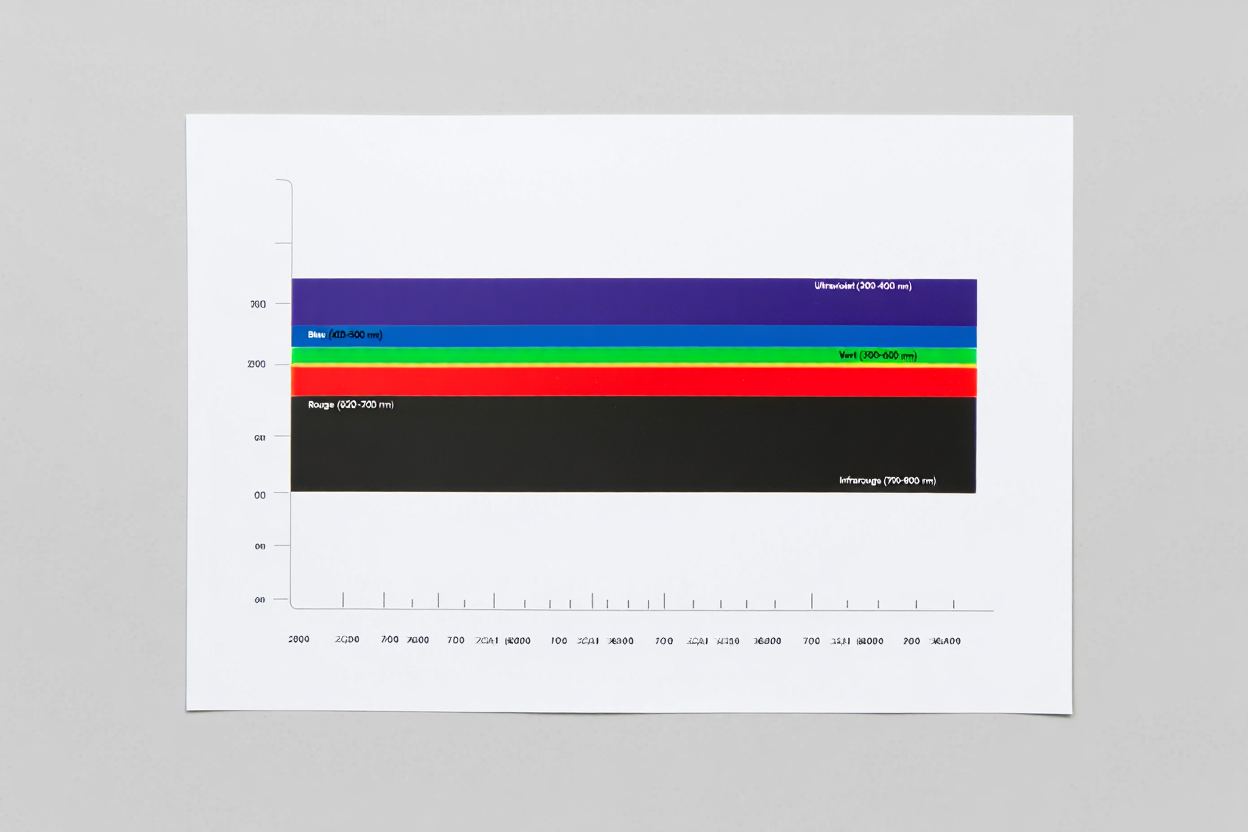
Plants don't "see" light the same way our eyes do. To ensure their growth, they crucially need very specific wavelengths. An LED grow light emits a neutral white light spectrum (between 3000 and 6500 K), specially enriched in blue and red, two colors that are absolutely vital for the photosynthesis process.
Conversely, a regular bulb, like the ones we use to light our homes, mainly produces warm white light. The problem? This light sorely lacks the necessary amounts of blue and red to be genuinely beneficial and let a plant develop properly.

How Plants Use Blue and Red
Blue light (between 430 and 470 nm) is perfect for encouraging robust growth, with sturdy stems and dense foliage. Red light (between 640 and 680 nm), meanwhile, plays a key role in triggering and supporting flowering, while helping produce more beautiful and resilient flowers. Offering a balanced spectrum is a bit like giving your plant a meal perfectly suited to its nutritional needs.
Comparing PPFD Between LED Grow Lights and Regular Bulbs
PPFD (Photosynthetic Photon Flux Density) is a unit that measures the amount of photons truly usable by the plant for photosynthesis (expressed in µmol/m²/s). A good grow module fitted with 50 Philips-brand LEDs can easily deliver between 400 and 600 µmol/m²/s over an area of about 1 to 1.5 m². By comparison, a 60W regular bulb barely reaches 100 µmol/m²/s.
In other words, you'd need to put together 4 or 5 regular bulbs to hope to get the same photon output as a single LED grow light. The performance gap is simply enormous, don't you think?
- Concentrated photon output: Grow LEDs are designed to deliver the right wavelengths exactly where the plant needs them.
- Even coverage: A single 200W spot can light plants uniformly over 1 to 1.5 m², with no shaded areas.
- Consistent spectrum: Unlike regular bulbs, whose color and intensity vary over time, grow LEDs maintain a stable light spectrum quality over time.
- No stray infrared: They don't emit excessive heat, which eliminates any risk of burning your plants' delicate foliage.
For an equivalent lighting result, an LED grow light uses 30% to 40% less energy than a conventional solution. Over a grow that lasts a whole year, this energy efficiency translates into substantial savings on your electricity bill!
The Importance of Infrared and UV for Growing
Some high-end LED grow light models also include a small amount of infrared (IR). This light, perceived as gentle warmth, is very beneficial for the plant's respiration and can boost its flowering. It's a "useful" heat, perfectly controlled, that supports the plant's metabolism without harming it.
Similarly, a small dose of UV (ultraviolet) can greatly boost the production of terpenes and other aromatic compounds in flowers and herbs, enhancing their flavors and scents. Regular fluorescent or incandescent bulbs produce virtually none of it, which can leave your indoor plants a bit bland and less expressive.
Adapting Lighting to Your Plants' Growth Stages
A plant's light needs change considerably throughout its life cycle. For optimal results, it's essential to adjust your grow lighting to each specific stage. It's often this attention to detail that makes all the difference between an ordinary grow and an exceptional harvest.

Blue Spectrum for the Vegetative Stage of Indoor Plants
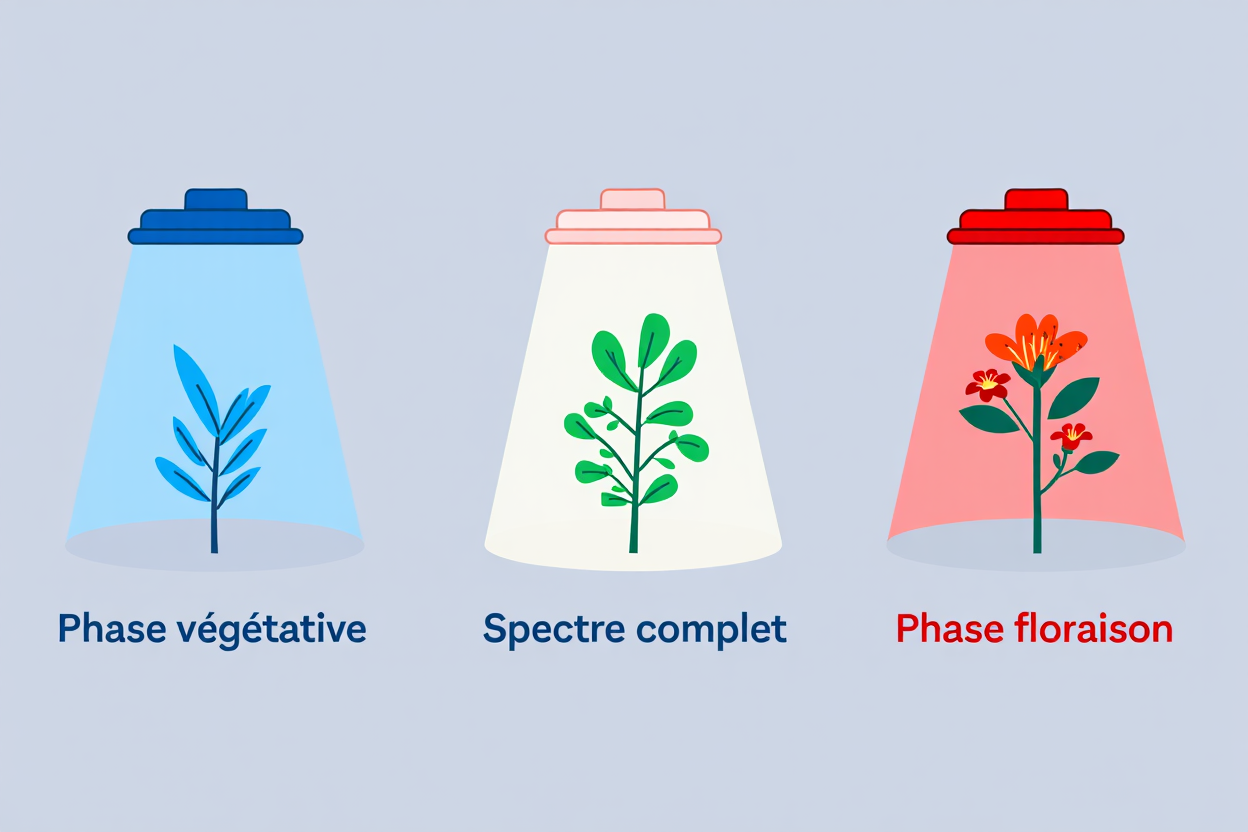
During the vegetative stage, the plant puts its energy into developing its stems and foliage. A spectrum rich in blue (about 70% blue to 30% red) encourages a compact, sturdy structure. Without this specific light, indoor plants tend to stretch out searching for light, which compromises their health.
Choosing a plant grow LED offering a blue-enriched spectrum is ideal for seedlings and herbs. An adjustable grow light with spectrum control lets you precisely dial in the blue intensity at the start of the cycle, then gradually balance the lighting. Far from the excessive heat given off by a regular bulb, these devices perfectly meet plants' needs.
For LEDs, position the light source 30 to 60 cm from the plants; for HPS models, plan for a distance of more than 60 cm. A suitable amount of blue ensures thick, vigorous foliage. You'll quickly notice how positively well-calibrated lighting affects growth.
Red Spectrum to Optimize Flowering in Indoor Growing
Flowering is a decisive stage where the plant devotes itself fully to producing flowers or fruit. A mostly red spectrum (around 80%) acts as a trigger to stimulate bud development. For example, the Grolux HPS grow bulb combines 30% blue in its spectrum, supporting vegetative growth while boosting flowering for a generous harvest.
Adjustable LED systems let you finely tune the blue/red ratio as your indoor growing progresses. This flexibility is simply impossible with a standard regular bulb. During the flowering stage, gradually increasing the proportion of red will significantly optimize your yields.
Scheduling Light Cycles by Development Stage
Managing lighting cycles is easy to master and greatly determines the success of your project. The general recommendation is:
- 14 to 16 hours for germination,
- 16 to 18 hours for the vegetative stage,
- 12 hours for flowering.
These time windows mirror the rhythm of the natural seasons and are therefore not arbitrary.
- Germination with blue dominance: this setting helps young seedlings get off to a vigorous start and strengthens their roots.
- Full-spectrum vegetative stage: a balanced mix of blue and red promotes healthy stem development and abundant foliage.
- Red-dominant flowering mode: energy is directed toward flower production, which increases yields.
A daily setting that mimics nature — with more blue in the morning and more red in the evening — stimulates photosynthesis. Your plants will respond as if they were basking fully in outdoor sunlight.
Modern plant grow LED solutions offer the ability to fully automate these settings via timers or dedicated apps. With a regular bulb, manual management is not only tedious but also far less precise over time.
Consumption and Heat: LED Grow Light Versus Regular Bulb
It's only natural that many growers worry about the impact of their setup on their electricity bill. Thanks to technological advances, it's now possible to optimize your energy consumption without compromising growth results.

Photon Efficiency of LED Bars Versus Traditional Bulbs
Photon efficiency, measured in µmol/J, is a key indicator for assessing the light efficiency of a lighting system for growing. While a regular bulb barely reaches 1.2 µmol/J, modern LED bars deliver much higher performance, generally between 4.0 and 4.5 µmol/J. This considerable gap drastically reduces the energy consumption needed to produce a similar light intensity.
This guide details why an LED grow light is often a better choice than a regular bulb for indoor growing on a 60 cm x 60 cm area, mainly thanks to its full, customizable spectrum. To dig deeper into the topic and choose your equipment well, check out our article on the best LED grow light. These models combine high energy efficiency with abundant photon output, all while generating very little heat.
Let's take the example of a one-square-meter hydroponic grow space lit twelve hours a day. A high-performance 200W LED system will use roughly half as much as a traditional halogen setup of equivalent power. Over a year, this technological difference can translate into substantial savings of several hundred euros.
| Light type | Power (W) | Photon efficiency (µmol/J) | Consumption 12h/day (kWh) | Heat output (%) |
| LED grow light 200W | 200 | 4.0–4.5 | 2.4 | <10% |
| HPS Grolux 400W | 425 | 2.0–2.5 | 5.1 | 60–70% |
| Halogen 120W | 120 | 0.9–1.2 | 1.44 | 65–75% |
| Standard incandescent 60W | 60 | 0.8–1.0 | 0.72 | 70–80% |
Heat Management to Avoid Thermal Stress
A latest-generation grow light is characterized by its ability to convert energy mainly into light, rather than residual heat. While incandescent lighting often wastes more than 60% of its energy as heat, LEDs show remarkable light efficiency, often above 150 lm/W, far surpassing older technologies like HPS lights.
Using regular bulbs often causes a significant rise in ambient temperature, of up to 10 to 15 °C. To offset this overheating, the grower is then forced to invest in costly cooling and ventilation systems. In contrast, LED lighting requires much simpler and more economical climate management.
In a small space, this heat control greatly helps protect every plant against the risk of burning or dehydration. This lets you place your light source closer to the canopy without fear of damaging even the most delicate leaves. It's a genuine improvement that simplifies the day-to-day management of your grow space.
Durability and Real Cost of an LED Grow Light for Plants
Admittedly, the upfront investment for an LED grow light is higher than for a regular bulb. But looking at the long term, especially over five years, the numbers speak for themselves. Thanks to lower energy consumption and far less frequent replacements, the return on investment is quick and clear.
Lifespan Compared: Grow LED Versus Regular Bulb
An LED grow light generally offers a lifespan of 30,000 to 100,000 hours, outlasting every other lighting technology. As an example, a Grolux HPS bulb lasts around 26,000 hours, while an incandescent regular bulb rarely exceeds 2,000 hours. This longevity is a major asset, since it generates both less waste and significant savings.
- Frequent replacements with a regular bulb: with a 12-hour-per-day grow cycle, you'll need to replace the bulb roughly every two months, which represents a significant recurring expense.
- LED reliability and longevity: after installation, you can practically forget about your equipment for 2 to 5 years, with nothing to worry about.
- Sturdiness and high protection rating: some models, like the SPOT 200W, carry an IP66 certification, making them perfectly watertight and suited to the ambient humidity of a grow space.
- Extended manufacturer warranty: At GrowLED, the warranty covers 3 years, protecting you against any manufacturing defect.
It's generally recommended to only replace your light once its efficiency drops by more than 10%, which often happens after 50,000 hours of use. In other words, your plants will have time to complete several growth cycles before your light starts to weaken!
Unlike conventional models that can rust or corrode, a quality LED offers far better resistance. This durability keeps maintenance to an absolute minimum, even in very humid environments. These fixtures are built to last a long time, even in confined spaces exposed to water.
Calculating Return on Investment Over 5 Years
Let's look at a concrete estimate: a 150W grow light costs around €100 to €120, for an advertised lifespan of 40,000 hours. By comparison, a halogen regular bulb costs about €15 but barely lasts more than 2,000 hours. Over a five-year period, with 12 hours of daily use, you'll be forced to buy that same bulb more than ten times. The total cost in equipment may end up being similar, but it's the electricity consumption that makes all the difference.
- Upfront investment for the LED: budget between €100 and €150 for a unit that will serve you trouble-free for five years.
- Recurring expenses for the regular bulb: around €150 over five years, just from repeated replacements.
- Substantial energy savings: LED technology lets you save between €200 and €300 on your bill, depending on your usage pattern.
- Guaranteed peace of mind: you avoid the hassle of a failure in the middle of your plants' growth cycle.
The return on investment is even more pronounced if your light runs more than 12 hours a day. Whether for a greenhouse or an indoor space, the total cost of acquisition is often paid off in as little as 18 months. Beyond that, every extra hour of lighting represents pure savings.
Plug-and-Play Installation and IP Protection for Growing
Some models, like the SPOT 200W GVL, come ready to use, with cable and adjustable mounts included, for the simplest possible installation. No more complicated setups or buying external ballasts, which are required with HPS lights. While a regular bulb often requires specialized sockets, the LED solution is immediate and intuitive.
High-end grow light models feature an IP66 protection rating, perfect for terrariums or very humid setups. Humidity tends to quickly deteriorate non-waterproof conventional bulbs, increasing technical risks. With a waterproof grow light, you guarantee every plant a safe environment, protected from short circuits.