



































































Want to give your indoor plants powerful, easy-to-use artificial light? This guide walks you through choosing the perfect LED grow light, from seedlings to flowering, without complicated technical jargon. You'll learn why a full light spectrum matters, how much light intensity you need, and how to set up your equipment correctly for professional-level results.
Which light spectrum to choose for your indoor plants
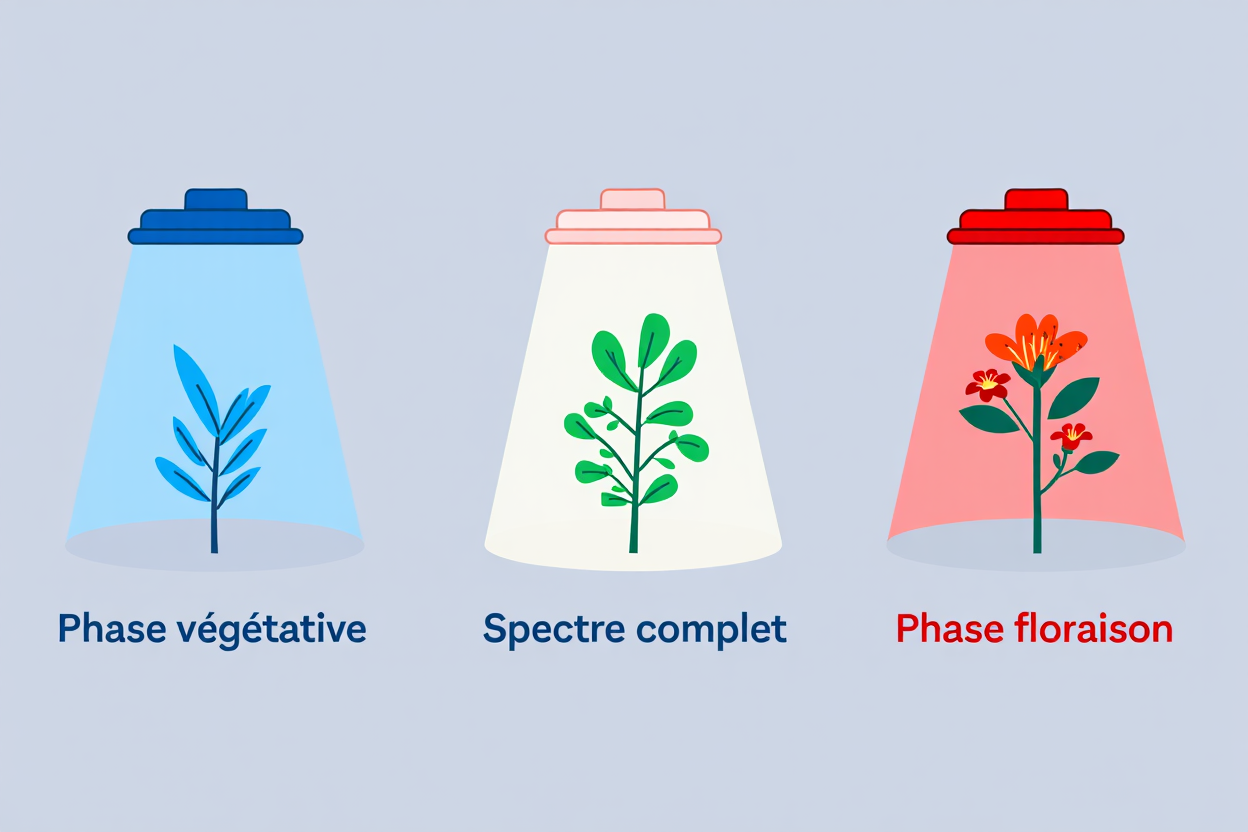
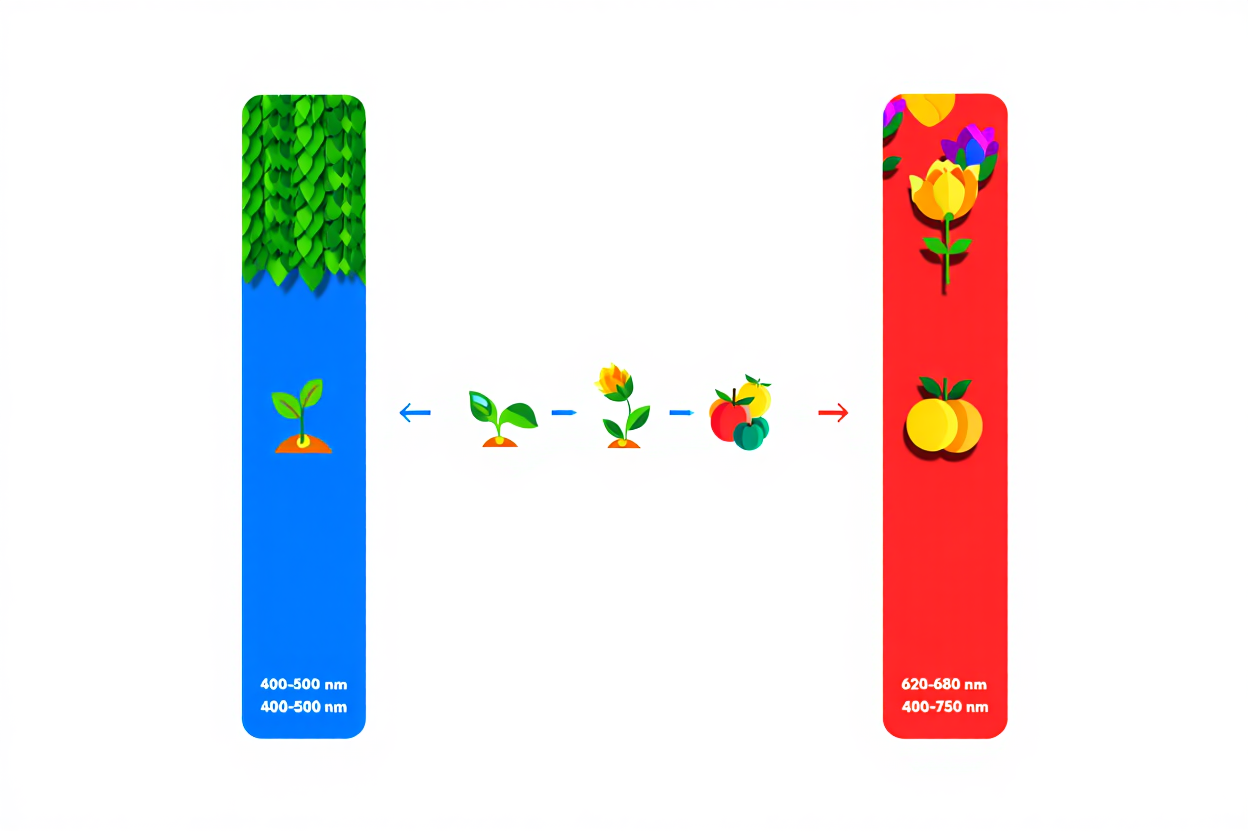
The light spectrum is the foundation of successful indoor growing. Each color specifically affects development: blue promotes compact growth, while red triggers flowering and strengthens pigments. A full spectrum, and ideally one covering 400 to 780 nm, reproduces natural sunlight and supports every growth stage without needing to change lamps.

Why choose a full-spectrum LED grow light
Choosing an LED grow light with a full light spectrum simplifies your setup and cuts costs. Instead of buying two different fixtures, you get a single, affordable and natural solution that indoor plants love. The result is an uninterrupted cycle, from germination to flowering, thanks to perfectly matched light.
- Blue (440-460 nm): promotes a compact habit and dense foliage; essential during the vegetative stage and for sturdy seedlings.
- Red (620-730 nm): encourages flowering, fruiting and improves yields; increase this part of the spectrum during the reproductive stage.
- Neutral white (5000-6500 K): balances the full spectrum and ensures synthesis of all pigments without any light deficiency.
- Near-UV and light infrared: improve sturdiness, coloration and aromas; perfect for LED grow lights for demanding plants grown indoors.
Absolutely avoid using only blue or only red: the former delays flowering, the latter produces stretched, fragile stems. A balanced spectrum remains the essential solution for professional-quality harvests every cycle.
Advantages of horticultural LEDs over other technologies
Horticultural LEDs are revolutionizing growing by using 60% less electricity than an HPS lamp and generating very little heat. With a lifespan of over 50,000 hours, your LED grow light can run twelve hours a day for more than ten years without losing power, all while maintaining stable, optimal light intensity.
By comparison, T8 fluorescent tubes or CFLs work fine for small areas, but they need to sit 20 cm from the foliage to avoid shaded spots. LED grow lights cover a wider area, at a distance of 30-60 cm, thanks to uniform light intensity, which makes the setup more flexible and effective over the long term.
As for incandescent bulbs, forget them for good. Their light spectrum is unsuited to photosynthesis, and their excessive heat can burn your plants. LED grow lights therefore provide more usable light, less heat and minimal power consumption: a clear step forward for any indoor growing under artificial light.
How to determine the light your plants need
Wondering what amount of light is ideal for your indoor plants to develop properly? The key parameter to know is PPFD, which measures the photon flux actually usable per second. Mastering this figure turns gardening into a precise process, making the difference between decent growth and an abundant harvest.

Understanding PPFD and light needs by species
PPFD (Photosynthetic Photon Flux Density) expresses the density of photosynthetic photons your LED grow light delivers per square meter per second. Unlike lux, which simply measures brightness as perceived by the human eye, PPFD focuses on the wavelengths actually used by plants. Once you master it, it makes it easy to optimize light cycles and ensure steady growth indoors.
- Shade plants (ferns, pothos, philodendrons): A PPFD of 100-150 µmol·m⁻²·s⁻¹ is enough; these plants thrive on low light output.
- Medium-light plants (monstera, alocasia, anthurium): 180-200 µmol·m⁻²·s⁻¹ promotes lush foliage and deep coloration.
- Light-hungry plants (tomatoes, basil, succulents grown indoors): They need 300-600 µmol·m⁻²·s⁻¹ to reach their full potential.
For most indoor plants, aim for 30-35 µmol·m⁻²·s⁻¹ during the vegetative stage, then 45-55 µmol·m⁻²·s⁻¹ during flowering. A lux meter will show about 1,000-2,000 lux in a well-lit room, but PPFD remains the most reliable unit for precisely adjusting the amount of light without wasting energy.
| Species | Recommended PPFD (µmol·m⁻²·s⁻¹) | Light hours/day | Lamp distance (cm) |
| Shade plants | 100-150 | 6-8 h | 40-60 |
| Medium-light plants | 180-200 | 12-14 h | 30-50 |
| Light-hungry plants | 300-600 | 16-18 h | 20-40 |
| General flowering | 45-55 | 12 h | 45-60 |
Calculating the right LED wattage for your space
Calculating the light output you need is simple: divide the total wattage (in watts) by the area to light (in m²). For decorative foliage, plan on 7 to 20 W per 0.3 m² to avoid stretching. To cover 1 m² with a PPFD of 200 to 400 µmol·m⁻²·s⁻¹ (depending on species), go for around 40 W.
Let's take an example: a 30 W LED grow light is perfect for lighting a 40 × 40 cm area during flowering, placed at a distance of 30-40 cm. Two 60 W modules, meanwhile, will cover 1.2 m². The horticultural quantum boards HLG 260W V2 provide even coverage over 120 × 120 cm thanks to their excellent efficacy of 2.6 µmol/J. The higher the efficacy, the more useful photons your setup produces for the same energy consumption.
If your grow space is an irregular shape, go for a modular system: several small panels let you fine-tune coverage without dismantling everything. Be sure to check connector compatibility and voltage (120 V/240 V). The LED grow light BloomLED X30 pack (30 W, E27 base) simply screws into a standard socket, for a quick, affordable setup.
Detecting and fixing improper indoor lighting
Plants talk to you through their appearance. A lack of light causes stretching: stems that grow excessively long, pale leaves and late flowering. Conversely, too much light can scorch the foliage. Adjusting the amount of light at the right time restores vigor and balance to your crop.
- Stretching: Thin stems and widely spaced leaves. Solution: move the LED grow light 5 to 10 cm closer or increase the light hours.
- Photoinhibition: Scorched leaf edges, stalled growth. Solution: move the light source farther away or reduce its intensity.
- Asymmetrical growth: The plant leans noticeably. Solution: rotate the pot a quarter turn each week.
- Dull colors: Pale green leaves. Solution: increase the PPFD or extend the light cycles by 2 to 3 hours.
Handy tip: a small PPFD meter or a smartphone app that measures lux (for a few dozen euros) makes it easy to keep track of your light output. Take your readings at foliage level, adjust the distance or intensity, then let the plant acclimate before making another adjustment. Patience and observation are your best allies.
Setup and timer scheduling for your grow light
Properly setting up your grow light is half the battle in indoor growing. Correct positioning, regular light cycles and well-dosed power create a stable, natural ecosystem. Thanks to this thoughtful setup, plant growth stays steady and maintenance is limited to a few minor tweaks.

Setting light cycles according to growth stages
Light cycles directly govern plants' biological rhythm, from seedling growth through flowering. Each species has its own ideal photoperiod; respecting it ensures even, stress-free growth. A basic, inexpensive timer automates these schedules and saves you from forgetting to switch the light on manually.
- Germination and young plants: 16 to 18 hours of light and 6 to 8 hours of darkness provide the energy needed for seedlings to develop full foliage.
- Vegetative stage: 18 hours on / 6 hours off, or 14 to 16 hours to cut consumption, stimulates branching and chlorophyll synthesis.
- Flowering: 12 hours on / 12 hours off triggers the switch to reproductive mode, encouraging an abundance of flowers and fruit.
- Shade plants: 6 to 8 hours a day at low light intensity is enough for slow but well-balanced development.
Even tropical plants native to forest understories need 4 to 6 hours of darkness to replenish their metabolic reserves. Use a standard timer or a digital dimmer to manage light intensity: low at sunrise, peak at midday, then tapering off in the evening. This profile mimics the solar cycle, reduces energy use and optimizes the PPFD available for photosynthesis.
Positioning your indoor lighting correctly
Where you place your LED grow light determines whether the canopy stays even or becomes unbalanced. Too high, it creates shadows; too low, it risks scorching the tips. An adjustable setup ensures consistent light distribution and avoids constant tweaking.
During the vegetative stage, keep 30 to 45 cm between the bulb and the foliage; during flowering, increase that distance to 45-60 cm. A 30 W source can sit closer, while a 100 W model should stay farther away. Rotate the pots a quarter turn every week, add gentle ventilation, and use a reflector to recover up to 30% extra lux.
Choosing the right format for your grow space
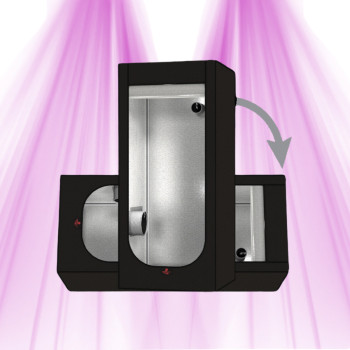
Just like shoes, each lighting format has its own advantages and limits depending on the space. A compact E27 bulb suits a terrarium, while an LED bar easily lights an entire shelf. In a grow tent, a single panel provides even coverage and a consistent PPFD.
Bulbs from 7 to 13 W install with no modification and light two plants; bars from 20 to 60 W support ten specimens; panels from 60 to 300 W cover more than 0.5 m². In a HomeBox Q30, a 30 W LED grow light placed 35 cm away delivers the ideal output for four compact plants through the dark winter. Grouping species with similar needs simplifies the setup and the adjustment of light cycles.