



































































Looking for an efficient, quiet exhaust fan for your bathroom, bedroom, or kitchen? This article helps you choose a quiet, powerful model suited to each room. You'll discover how to easily assess airflow, noise level, and energy consumption to ensure effective air exchange every day.
Quiet, powerful exhaust fan: choosing and sizing
A quiet indoor exhaust fan combines insulated double walls, high-precision bearings, and an EC motor, ensuring discreet, durable ventilation. These technologies work together to reduce vibration and keep noise levels low, even at full power.

Vent or exhaust fan: what's the difference for your ventilation?
A vent allows for light air exchange with moderate airflow, while a quiet fan for indoor growing offers much more powerful forced air extraction. The vent-style extractor is handy for a small WC, but a bathroom or kitchen often requires a quiet, powerful wall-mounted exhaust fan to effectively remove moisture and odors.
- Simple vent: gentle air exchange (30-50 m3/h), discreet but limited for damp rooms.
- Powerful exhaust fan: airflow of 200 to 2380 m3/h depending on the model, ideal for bathrooms, kitchens, and indoor growing.
- Wall-mounted exhaust fan: surface installation, adjustable airflow, compatible with standard ducting.
In short, comparing a vent and an exhaust fan is like comparing a desk fan to an industrial extraction system; the performance difference is immediately noticeable.
How to size an exhaust fan for a bathroom or kitchen
Here's how to size an exhaust fan simply: multiply the room's volume by 6 to 9 to get the required airflow. For example, a 15 m3 bathroom will need between 90 and 135 m3/h. A larger kitchen will generally need more than 200 m3/h.
- Small bathroom (10-15 m3): airflow of 90-135 m3/h, recommended diameter of 125-150 mm.
- Medium bathroom (15-25 m3): go for 150-250 m3/h with a 150 mm diameter.
- Kitchen or large bathroom (25-40 m3): plan for at least 200-300 m3/h, favor 200 mm.
Add a 20 to 30% margin if you're installing a carbon filter or a long duct; each bend causes roughly a 10% loss in airflow. It's therefore wise to slightly oversize the unit to maintain optimal performance.
100mm exhaust fan and bathroom extractor fan: which model to choose?
The term 100mm exhaust fan only indicates the diameter, not the airflow. In practice, the most common diameters are 125, 150, 200, or 315 mm. The QuietLINE 125 mm model delivers 197 m3/h for just 13 W. A standard bathroom extractor fan will do well with a 150 mm diameter, paired with an IPX4 rating and a hygrostat.
| Model | Airflow (m3/h) | Power (W) | Noise level (dB) | Ideal use |
| QuietLINE 125 mm | 197 | 13 | 32 | Small spaces, WC |
| ISO-MAX 315 mm | 2380 | 265 | 74 | Growing, 15-30 m2 room |
Quiet fan for indoor growing: technologies and optimal installation
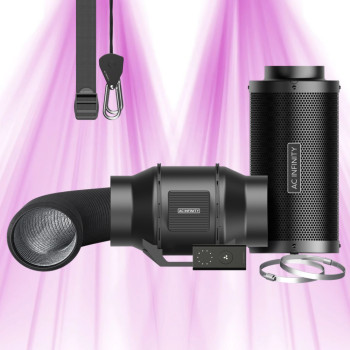
For discreet indoor growing, the quiet exhaust fan Iso-MAX 315 mm delivers 2380 m3/h without overheating, thanks to its German-made motor designed to run reliably around the clock. Its asymmetrical blades, double wall, and precision bearings keep noise levels under 35 dB, comparable to a whisper.
For even more quiet, add a PhonicTrap duct and suspend the unit with anti-vibration straps. Favor gentle curves to avoid airflow loss or unwanted noise. To ensure healthy air and constant air exchange, clean the blades every two to three months and change the filters every six to twelve months.
Looking for a compact model? The quiet exhaust fan QuietLINE 125 mm delivers 197 m3/h for just 13 W. It proves that a quiet fan can be powerful, efficient, and perfectly suited to a bathroom extractor fan.