




































































You want to know exactly what your LED grow light will cost you in electricity? This simple, practical guide will teach you how to easily assess your power consumption.
Calculating your LED grow light's power consumption in advance lets you better plan your monthly budget. You'll then be able to adjust your setup to optimize your yield. Our goal is to help every grower understand their real power consumption.
How to calculate the power consumption of an LED grow light
Determining the power consumption of a grow light is very simple. Here are three steps: Start by converting your light's wattage into kilowatts. Then multiply that number by the number of hours of use per day, then by the period you're interested in.

Basic calculation formula and real wattage
The universal formula is: Consumption (kWh) = Power (kW) × Hours per day × Number of days. For example, a 450 W light used 18h per day consumes 8.1 kWh per day. Over a month (30 days), that comes to 243 kWh.
It's essential to use the light's real wattage, since some manufacturers advertise a higher grow light wattage than reality. At GrowLED, we state the real wattage of every grow light so your power consumption calculations stay accurate.
Real-world examples based on daily usage hours
Let's take a grow light with a wattage of 60 W: - If it's on 12 hours a day: monthly consumption of 21.6 kWh. - If it's on 18 hours a day: monthly consumption of 32.4 kWh. That's a significant increase!
With a 200 W light, the difference is even more pronounced. The cost varies enormously depending on whether you run your light 12 or 18 hours a day. So adjust your lighting duration based on your grow cycle and your budget.
- 60 W light at 12 h/day: 21.6 kWh/month (≈3.89 €)
- 60 W light at 18 h/day: 32.4 kWh/month (≈5.83 €)
- 200 W light at 12 h/day: 72 kWh/month (≈12.96 €)
- 200 W light at 18 h/day: 108 kWh/month (≈19.44 €)
If you use several lights, the principle stays the same: every extra source of light increases your bill proportionally. So it's important to plan your lighting needs carefully before buying.
Impact of the dimmer and driver losses
If your system is fitted with a dimmer, your LED grow light's power consumption drops when you reduce the intensity. This feature is ideal for saving energy during the vegetative stage, when light needs are lower.
Electronic components, like the driver, cause slight energy losses, usually minimal. To simplify your calculations, our LED power consumption calculator factors in these parameters. That gives you a very accurate estimate in just a few clicks!
Estimating monthly and annual electricity costs
Once you've worked out your energy needs, the next step is to assess your budget for electricity. This amount depends directly on your overall power consumption and the rates in effect in your region. In France, the average price per kilowatt-hour is around 0.18 €, but it's essential to check this on your own bill.
Coefficient method by growth phase
The GrowLED brand suggests using practical coefficients that vary depending on your plants' stage of development. For the vegetative stage, with about 18 hours of lighting per day, estimate a monthly cost of 0.08 € per watt. During the flowering stage, where lighting is generally reduced to 12 hours a day, this cost drops to 0.05 € per watt.
These coefficients already factor in standard usage durations, which greatly simplifies your estimates. So, a 200 W grow light will represent an expense of around 16 € per month during the vegetative stage. Once you switch to flowering, the monthly bill drops to 10 €.
Of course, you can also manually calculate this grow light's power consumption. For example, for a 200 W light used 18 hours a day over a month, you get a total consumption of 108 kWh. The suggested coefficients offer a simple alternative that's just as accurate as this calculation.
Real costs across different light models
Let's take the example of a common model: a 60 W LED light. If you use it 12 hours a day, the monthly cost comes to 3.89 €. It's always wise to plan for this monthly grow light cost to better anticipate your expenses.
A 200 W light used at the same rate will cost you 12.96 € per month. For a more powerful 600 W unit running 18 hours a day, the monthly budget will reach 58.32 €. These differences show how important good energy planning is in indoor growing.
To effectively cover a one-square-meter area, a wattage of around 250 W is generally recommended. Lighting such a space then represents a significant investment. Over a three-year period, the total bill can reach around 875 €. These figures highlight the value of choosing your equipment carefully and monitoring your consumption.
| Power (W) | Hours/day | kWh/month | Monthly cost (€) | Annual cost (€) |
| 60 | 12 | 21.6 | 3.89 | 46.68 |
| 60 | 18 | 32.4 | 5.83 | 69.96 |
| 200 | 12 | 72 | 12.96 | 155.52 |
| 200 | 18 | 108 | 19.44 | 233.28 |
| 450 | 18 | 243 | 43.74 | 524.88 |
| 600 | 12 | 216 | 38.88 | 466.56 |
| 600 | 18 | 324 | 58.32 | 699.84 |
Energy savings: LED versus HPS and MH
Why choose the new technology over old lighting systems for your grow? You'll achieve substantial electricity savings, since this efficiency is scientifically proven. These panels significantly reduce overall consumption compared to high-pressure sodium lights.

Light output comparison and equivalent wattage
The numbers speak for themselves when comparing the wattage and output of different systems. A typical HPS light shows an efficiency of around 1.5 µmol/J, while a modern LED unit comes close to double that. So a small LED setup can easily replace a large traditional model while still ensuring excellent growth.
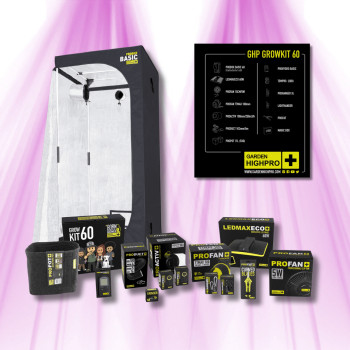
For example, a 60W model like this one offers very low consumption while delivering an optimized full spectrum. Running 12 hours a day, it uses little energy, which ensures vigorous plant growth with minimal impact on your bill.
PPE (photosynthetic photon efficacy) measures the amount of photons produced per joule consumed. High-end LED models far outperform older technologies, which quickly hit their limits. Your plants thus enjoy generous flowering while needing less grow lighting day to day.
Calculating real savings over a year
Let's take a concrete LED vs HPS vs MH comparison example to assess the potential savings. Replacing an energy-hungry system with a suitable LED light significantly cuts your annual electricity cost. Over several years, these savings become very worthwhile for your budget.
- HPS 600 W (12 h/day): 216 kWh/month → 39 €/month
- Equivalent LED 420 W: 151.2 kWh/month → 27.22 €/month
- Monthly savings: 64.8 kWh → 11.66 €
- Annual savings: 777.6 kWh → 139.96 €
Equipping your entire indoor grow with these LED panels can generate considerable annual savings. You can adapt these estimates to your situation with our LED grow light power consumption calculator.
Impact on cooling and ventilation costs
These modern panels give off much less heat, which is a notable thermal advantage. Unlike traditional systems that heat up considerably, LED technology greatly limits cooling needs. This reduces your cooling costs for your grow space.
By lowering the ambient temperature of your setup, you also reduce the load on your ventilation system. These indirect savings add to the other financial benefits of LED grow lighting, maximizing your profitability.
Finally, the exceptional lifespan of this equipment considerably cuts replacement costs. The initial investment pays for itself quickly, offering an excellent return on investment within just a few years. These premium systems quickly become cost-effective throughout your indoor grow cycles.
Do LED grow lights really use a lot of electricity?
People often wonder whether LEDs use a lot of electricity to light plants indoors. The reality is quite different: this technology stands out for its excellent energy efficiency. Compared to older systems that are nonetheless known for good output, its power consumption stays remarkably low.
Real consumption based on grow area
The amount of energy needed depends above all on the area to be lit. For a one-square-meter grow, a grow light wattage of around 250 W is generally enough. This wattage equals a monthly consumption of around 135 kWh, roughly the same as a large refrigerator.
- Small 60×60 cm tent: a 60-100 W light uses between 27 and 45 kWh per month.
- 1 m² space: a 250 W LED uses around 135 kWh/month.
- Two 1 m² tents: two lights totaling 500 W LED use nearly 270 kWh/month.
- Intensive 2 m² zone: a 600 W LED needs around 324 kWh/month.
The remarkable efficiency of these systems lets you light effectively with just 40 W/m², where older lights needed double that. You thus use much less electricity day to day, while giving your plants an ideal growing environment.
To succeed at your indoor growing, adapt your LED grow light to the specific needs of each stage of development. During the vegetative stage, moderate intensity of around 200 W is generally enough. On the other hand, the flowering stage requires a suitable light spectrum and can need up to 400 W.
Practical strategies to optimize your consumption
Optimizing LED consumption starts with carefully scheduling your lighting cycles. Using a timer ensures light is delivered only when it's actually useful for the plants. Cutting unnecessary lighting thus helps meaningfully reduce your energy bill.
- Mylar reflectors: they improve light output and reduce power needs.
- Adjustable intensity: lowering the light intensity during the vegetative stage delivers significant savings.
- PPFD measurement: adjusting the light height helps focus useful light exactly on the foliage.
Adjusting your grow light's height as growth progresses is also an essential technique. A high-power light, positioned correctly, helps avoid wasting energy. This protects your budget while ensuring even light distribution across your entire grow area.
It's recommended to measure your real power consumption with a wattmeter to catch any hidden malfunctions or overloads. Using quality LED grow light bars ensures stable, safe performance for your setup. Also remember to check that your electrical installation can handle the total load of all your equipment.