









































































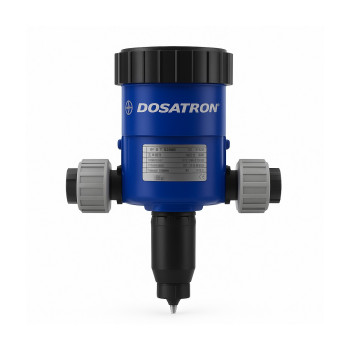
DOSATRON
Dosatron SYSD15RE05VF – Proportional doser for precise indoor cultivation
Ships within 2 weeks
2 187,90 € or 3× 729,30 €

Product successfully added to your shopping cart
Ça pousse dans le bon sens

1 product
A proportional doser injects a stock solution into the irrigation network in proportion to the water flow passing through it: concentration stays constant however many drippers are open. That is the fundamental difference from a fixed-output pump, which drifts as soon as the irrigation regime changes.
A water-driven volumetric doser is powered by the water flow itself: it needs no electrical supply. On the other hand it carries no probe, no electronics and no feedback. It applies a dilution ratio; it does not correct pH or EC drift, and it does not compensate for a badly prepared stock solution. Closed-loop pH/EC regulation is a distinct function, carried by an in-line electrode and a dedicated injection loop: the two devices complement each other, they do not replace each other. Confusing them leads to buying a device for a function it does not perform.
Injecting fertilisers into a network connected to a potable supply requires a correctly sized backflow prevention device — a break assembly and check valves upstream of the injection point. This is not a comfort option: it is the condition of connection.
Upstream, filtration by screen or disc, with mesh size expressed in µm, governs the life of the doser as well as that of the drippers: clogging is the leading cause of breakage and of dosing drift. An outlet check — EC and pH of the diluted solution, volumes recorded — remains the only way to verify that the rate applied matches the rate expected.
The seals of a proportional doser are consumables, replaced at an interval linked to the product injected and the volume treated. No model is “compatible with all fertilisers”. Ordering the spares kit at the same time as the unit avoids a stoppage in the middle of the irrigation season.
GrowLED lists Dosatron proportional dosers and studies multi-channel injection frames against a specification; the flow and pressure of the chosen model are checked on the manufacturer's data sheet. Pressurising the network is a matter for booster pumps. For non-professional use, our watering and irrigation equipment covers small networks, and manual dosing by syringe remains suitable for small volumes. Back to grow room automation.


