














































































Professional Growing Tables
2 products
A growing surface is sized, not simply chosen
A professional growing table answers four constraints at once: the building grid and aisle width, the load to be carried once the trays are filled, the water strategy adopted, and the ability to clean the surface between batches. The format follows from those constraints, never from a standard dimension.
Containment tray or gravity drainage
- The sealed tray with no outlet, known as a flood and drain bench, holds the solution for the duration of the irrigation: the water stays in the tray, taken up by capillarity and then actively drained. This is the principle of sub-irrigation.
- The perforated, gravity-drained tray discharges the leachate to a collector, with a drainage fall and a return network to be designed in from the start.
These two strategies do not mix. Sub-irrigation removes the discharge, but it recirculates: it concentrates salts and moves root pathogens across the whole surface of the tray, which calls for EC monitoring, disinfection of the solution and cleaning between batches. Gravity drainage uses more water, but it isolates the plants.
Load rating, flatness and working height
A loaded surface is heavy: a few centimetres of solution added to the weight of the blocks represents several tens of kilograms per square metre, to which the weight of an operator leaning on it is added. The frame is chosen on its load rating, not on its footprint.
Flatness is the direct corollary. On a containment tray, an error in level produces a permanent film of water on one side and a dry substrate on the other, and so an unevenness that no irrigation will make up: adjustable legs, levelled at installation, are not a convenience. Accessible width finally depends on the number of sides served, in the order of eighty centimetres for a bench against a wall, twice that when it can be reached from both sides.
Cleanability and layout density
A growing surface is a sanitary crossing point. Rounded corners, absence of water traps, resistance to disinfectants and the ability to dismantle govern the turnaround time between batches, a labour item that is often underestimated.
Then there is layout density. Multiplying benches at the expense of aisles increases productive area and degrades everything else: trolley circulation, access to plants at the back, ventilation uniformity, harvest time. Usable area is calculated with the aisles included.
What this section covers
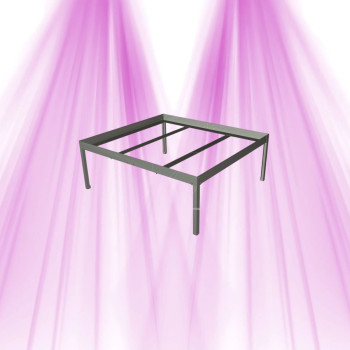
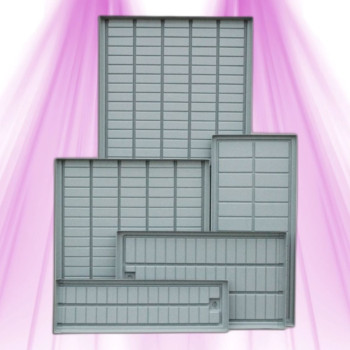
The items listed here are combined: on one side a plastic growing tray with no outlet, with a raised base and internal channels, in ten sizes; on the other a galvanised sheet-steel stand designed for those trays, in twelve sizes. A table is therefore made up of two references whose dimensions must match. Complete tables, rolling or with integrated flood and drain, are studied project by project.
For non-professional use, growing trays cover occasional needs. Upstream, nutrient solution supply sets the rhythm of the feeds. This section forms part of professional propagation.