












































































Want to master how photosynthesis works for your Year 13 exam? This article gives you a complete Year 13 photosynthesis diagram, along with clear explanations of the two main phases that let the plant convert light energy into glucose.
Organization of the plant's chloroplast
The chloroplast functions like a true micro-factory inside chlorophyll-containing cells. It's made up of three main compartments: the outer membrane, the stroma and the thylakoids. This architecture is essential for letting photosynthesis take place efficiently within specialized spaces.

Compartments and their roles in photosynthesis
The thylakoids are flattened sacs stacked into grana. It's on their membrane that the pigments and photosystems are found, where photons are captured. The stroma, the fluid surrounding these structures, is where CO₂ fixation happens and where the Calvin cycle takes place. Blackman's research showed that light acts directly on the thylakoids, and Arnon's work proved that this is where ATP and NADPH are synthesized. The plant thus splits the work between two perfectly distinct zones.
The stroma contains Rubisco and all the enzymes needed to convert CO₂ into glucose, while continuously regenerating RuBP. This spatial separation maximizes the overall efficiency of the process.
Thylakoids, pigments and photosystems
The thylakoid membrane carries various pigments, notably chlorophyll a, chlorophyll b and carotenoids. These pigments can absorb specific wavelengths, mainly in the blue (400-500 nm) and red (600-700 nm) ranges, forming a powerful photosynthetic antenna. Two photosystems work together: PSII first captures the photons, expels electrons and releases protons into the lumen. Then PSI takes over to reduce NADP⁺ to NADPH.
The buildup of H⁺ protons in the lumen generates an electrochemical gradient. As it passes through ATP synthase, this gradient directly produces the ATP essential for the following reactions.
Stroma and Calvin cycle enzymes
The stroma, rich in ions and metabolites, hosts Rubisco — the most abundant enzyme on Earth — which fixes CO₂ onto RuBP to form 3-phosphoglycerate. Other enzymes of the Calvin cycle phosphorylate, reduce and regenerate the intermediates until glucose is produced, while also rebuilding RuBP.
Thanks to the continuous supply of ATP and NADPH from the thylakoids, these « dark » reactions keep up a steady pace. This perfect collaboration between compartments is the key to the energetic success of the plant.
Photochemical phase of photosynthesis
The photochemical phase is the stage that depends directly on light. It takes place entirely at the thylakoid membrane. Its role is crucial: it generates the chemical energy essential to fuel the rest of the process. Without this energy production, the Calvin cycle could neither start nor result in glucose synthesis.
Light capture and the electron transport chain
The initial step sees photons of sunlight captured by the pigments, causing them to become excited. This mechanism is often illustrated with a photosynthesis diagram. At photosystem II (PSII), this excitation causes the ejection of electrons, kicking off a series of transfers essential to the plant.
- Water photolysis at PSII: Two water molecules (H₂O) are split, producing dioxygen (which diffuses into the atmosphere), four protons (H⁺) and four electrons (2 H₂O → O₂ + 4 H⁺ + 4 e⁻).
- Electron transport: The electrons then pass through plastoquinone, the cytochrome b₆f complex, then plastocyanin, on their way to photosystem I (PSI). This journey releases energy used to pump protons.
- NADP⁺ reduction: Once at PSI, the electrons are finally captured by NADP⁺ reductase, enabling the production of NADPH, a powerful reducing agent needed for the Calvin cycle.
- Photophosphorylation: The resulting proton gradient activates the ATP synthase enzyme, which catalyzes the conversion of ADP into ATP through the production of chemical energy.
. The efficiency of this system is remarkable: within milliseconds, light excites chlorophyll, electrons flow, and ATP and NADPH are produced. Meanwhile, carotenoids protect chlorophyll against damage caused by excess light.
Proton gradient and ATP synthase
Creating a proton gradient is a fundamental feature of the light-dependent phase. As electrons are transported, protons build up inside the thylakoids, creating a significant difference in concentration and electric charge on either side of the thylakoid membrane.
ATP synthase then uses this gradient: as protons pass back through the membrane via this enzyme, they release the energy that activates the synthesis of ATP. This process demonstrates the direct link between light absorption, the proton gradient and the formation of chemical energy that will be used in the stroma.
Production of ATP, NADPH and O₂
The net result of the photochemical phase is the simultaneous production of ATP, NADPH and dioxygen. Every photon absorbed by PSII contributes to this triple synthesis, which lies at the heart of photosynthesis.
Once synthesized, ATP and NADPH leave the thylakoids to reach the stroma, where they will serve as fuel for the Calvin cycle. It's therefore clear that without this photochemical phase, there would be no production chemical energy production: no NADPH, no ATP, and therefore no glucose for the plant.
Chemical phase of photosynthesis
The chemical phase, also called the Calvin cycle, lets plants convert carbon dioxide into organic matter. This key stage of photosynthesis follows the photochemical phase and can occur without direct light. However, it absolutely requires the ATP and NADPH produced during the light-dependent phase to function properly.
Steps of the Calvin-Benson cycle
The Calvin cycle has three fundamental steps that are essential to remember for a successful Year 13 photosynthesis diagram:
- Carboxylation: Rubisco catalyzes the fixation of carbon dioxide onto RuBP (ribulose-1,5-bisphosphate), forming two molecules of 3-phosphoglycerate.
- Reduction: 3-phosphoglycerate is phosphorylated by ATP then reduced by NADPH to produce glyceraldehyde-3-phosphate (G3P).
- Regeneration: Part of the G3P is used to regenerate RuBP, consuming ATP once again.
Energy balance and RuBP regeneration
Fixing each molecule of carbon dioxide requires three ATP and two NADPH. To produce one molecule of glucose, the cycle must run through six complete turns, using up 18 ATP and 12 NADPH.
The glyceraldehyde-3-phosphate (G3P) from this production is used directly for the synthesis of glucose, sucrose and starch, making it an essential metabolic crossroads for the plant.
- Energy consumption per turn: Three ATP and two NADPH are needed to fix one molecule of carbon dioxide.
- Triose phosphate (G3P) production: G3P directly fuels the synthesis of glucose, sucrose and starch.
- RuBP regeneration: This crucial step ensures the cycle keeps running through a precise feedback mechanism.
Without light, ATP and NADPH reserves are quickly depleted. Rubisco slows down its activity, 3-PGA builds up, and photosynthesis stops. This energy dependence shows that the plant essentially functions as an energy converter controlled by light.
Overview and matter production by the plant
You already know the two main stages of photosynthesis; now let's see how they fit together into a coherent process. The production of matter by the plant boils down to the photosynthesis equation you've known since Year 8, but each detailed mechanism reveals unsuspected beauty.

Overall equation and proof of the origin of O₂
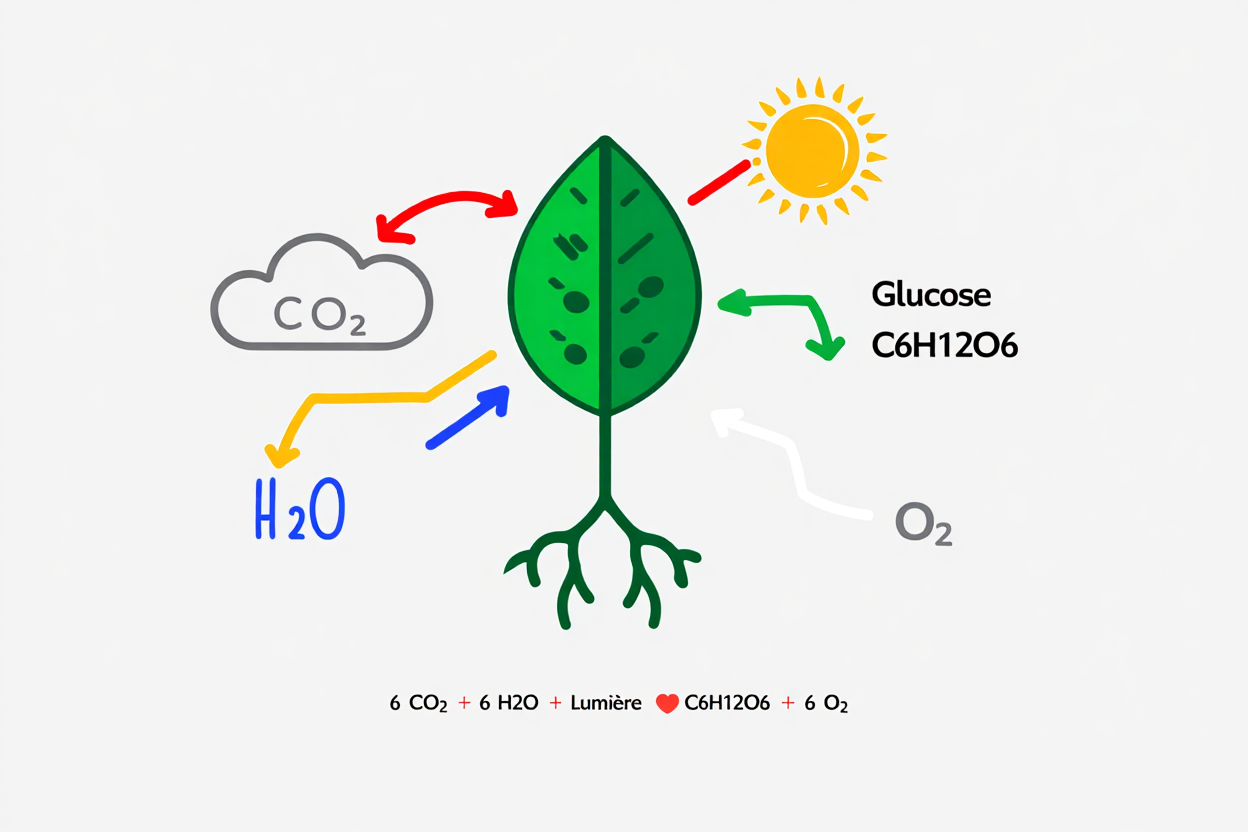
The overall equation is: 6 CO₂ + 6 H₂O + light energy → C₆H₁₂O₆ + 6 O₂. To properly label a photosynthesis diagram, you need to know the origin of each product; dioxygen comes entirely from water photolysis at PSII, and never from carbon dioxide.
. The definitive proof comes from the Ruben and Kamen experiment, which used water enriched with the isotope ¹⁸O. After the photochemical phase, the ¹⁸O ends up in the released dioxygen, while the glucose remains unlabeled, demonstrating that O₂ indeed comes from H₂O and not from CO₂.
From glucose to storage and transport
The glucose formed in the stroma of the chloroplast is only a starting point. It's either consumed through cellular respiration, or converted into sucrose to be exported via the elaborated sap to the roots, seeds or growing organs, thereby enabling the production of matter throughout the whole plant.
Excess glucose is stored as starch inside the chloroplast; a Lugol's iodine test then reveals a characteristic blue-black coloration. This same glucose also serves as a precursor for cell wall cellulose, wood lignin and various pigments such as anthocyanins.
Limiting factors and optimization for indoor growing
Photosynthesis depends on four main factors. The more the photon flux increases, the more the photochemical phase produces ATP and NADPH, until it reaches a saturation threshold where additional light absorption no longer increases yield.
Between 25°C and 30°C, Calvin cycle enzymes work optimally; below that range they slow down, and above it they denature. A high carbon dioxide concentration improves fixation, while adequate water availability remains essential for photolysis, ATP synthesis and, ultimately, dioxygen production.
To maximize the process in indoor growing, growers use blue-red LEDs that match the absorption peaks of chlorophyll, providing an efficient supply of light energy while limiting heat loss.
| Limiting factor | Effect on photosynthesis | Optimum | Note |
| Light intensity | Increases up to saturation | 1000-2000 μmol m⁻² s⁻¹ | Blue+red LEDs maximize efficiency. |
| Temperature | Bell curve around the optimum | 25-30 °C | Calvin cycle enzymes are temperature-sensitive. |
| CO₂ (carbon dioxide) | Increasing yield up to saturation | 800-1200 ppm | Rubisco requires an adequate supply. |
| Water (H₂O) | Essential for photolysis | Moist, non-waterlogged soil | Without water, no ATP, no dioxygen. |
Year 13 diagram of plant photosynthesis
A clear Year 13 photosynthesis diagram remains an essential ally for succeeding on your plant biology exam. It must reveal, without missing any detail, the plant's photosynthesis: precise location, energy flow and numerical summaries. Highlight the photochemical phase and the chemical phase so that each step becomes immediately clear.
Essential elements on the diagram
Your drawing must reflect the microscopic reality of the chloroplast and highlight the essential players in the process. Be sure to include all the necessary structures, molecules and flows, so the examiner can see at a glance how coherent your representation is.
- Chloroplast compartments: show the outer membrane, the stroma and the thylakoids — grana plus stromal lamellae. Indicate that the photochemical phase occurs on the thylakoid membrane, while the chemical phase takes place in the stroma.
- Pigments and photosystems: place chlorophyll a, chlorophyll b and carotenoids anchored in the membrane. Position PSII on the left, PSI on the right; note that they mainly absorb blue and red wavelengths.
- Electron transport chain: link PSII to PSI via plastoquinone, the cytochrome b₆f complex, then plastocyanin. Draw arrows illustrating the passage of electrons and the buildup of protons in the lumen.
Then place the rotary ATP synthase crossing the thylakoid membrane; draw an arrow toward the stroma to show the production of ATP and NADPH, plus the released O₂. These details confirm that light converts its energy into usable chemical molecules.
Arrows, flows and summaries to label
Each arrow should tell the story of matter and energy on the move. Show water entering PSII for photolysis, follow the electrons toward PSI, then illustrate how the proton gradient drives ATP synthase. The photosystems thus convert solar energy into a continuous electronic current.
Show ATP and NADPH migrating toward the stroma, where Rubisco fixes CO₂. Draw the Calvin cycle as a closed loop: 3-PGA, G3P, RuBP regeneration and ultimately glucose formation. All the steps should remain proportional to their actual importance.
Finish with the summaries: during the photochemical phase, each photon excites an electron, generates a proton gradient and results in the production of ATP plus NADPH. In the Calvin cycle, three ATP and two NADPH are enough to reduce one CO₂; six turns synthesize one molecule of C₆H₁₂O₆, numerical proof of the overall energy efficiency.