














































































Want to get a better handle on the link between solar energy and photosynthesis for your Year 12 science class? This article explains in detail how plants convert sunlight into storable chemical energy. Let's explore together this mechanism that is absolutely vital to the entire living world.
How solar energy powers photosynthesis
Photosynthesis is the natural process that converts solar energy into nutritive resources. By capturing energy from the sun, the plant produces glucose, a crucial energy source for its growth. At the same time, it releases dioxygen into the atmosphere, making the air breathable for other living beings.

Principle of converting light energy into chemical energy
The balanced equation sums up this reaction perfectly: 6 CO₂ + 6 H₂O + light → C₆H₁₂O₆ + 6 O₂. Starting from carbon dioxide and water, light enables the production of glucose and dioxygen. This fundamental concept in science shows how solar energy and photosynthesis give rise to complex organic molecules.
- Photon absorption: Chlorophyll, located in the leaf, captures the photons carried by radiation. This absorption excites the electrons and instantly triggers the biochemical reaction.
- ATP and NADPH production: These molecules, which act as energy carriers, form in the thylakoids during the light-dependent phases. They then supply the energy needed for glucose synthesis.
- Chemical energy storage: The glucose produced forms a stable reserve of chemical energy for the plant. It becomes the nutritive base that supports the entire food chain.
It's important to note that only around 3% of the light energy received is actually converted into biomass. Most of it is dissipated as heat or immediately reflected. Despite this modest yield, this production of matter remains absolutely essential to life on Earth.
The role of photosystems in capturing photons
Photosystems act like tiny solar sensors nestled at the heart of plant cells. The first, photosystem II, preferentially absorbs blue light, while the second, photosystem I, captures red wavelengths, maximizing overall efficiency. Their coordination ensures the conversion of light energy into chemical fuel to power photosynthesis.
A single leaf fragment contains millions of chloroplasts, which function like microscopic factories. These structures enable intense production and release enormous quantities of this vital gas. It's at this infinitely small scale that the energy future of the living world is decided.
Energy yield of photosynthesis in plants
But how much solar energy can plants actually store in their tissues? While theory predicts a yield of up to 11%, reality sits closer to 1 to 3% for the most common plants. Some species, such as corn (C₄ plants), fix carbon more efficiently and can reach up to 6%.
Ambient temperature and light intensity strongly influence the efficiency of this biological process. Excess radiation can saturate the plant's machinery, dissipating the surplus energy as heat. Precise, well-controlled lighting is therefore essential for maximizing crop growth.
| Parameter | Optimal value | Impact on photosynthesis |
| Light intensity | 200 µmol m⁻² s⁻¹ | Optimizes CO₂ fixation without causing saturation |
| CO₂ concentration | 400 ppm | Balances the yield and efficiency of the process |
| Blue wavelength | ≈450 nm | Mainly activates photosystem II |
| Red wavelength | ≈680 nm | Mainly activates photosystem I |
| Practical C₃ yield | 1-3% | Actual conversion rate of light into biomass |
| Practical C₄ yield | 5-6% | Better efficiency thanks to an optimized biochemical mechanism |
Light spectrum and efficiency of biological conversion
It's essential to understand that not all light sources are equal when it comes to feeding plants through photosynthesis. Choosing the optimal light spectrum is decisive and radically influences the efficiency of the process. It's comparable to tuning a radio: without the right frequency, no signal gets through! At GrowLED, we know that the biological conversion of solar energy through photosynthesis depends entirely on the precision of these light spectra.

Wavelengths absorbed by plant photosystems
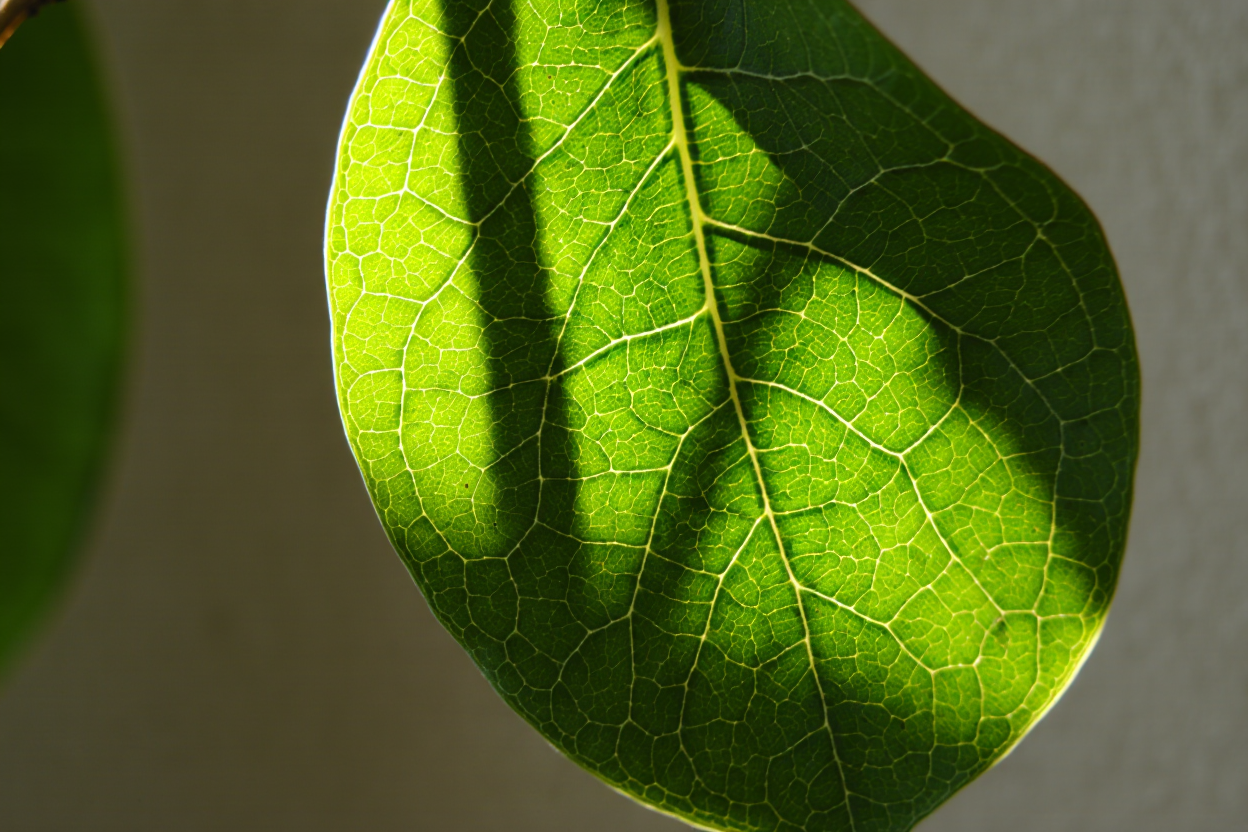
Plants show very distinct spectral preferences: they heavily absorb blue (around 430 nm) and red (around 660 nm) light. On the other hand, they reflect green light, which explains why we perceive leaves as that color! This specificity stems from the molecular structure of chlorophyll. These chlorophyll pigments have adapted to capture the wavelengths that best pass through the atmosphere and water.
- Blue light (430 nm): It stimulates photosystem II, triggering the photolysis of water and the essential release of O₂. This step is the critical starting point of the process.
- Red light (680 nm): It reactivates the electrons of photosystem I, producing the ATP and NADPH needed for the Calvin cycle.
- UV rays: They trigger the synthesis of protective compounds, such as flavonoids, strengthening the plant's immunity.
- Green light: It penetrates deeper into the leaf, where it is captured by accessory pigments such as carotenoids.
It's fascinating to isolate and measure these spectral effects experimentally. A plant grown under a blue light develops very differently from one exposed only to red. Researchers use exactly this principle to improve agricultural yields and optimize crop growth.
Benefits of LED grow lights for reproducing the solar spectrum
This is where modern technology makes all the difference! Horticultural LED lights, such as our ATS 200W PRO and Zeus 600W PRO models, deliver an optimal light spectrum, perfectly tuned for photosynthesis. Unlike older HPS lamps that dissipate 60% of their energy as heat, LEDs convert electricity directly into useful photons. This efficiency represents a genuine revolution for science education.
Our panels offer a precise balance of blue, red, and UV to faithfully reproduce sunlight. Adding UV/UVB supplements promotes the synthesis of protective pigments, simulating the natural action of the sun. In the classroom, you can set the intensity to 200 µmol m⁻² s⁻¹ to watch plants react live, making the experience concrete and educational.
The photon efficiency of our equipment, such as the HLG 300L RSPEC, reaches 2.5 µmol per joule consumed. To put it simply: one watt of LED power generates roughly 1 µmol m⁻² s⁻¹ of photosynthetically active flux (PAR). This practical ratio greatly helps students convert electrical power into photon flux without unnecessary complexity.
Hands-on experiments to study photosynthesis and energy
Let's move from theory to practice! Discover hands-on classroom experiments that illustrate exactly how energy conversion works during photosynthesis. These protocols, using controllable LEDs, let you directly observe the production of organic matter from mineral matter.

Observation protocols with controlled LED grow lighting
Here is a simple, effective protocol for getting solid results with your students. Take two identical bean plants: place the first under an LED grow light on a 12h/12h cycle, and the other in total darkness. After ten days, by measuring the dry biomass, you'll see that the lit plant has grown while the other has withered.
This experiment clearly shows that the combination of light energy, water, and CO₂ is essential for growth. These classroom photosynthesis experiments thus become tangible demonstrations of essential biological mechanisms.
- Blue vs. red spectrum test: Use a multi-spectrum lighting system to compare growth under blue, red, or combined light. Then measure plant height and count the number of leaves after fifteen days.
- Intensity variation: Set a light-intensity dimmer to create a gradient (for example, from 50 to 300 µmol m⁻² s⁻¹) and plot a growth curve to identify the light saturation point.
- UV-protection observation: Expose plants to UVB for a week and compare leaf coloration, which reveals the plant's production of protective pigments.
- O₂ production measurement: Place a fresh leaf under a transparent bell jar lit by an LED, add CO₂, and use a sensor to quantify the release of dioxygen.
Each protocol takes one to three weeks to produce accurate results. The observations are unambiguous and show how light energy is transformed into plant growth, a perfect example of active learning for science education.
Measuring photosynthetic yield under laboratory conditions
Now let's move to a more quantitative step: calculating the yield of photosynthesis. LED-based teaching applications make this experimental approach easier. Grow a bean plant for eight days under an LED with a regular light cycle.
Weigh the dry biomass at the start and at the end, after drying. Calculate the solar energy supplied (power in watts × duration in hours). Compare this value to the stored chemical energy, estimated by multiplying the dry mass produced by 17 kJ/g (the average energy value of organic matter).
The ratio between the stored chemical energy and the light energy received gives the photosynthetic yield. The result is generally between 2 and 4%, which matches the theoretical data. This exercise turns students into researchers testing the yield hypothesis, producing a solid, validated revision sheet.
GrowLED teaching equipment for Year 12 science
Complete kits including LED panels, easy to set up on any classroom bench, are available. These LEDs adjust to the height of the plants, and their intensity can be adjusted with a simple dimmer, making them ideal for a classroom setting.
Some models offer maximum flexibility, letting you vary light intensity in real time. Students can then directly observe how plant growth responds. This equipment faithfully reproduces the conversion of solar energy into chemical energy for high-quality hands-on work.
Multi-spectrum LEDs allow direct comparisons between the effects of different wavelengths (blue, red). Unlike fluctuating natural light, they guarantee controlled, stable conditions, essential for reproducible, solid results in science education.