


















































































Photosynthesis is the process by which plants feed themselves by turning light energy into essential nutrients. Let's explore how this fascinating mechanism works, from its three fundamental components to its practical applications in indoor growing. Get ready for a simple, accessible explanation!
How photosynthesis works in plants
Have you ever wondered how plants manage to grow without eating like we do? The secret lies in photosynthesis, nature's marvel where the energy of light is converted into food. Let's dive into this amazing phenomenon that turns photons into life! ✨

The three essential ingredients of the process
Photosynthesis requires three essential elements, just as a recipe needs precise ingredients. Without them, nothing happens! Water, atmospheric carbon dioxide, and sunlight form an irreplaceable trio. It's like trying to cook without one of the main ingredients: it simply doesn't work!
- Water: Absorbed by the roots, it travels up to the leaf and becomes a key reactant in the reaction.
- Carbon dioxide (CO₂): It is captured through the leaf stomata and supplies the carbon needed to synthesize glucose.
- Sunlight: It provides the energy needed to trigger the reaction and convert these raw elements into food.
The absence of just one of these components stops photosynthesis in its tracks. A plant deprived of light withers, and without water or carbon dioxide, making glucose is impossible. Every element plays a role just as crucial as the others!
The central role of chlorophyll
Chlorophyll is one of the great protagonists of this story! This green pigment, housed in the chloroplasts of plant cells, is tasked with capturing light energy. It mainly absorbs the blue and red wavelengths of the light spectrum, which gives plants their characteristic green color.
Picture chlorophyll as a micro power plant: it receives photons of light and turns them into energy the plant can use. Without this vital molecule, photosynthesis couldn't take place. It's the spark that sets the whole biological process in motion! ✨
The chemical equation of photosynthesis explained
Although it looks technical, the chemical equation sums up a simple idea: 6 CO₂ + 6 H₂O + light → C₆H₁₂O₆ + 6 O₂. In other words, six molecules of carbon dioxide and six molecules of water, under the effect of light, produce glucose and oxygen. In this way, the plant feeds on sugar while releasing the oxygen we breathe!
The two phases of photosynthesis
Photosynthesis doesn't happen in a single step: it consists of two distinct phases working in perfect harmony, like a well-orchestrated duo. The first phase depends directly on light, while the second works independently of it, creating a surprising contrast that is nonetheless essential to the process.
Light phase: energy production in the thylakoids
This first step takes place inside the thylakoids, small stacked structures inside the plant's chloroplasts. When light reaches these structures, a fascinating process kicks off: water molecules are split apart, releasing oxygen into the atmosphere.
This reaction generates two essential energy molecules, ATP and NADPH, which will serve as an energy source for the next steps. In the thylakoids, photons are captured to create a flow of electrons that produces the energy needed for the future synthesis of glucose.
Calvin cycle: carbon fixation
Once produced, ATP and NADPH leave the thylakoids and head to the stroma, the liquid part of the chloroplast. This is where the Calvin cycle begins, a phase that doesn't need direct light to work.
This step uses the energy stored earlier to turn carbon dioxide into glucose, which is the plant's true source of nutrition. The process relies on the enzyme Rubisco, which fixes carbon before it is converted into sugars with the help of NADPH.
For this mechanism to work efficiently, about eight photons are needed to fix one CO₂ molecule and release oxygen. It's a precision process that allows the essential elements to regenerate so the cycle can continue indefinitely.
The importance of light for feeding plants
As you probably already know, light is essential for photosynthesis: without it, your plants simply cannot feed themselves. But be careful, not all light sources are equal when it comes to supporting healthy, vigorous growth. The quality and intensity of the light have a major impact on the final result of your crops.
Which light spectrum favors photosynthesis
The ideal light spectrum for plants lies between 400 and 700 nanometers, which corresponds to the visible part of light. However, plants don't perceive light the same way the human eye does. Chlorophyll a mainly absorbs blue (around 440 nm) and red (around 680 nm) wavelengths, and reflects green light.
Chlorophyll b, meanwhile, captures more blue-green light, helping the leaf maximize the absorption of the available light energy. Other pigments, such as carotenoids, absorb green light while protecting the plant against excess light. For aquatic algae, phycobilins allow the use of blue-green and yellow-green tones, shades that are often overlooked. Each plant organism thus has its own sensors, perfectly suited to its environment.
| Wavelength (nm) | Color | Effect on the plant |
| 400-450 | Violet-Blue | Encourages compact growth, thickens foliage, and strengthens stems. |
| 450-495 | Blue | Essential for photosynthesis and crucial for root development. |
| 495-570 | Green | Penetrates the lower layers of the canopy, but is poorly absorbed. |
| 620-750 | Red | Very energy-efficient, it strongly stimulates flowering and fruiting. |
| 750+ | Infrared | Invisible, yet it still influences the plant's shape and flowering. |
Blue and red therefore turn out to be indispensable allies for successful indoor gardening. This is why modern artificial lighting focuses specifically on these precise wavelengths. Lighting systems thus faithfully reproduce what your plants need to thrive.
Optimizing lighting with LED grow lights
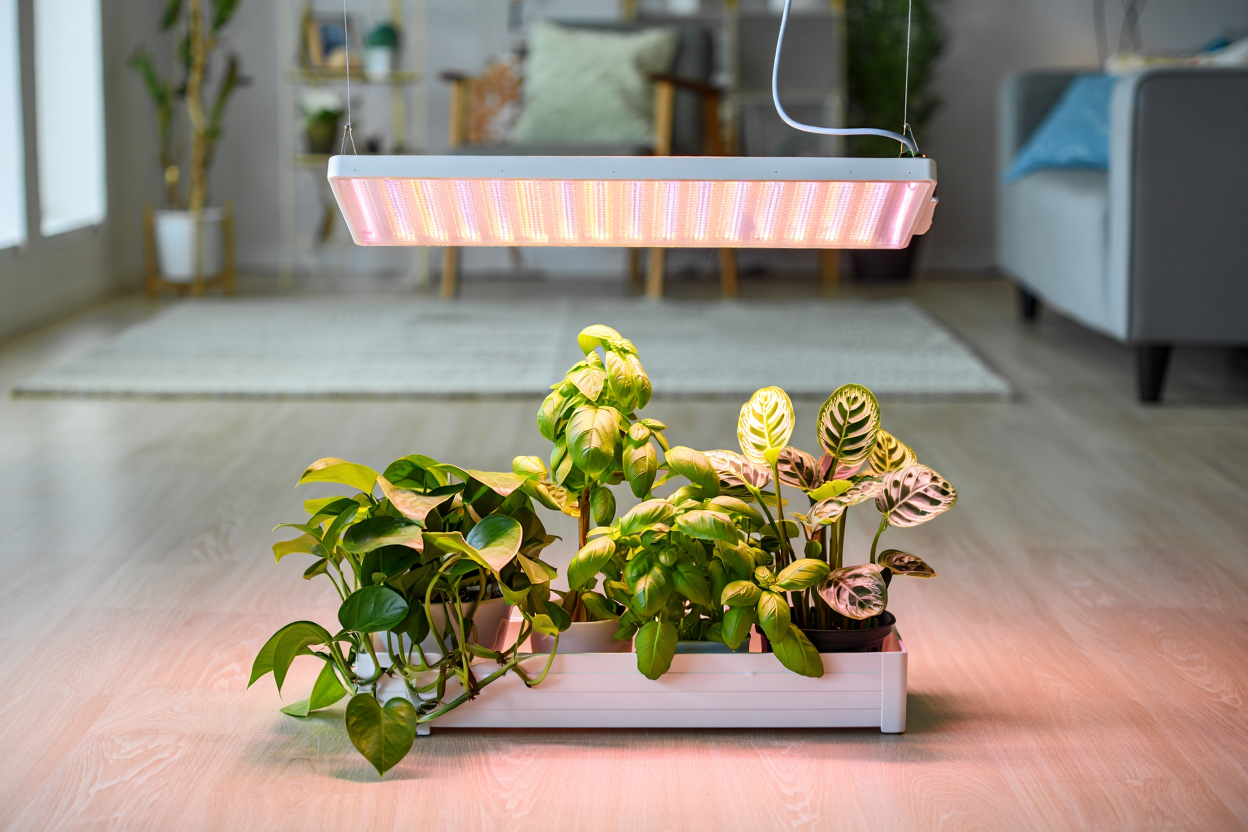
Using LED grow lights revolutionizes indoor growing by providing a light spectrum perfectly suited to plant needs. Unlike regular bulbs, which give off full white light, these devices target only the useful areas of the spectrum. It's like offering your crops a custom-tailored nutritional cocktail.
- Blue and red duo: This calibrated mix ensures a higher photosynthetic yield, often far more effective than unfiltered natural light.
- Duration control: Indoors, you can program lighting for up to 16 hours a day, speeding up growth regardless of the season.
- Energy savings: LED technology uses noticeably less electricity than discharge lamps, which is good for your budget and the environment.
- Intensity management: It's easy to adjust light output depending on the plant's stage of development.
By equipping yourself with quality gear, you turn your growing space into a perfectly optimized environment. Your plants get the energy they need at just the right time, which keeps them healthy and vigorous. The results show quickly: faster growth and abundant harvests, even for beginner growers.
Compensation point and light saturation
Have you heard of the light compensation point? It's a critical threshold for your plant's survival. It's the light intensity at which oxygen production through photosynthesis exactly offsets the plant's respiration. Below this level, it withers; above it, it starts growing actively.
There's also an upper limit, called the light saturation point. Beyond this threshold, extra lighting becomes pointless. Once this stage is reached, photosynthetic capacity plateaus and the plant can no longer absorb more energy. LED grow lights make it possible to find this ideal balance without wasting electricity.
Practical applications in indoor growing
Now that the theoretical basics are covered, let's see how to put them into practice to grow successfully at home. Indoor growing represents a real revolution, especially thanks to the use of high-performance LED grow lights and tight climate management. In this controlled environment, your plants can develop spectacularly.

Optimizing photosynthesis in indoor growing
To succeed at indoor growing, a strategic approach is essential in order to recreate a living, balanced ecosystem. Using LED grow lights is only one part of it; you also need to control CO₂ levels, humidity, and air circulation. All these elements work together to maximize photosynthetic yield.
- Optimal air circulation: effective ventilation renews CO₂ and maintains an ideal temperature, generally between 18 and 25 °C. It clears out stale air and significantly improves your photosynthetic yield.
- Cleaning the leaves: dust that builds up on leaves blocks some of the light needed by the chloroplasts. Gently wiping each leaf with a soft cloth once a week can increase light absorption by 10 to 15%.
- Choosing the right species: some plant varieties are better suited to indoor conditions and need less energy to develop. Favor species known for their vigor indoors to make the best use of your resources.
The key to success lies in combining quality artificial lighting with precise climate management. This way, your plants get ideal conditions to carry out photosynthesis at full capacity. It's really about creating a tailor-made environment, perfectly suited to their needs.
Measuring photosynthesis efficiency
Several simple methods let you check that your setup is working properly without needing biochemistry expertise. For example, an electrode can detect oxygen production, and an iodine test reveals the presence of starch in the leaves. Flow chambers can also precisely measure gas exchange in real time.
Chlorophyll fluorometry is a fascinating non-invasive technique: it analyzes how chloroplasts react to light without harming the plant. A healthy plant shows high fluorescence, unlike a stressed plant. These sensors help you fine-tune your settings for optimal growth.
For a simple visual demonstration, place an aquatic plant under your lamp: you'll clearly see oxygen bubbles escaping. That's tangible proof that photosynthesis is at work, a phenomenon visible to the naked eye. A properly lit plant stays vigorous, while a lack of light quickly leads to its decline.
The ecological role of photosynthesis
Far more than just a way for your plants to feed, photosynthesis is the single most fundamental process for life on Earth. It produces the oxygen we need to breathe and actively helps regulate our global climate. A true pillar of the biosphere, it sustains the whole of the planet's ecosystems.
Impact on the carbon cycle
The carbon cycle depends entirely on this biochemical process, which converts atmospheric CO₂ into plant biomass. Without this transformation, carbon would remain in gas form, dangerously worsening the greenhouse effect. Green plants precisely capture light energy to fix this carbon and store it long-term.
- Massive CO₂ capture: every year, photosynthesis traps about 130 terawatts of solar energy, far surpassing the world's entire human energy consumption. Even your houseplants take part in this planet-wide effort!
- Carbon storage: the glucose produced gradually builds up in leaves, stems, and roots. Carbon thus stays locked away throughout the plant's life, making mature forests true carbon sinks. ️
- Climate regulation: by lowering atmospheric CO₂ levels, photosynthetic organisms directly help ease the greenhouse effect. They act like a natural thermostat that is essential to our survival. ️
- Perpetual cycle: photosynthesis maintains a dynamic balance between biomass production and decomposition. This system has self-regulated with remarkable precision for billions of years.
Growing plants at home means actively helping to reduce atmospheric carbon dioxide. Every new leaf that grows is a small victory in capturing carbon. An activity that's both eco-friendly and rewarding.
Oxygen production and biodiversity
This is where the full magic of photosynthesis shows itself, releasing around 1,400 gigatons of oxygen every year. Without this vital gas, produced by land and aquatic photosynthetic organisms, human life would be impossible. The Great Oxidation, triggered by bacteria, transformed our atmosphere billions of years ago.
Terrestrial primary productivity converts a colossal amount of captured energy into essential organic matter. The glucose produced this way forms the base of food chains, from herbivores to top predators. Without oxygenic photosynthesis, no complex biodiversity could exist today.
It's fascinating to see that ecosystems generally maintain a neutral oxygen balance over the long run. What photosynthesis generates is ultimately consumed by respiration, forming a perfectly balanced cycle. Every plant you grow takes part in this wonderful natural balance. ⚖️
Future applications and artificial photosynthesis
Scientists today are exploring new ways to harness photosynthesis to produce clean fuels from sunlight. Reproducing this process artificially is a major quest to obtain sustainable, unlimited energy. Innovative projects are combining biotechnology and light to develop the solutions of tomorrow.
Some research aims to introduce partial photosynthetic mechanisms into micro-organisms to directly produce biofuels. Imagine a bacterium able to use CO₂ to make energy instantly. Elsewhere, a particular algae is being cultivated to generate hydrogen using light. ⚡
Artificial photosynthesis could transform our global energy systems by drawing on strategies found in nature. All these advances stem from the simple mechanism your plants carry out every day before your eyes.