















































































Want to know how your plant turns light into energy? This article explains photosynthesis at the cellular level, step by step and without complicated jargon. Together, let's explore the fascinating role of the chloroplast and how it directs this remarkable process, essential to life on Earth.
How the Chloroplast Orchestrates Cellular Photosynthesis
The chloroplast is the key organelle in your plant: this is where the magic happens! Think of it as a mini-factory specializing in the production of energy and organic matter, essential for plant growth. Discover the essential role of the chloroplast in cellular photosynthesis to understand how this organelle converts light into assimilable carbon. Each plant cell contains between 20 and 100 of them, depending on the tissue. Leaves are often packed with them, with more than 50 units per cell! This density is what lets them capture light so efficiently.

Chloroplast Architecture: Double Membrane and Compartments
The chloroplast's structure is truly fascinating to observe! It's surrounded by a protective double membrane enclosing a gel called the stroma, acting as a specialized cytoplasm. Inside, you'll find stacked structures called grana. Each granum is made up of 30 to 40 thylakoid membranes rich in pigments. This is where it all begins.
- Outer double membrane: it protects the organelle and strictly controls molecular exchanges between the chloroplast and the cytoplasm.
- Stroma: this liquid gel contains the enzymes, metabolites, and chloroplast DNA essential to the reactions of the Calvin cycle.
- Stacked thylakoids: these membranous structures, rich in chlorophyll and photosynthetic complexes, capture light energy.
- Cooperative genome: around 80% of chloroplast proteins are encoded by nuclear DNA and then imported using specific peptides.
This system works in perfectly coordinated fashion: the nucleus produces some proteins while the chloroplast synthesizes others locally. It's a real collaboration where every element has its role! In a lettuce leaf, for example, each palisade cell contains 20 to 30 chloroplasts arranged around the nucleus to optimize light absorption. Nature shows off some truly ingenious know-how.
Thylakoids and Grana: The Photosynthetic Power Plants
The stroma thylakoids are the true sites where light energy is captured! These stacked membranes house photosystems I and II, ATP synthase, and the electron transport chain. It's within the thylakoids that the light phase of photosynthesis takes place, during which water is split, releasing the oxygen we breathe. The pigments, notably chlorophyll a and b, act as microscopic solar sensors, absorbing mainly blue and red light.
The stroma, meanwhile, surrounds the thylakoids and contains the enzymes essential to the Calvin cycle. There's a clear functional separation: the light-dependent reactions take place in the thylakoids, while the light-independent steps occur in the stroma. It's like a factory with two specialized workshops! This compartmentalization lets the plant optimize each process without interference.
Stroma and Enzymes: The Seat of the Calvin Cycle
The stroma acts as a "chemical lab" for your chloroplast, where carbon compounds are formed. It's home to key enzymes, such as the famous rubisco, the most abundant enzyme on Earth! It fixes CO₂ onto ribulose-1,5-bisphosphate to kick off the Calvin cycle. Without it, there would be no glucose, no sugars, and no possible growth.
The stroma also carries all the metabolites essential to the Calvin cycle, such as 3-phosphoglycerate and G3P, along with the ATP and NADPH produced by the thylakoids. Do you see how integrated the system is now? The thylakoids generate the energy, and the stroma uses it to turn carbon into organic matter. It's a continuous flow, a truly and perfectly orchestrated molecular dance.
The Two Phases of Photosynthesis in the Plant
Photosynthesis relies on close collaboration between two distinct stages that work in perfect synergy. The light phase happens in the thylakoids, while the second, the Calvin cycle, takes place in the stroma. These two processes are inseparable: stopping one immediately blocks the functioning of the other.
Understanding this interaction is fundamental to grasping how every plant manages to turn light into essential sugars. Thanks to this internal cooperation, light energy is converted into a usable food source.

Light Phase: From Light to Energy Molecules
During the light phase, the plant actively captures solar radiation to kick off its energy production. This process takes place within the thylakoid membranes and depends entirely on the presence of light. It all starts when chlorophyll in photosystem II (PSII) absorbs photons, exciting the electrons.
This activation triggers a cascade of chemical reactions crucial to plant life. Here are the main steps that follow one another:
- Water photolysis: PSII splits water molecules to release protons, electrons, and oxygen.
- Electron transport chain: the electrons travel between proteins, creating a proton gradient.
- ATP synthesis: this proton flow activates ATP synthase, an enzyme that produces ATP, the main source of cellular energy.
At the same time, NADP⁺ captures the electrons at the end of the chain to form NADPH, acting as a chemical reserve. It takes roughly three protons passing through ATP synthase to generate one molecule of ATP. Under optimal light, this mechanism reaches remarkable efficiency inside every chloroplast.
Calvin Cycle: Turning CO₂ into Glucose
The Calvin cycle is the stage where mineral carbon is turned into glucose. This process takes place in the stroma and begins with CO₂ fixation via the rubisco enzyme. The energy supplied by ATP and NADPH then allows the intermediate compounds to be reduced into simple sugars.
Lastly, RuBP regeneration keeps the cycle running as long as resources are available. It's a continuous reaction that depends directly on the energy supply coming from the thylakoids. Without this constant supply, organic matter production would slow down considerably.
Synthesizing one complete molecule of glucose requires 18 ATP and 12 NADPH. This consumption shows the vital link between the photochemical phase and sugar production. Discover photosynthesis at the cellular level to dig deeper into the subtleties of this biological mechanism.
| Phase | Location | Light dependence | Key products |
| Light phase | Thylakoids | Depends on light | ATP, NADPH, O₂ |
| Calvin cycle | Stroma | Independent (uses ATP/NADPH) | G3P, glucose, RuBP |
Overall Equation and Energy Balance of Photosynthesis
The classic photosynthesis equation sums up this phenomenon: 6 CO₂ + 6 H₂O + light → C₆H₁₂O₆ + 6 O₂. Although simplified, it perfectly illustrates the conversion of basic elements into storable chemical energy. The stoichiometric coefficients here ensure that atom conservation is respected.
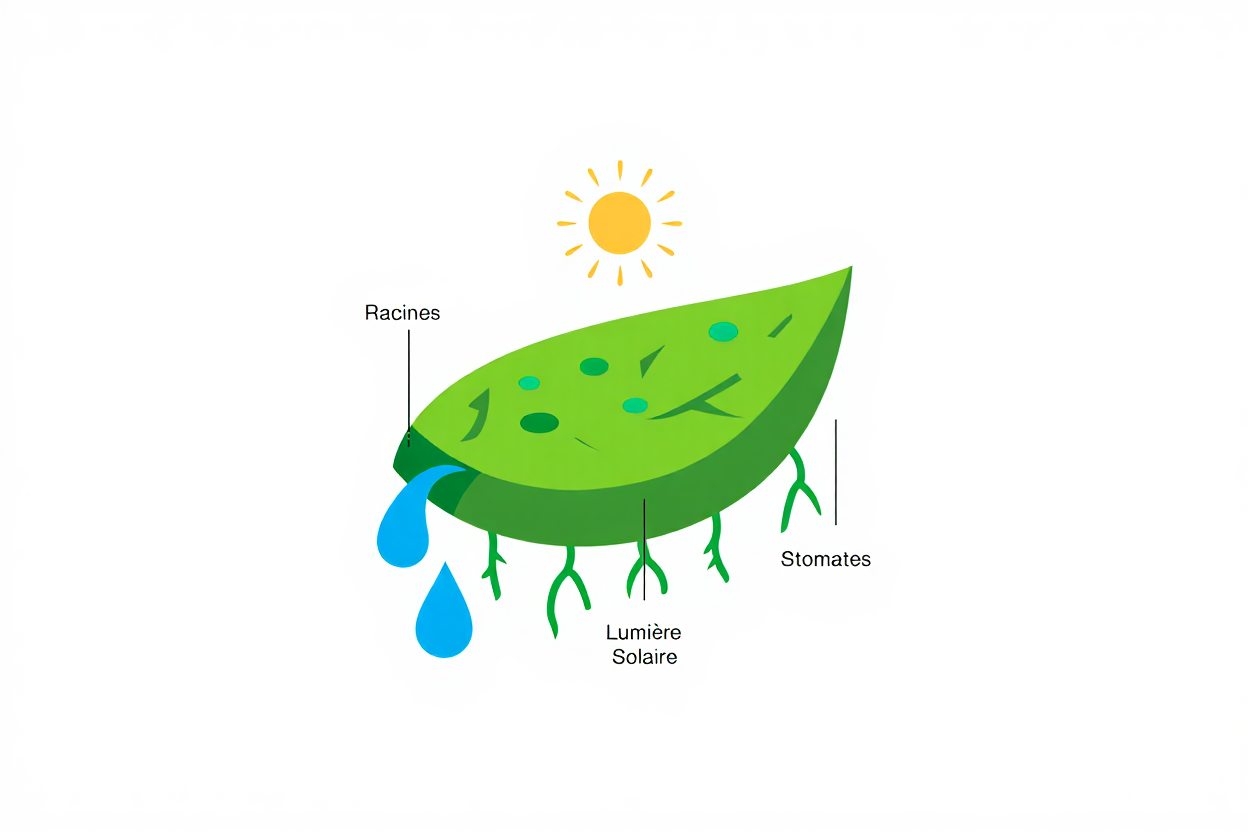
Carbon dioxide enters the leaf through the stomata, while water is transported up from the roots. Under optimal conditions, this biological machinery enables substantial production of organic matter. This reaction speed is what explains the vigorous growth of plants.
It's crucial to note that the oxygen released comes exclusively from the water molecules broken down at the start. The glucose produced will either be used for cellular respiration or stored as starch. Behind this seemingly simple photosynthesis equation lies a plant chemistry of remarkable complexity.
Optimizing Photosynthesis in Indoor Growing
Now that we understand its mechanism, let's see how to optimize it! In indoor growing or under a greenhouse, you control key factors like light, temperature, and CO₂. This is a major advantage for effectively steering the photosynthetic reaction.
With precise adjustments, it's possible to double, or even triple, biomass production compared to standard methods. Discover the photosynthesis equation and its link with cellular respiration to better understand these essential interactions. Let's explore the solutions together.
Light Spectrum and Absorption by Chlorophyll
Chlorophyll doesn't capture every color the same way — it favors certain areas of the spectrum. It mainly absorbs blue wavelengths (around 430-450 nm) and red wavelengths (around 660 nm), which explains why leaves look green.
Good LED grow lighting should offer precise intensity peaks at 450 nm and 660 nm to maximize the plant's absorption. Without these specific frequencies, a large part of the light energy is simply wasted.
Carotenoids, located in the thylakoids, complete this process by capturing energy and passing it on to chlorophyll. These pigments also play an essential protective role against excess light through heat-dissipation mechanisms. It's real teamwork at the pigment level!
Spectral filtration tests confirm it: expose a leaf to different lights and observe oxygen production. Red or blue light alone gives modest results, but combining them delivers optimal power for photosynthesis.
- Blue peak (450 nm): stimulates photosynthesis, limits stem stretching, and strengthens the plant's structure.
- Red peak (660 nm): this wavelength boosts photosynthesis and promotes flowering and sugar accumulation.
- Optimal combination: a red/blue ratio of 3:1 or 2:1 is ideal for maximizing indoor growth.
With a modern LED grow light that provides these spectra, your plant captures energy with formidable efficiency. It spends far less effort seeking the light it needs to develop. It's like giving your crop premium fuel.
Key Parameters: Light, Temperature, and CO₂ for the Plant
Optimizing photosynthesis relies on a delicate balance between three pillars: light intensity, ambient temperature, and carbon dioxide (CO₂) levels. Balancing these elements is crucial for achieving the best yields.
Ideal intensity is generally between 200 and 400 µmol·m⁻²·s⁻¹ during the vegetative stage, over 18-hour cycles. Going above 800 µmol·m⁻²·s⁻¹ no longer improves the reaction and can even slow it down because of photoinhibition.
- Light intensity: target 200-400 µmol·m⁻²·s⁻¹ during the vegetative stage and 400-800 during flowering for maximum efficiency.
- Ideal temperature: keep it between 25 and 30 °C, since enzymatic activity drops considerably outside this range.
- CO₂ enrichment: increasing up to 1000-1200 ppm can boost biomass by 20 to 40% compared to ambient air.
- Relative humidity: keep it at 50-70% to keep the stomata open without encouraging fungal disease.
Let's take a concrete example: a grow tent equipped with specific LEDs, heated to 27 °C with CO₂ enrichment at 1100 ppm. This setup doubled lettuce production in just ten days compared to standard lighting. That's twice as fast!
At 27 °C, enzymatic reactions speed up because the Rubisco enzyme runs at full efficiency. CO₂ enrichment ensures carbon never runs short to fuel the precious Calvin cycle. Everything works together for efficiency.
Watch out for photoinhibition, though: light that's too intense can cause irreversible damage if it exceeds actual needs. The plant then has to activate antioxidant defenses, which are very costly in energy, to neutralize this oxidative stress.
Stomatal opening regulates essential gas exchange: if they close due to stress, photosynthesis slows down instantly. Even with the best light, the overall balance of parameters remains the real key to success.