















































































Want to master your biology course on photosynthesis quickly and simply? This article reveals the inner workings of this fascinating mechanism, from capturing light to making glucose. Follow along to nail this key chapter of your science class!
What Is Photosynthesis in Biology?
Photosynthesis is a fundamental biological process through which plants and certain algae convert light energy into chemical energy. This energy is then stored as glucose, forming the foundation of the food chain. Without this mechanism, complex life as we know it would be impossible on Earth.

Definition and General Equation of the Process
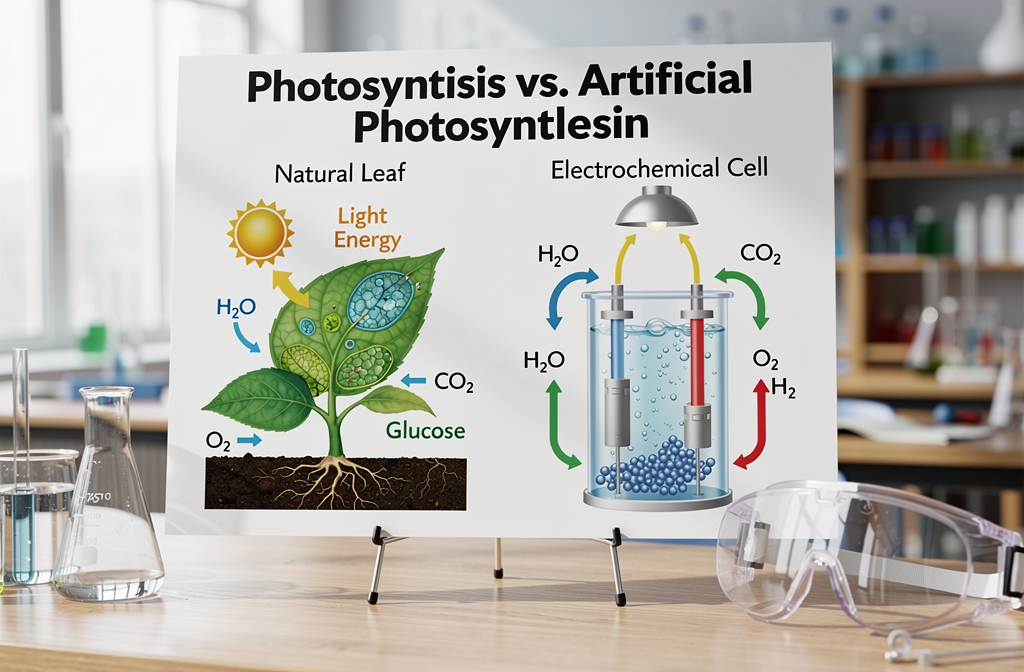
Your science course on photosynthesis rests on one key equation: 6 CO₂ + 6 H₂O + light energy → C₆H₁₂O₆ + 6 O₂. This formula shows how plants use carbon dioxide and water to produce glucose and dioxygen. It's thanks to this reaction that the oxygen we breathe is released every single day!
Every year, plants generate close to 150 billion tonnes of organic matter through this remarkable natural process. This organic matter production feeds every heterotrophic organism, from the smallest insect to the largest predator. Just imagine: without photosynthesis, life would die out within weeks.
- Energy conversion: light energy is transformed into chemical energy, stabilized within glucose molecules.
- Oxygen production: dioxygen is released as a by-product, coming solely from the splitting of water.
- Two complementary phases: a photochemical phase (light-dependent) and a chemical phase (light-independent).
Contrary to popular belief, the oxygen you breathe comes solely from water, not from CO₂. Using isotopic tracers, researchers confirmed that the dioxygen released comes exclusively from the water molecule. A major discovery for accurately establishing the overall balance of photosynthesis!
Cellular Location Within the Chloroplasts
In biology, photosynthesis mainly takes place in one specific organelle: the chloroplast, found in chlorophyll-containing cells. Each chloroplast is structured with stacked thylakoid membranes and an internal stroma. It's within these two compartments that the entire photosynthetic process takes place!
The thylakoid membranes house the photosystems, complexes capable of capturing light energy. The stroma, meanwhile, contains the Calvin cycle enzymes responsible for the chemical phase. This organization allows an efficient separation between the light-dependent reactions and the biochemical reactions.
The Three Essential Ingredients for Photosynthesis
Three ingredients are absolutely essential for photosynthesis to run properly. If just one of them is missing, the process stops immediately — a crucial parameter that growers keep a close eye on.
- Light: the primary energy source that triggers the photochemical phase in the thylakoids. Plants mainly absorb blue and red wavelengths.
- Water: supplies the necessary electrons; it's split during photolysis to release protons, electrons, and dioxygen.
- Carbon dioxide: the carbon source used to build organic matter through carbon fixation catalyzed by the RuBisCO enzyme.
In indoor growing, optimizing these three factors can transform your results. A suitable light intensity over an 18-hour period, for example, improves carbon fixation and significantly increases biomass. You'll notice that with the right lighting, the whole photosynthetic apparatus works much better.
How Does the Light-Dependent Phase of Photosynthesis Work?
The light-dependent phase kicks off the real process, where the magic happens. This essential stage takes place inside the chloroplast's thylakoids, converting light energy into indispensable chemical energy. Without this photochemical phase, the Calvin cycle couldn't get started, since the two phases are entirely interdependent.

Capturing Light Energy Through Pigments
In your Year 12 biology class on photosynthesis, you'll learn that it all starts with chlorophyll a and b. These pigments capture photons and mainly absorb blue and red wavelengths. Leaves look green to us because they reflect that color, while using the others to produce energy. Other molecules, such as carotenoids, broaden the absorption spectrum by capturing light energy that chlorophyll alone couldn't use.
Water Photolysis and Oxygen Release
The light-dependent phase of photosynthesis begins with a remarkable phenomenon: the photolysis of water. When photons reach photosystem II, they pull electrons from water molecules. This reaction releases oxygen, an essential gas that we breathe thanks to this ancient mechanism!
These freed electrons aren't lost: they travel along an electron transport chain. Passing from one molecule to another, they transfer their energy to pump protons (H⁺) across the thylakoid membrane. This phenomenon generates a concentration gradient, similar to an elevated reservoir ready to release its energy.
ATP and NADPH Production
This is where photophosphorylation comes in, a fascinating process of ATP production. The accumulated proton gradient passes through a complex enzyme called ATP synthase, which acts like a mini turbine. It converts the energy of the proton flow to produce ATP, the universal energy currency of cells.
Meanwhile, the electrons end their journey by being accepted by NADP⁺, which then becomes NADPH. These two molecules, ATP and NADPH, will serve as fuel in the Calvin cycle to synthesize glucose from CO₂. Research shows that specific lighting can boost this mechanism, highlighting the importance of well-suited light.
| Process | Location | Key products | Light dependence |
| Water photolysis | Photosystem II (thylakoid) | H⁺, e⁻, O₂ | Directly requires photons |
| Transport chain | Thylakoid membrane | Proton gradient | Powered by electrons |
| Photophosphorylation | ATP synthase (thylakoid) | ATP | Depends on the gradient |
| NADP⁺ reduction | Photosystem I (thylakoid) | NADPH | Accepts electrons from the chain |
In short, the light-dependent phase converts the photons' light energy into two key chemical resources. ATP provides the immediately needed energy, and NADPH supplies the reducing power required for the later reactions. Without these essential contributions to the Calvin cycle, organic matter couldn't form.
What Are the Steps of the Calvin Cycle?
Now that you understand how light produces ATP, let's see how these molecules help create the plant's food. The Calvin cycle, often called the dark phase, is the chemical synthesis stage that doesn't directly need light. It's at the heart of this mechanism that glucose forms, an energy source essential to the living world.

CO₂ Fixation by the RuBisCO Enzyme
The Calvin cycle begins with the capture of a molecule of carbon dioxide by the RuBisCO enzyme, which attaches it to an acceptor called ribulose bisphosphate (RuBP). The resulting unstable compound immediately splits into two molecules of 3-phosphoglycerate. This reaction repeats constantly, millions of times per second, in every leaf.
- Carbon fixation: RuBisCO combines CO₂ with RuBP, briefly forming an unstable six-carbon molecule.
- Immediate cleavage: this short-lived molecule splits at once into two molecules of 3-PG.
- Catalytic reaction: the efficiency of RuBisCO directly affects the rate of carbon fixation.
- Role of the stroma: these transformations take place in the stroma of the chloroplast, the fluid surrounding the thylakoids.
This step, called carboxylation, is the carbon fixation stage — the true gateway through which atmospheric carbon dioxide enters the biosphere. Sufficient light optimizes this mechanism by generating more ATP and NADPH, boosting enzymatic activity. Growers know this well: the right lighting improves RuBisCO's efficiency and stimulates plant growth.
Reduction and Formation of Triose Phosphate
The dark phase of photosynthesis continues with a key stage: reduction. The 3-PG obtained is converted into glyceraldehyde-3-phosphate (G3P), a simple three-carbon sugar. This transformation consumes the ATP and NADPH produced during the light phase, neatly linking the two stages of photosynthesis.
For every CO₂ molecule fixed, one unit of G3P is produced. To synthesize one complete molecule of glucose, the plant must fix six CO₂ and generate twelve G3P. Only two of these G3P will go on to form organic matter, while the other ten are recycled to regenerate RuBP.
RuBP Regeneration and Energy Balance
The final step is regenerating RuBP, essential for the cycle to continue. The remaining G3P molecules are converted back into RuBP to keep the process going. This conversion requires an additional input of ATP, an energy investment essential for sustaining the cycle.
- ATP consumption: producing one molecule of glucose from six CO₂ requires 18 molecules of ATP.
- NADPH requirement: the Calvin cycle uses 12 NADPH to complete the reduction phase.
- RuBP regeneration: five molecules of G3P are recycled into three RuBP, consuming additional energy.
- Energy dependence: as long as energy is available, the cycle continues; without light, it slows down and eventually stops.
To sum up, producing a single molecule of glucose requires fixing six molecules of carbon dioxide, consuming 18 ATP and 12 NADPH. This highlights the importance of the energy balance within the Calvin cycle. The more energy light provides, the faster the cycle runs, boosting plant growth and biomass yield.
How to Optimize Photosynthesis When Growing Plants?
Now that you've got the fundamental mechanisms down, let's look at how to put them into practice to boost your plants' growth. This is where theory becomes reality, turning your grow space into a genuine laboratory for achieving professional-level results.
The Role of Pigments and Light Adaptation
Optimizing photosynthesis isn't just about increasing light intensity — the reality is far more subtle. Plants adapt intelligently by adjusting their pigment makeup based on their environment. In full sun, they produce more carotenoids to protect themselves from UV and from light that's too intense.
Conversely, in low-light conditions, they increase their chlorophyll levels to capture every available photon. This natural flexibility is a remarkable survival strategy, showing how the plant optimizes every parameter. Chlorophyll a and b mainly absorb red (660 nm) and blue (450 nm), the ideal wavelengths for photosynthesis.
Accessory pigments, such as carotenoids or xanthophylls, capture other wavelengths of energy that they then pass on to chlorophyll. This is why full-spectrum horticultural LEDs, which target these specific peaks, are far more efficient than standard bulbs: they deliver exactly what the plant needs.
- Chlorophyll a: the main pigment, mainly absorbing red (663 nm) and blue (430 nm).
- Chlorophyll b: absorbs blue (645 nm) and transfers its energy to chlorophyll a to improve light capture.
- Carotenoids: absorb blue-green light (450-500 nm) and protect the plant against excessive light-induced oxidation.
- Flexible adaptation: the plant increases its chlorophyll when light is low and its carotenoids when light is intense — a remarkable plasticity.
With indoor growing, you get an advantage that traditional agriculture doesn't have: total control over the light spectrum. You can adjust the red/blue ratio as needed: favoring blue during the vegetative stage for compact plants, and red during flowering to encourage flower development. Programmable LED lights make your setup truly photosynthetic, dynamically optimizing every stage.
Regulation Mechanisms and Photoprotection
It's essential to understand that too much light can, paradoxically, damage a plant. This is where photoprotection mechanisms come into play against the limiting factors of photosynthesis, which include both a lack and an excess of energy. If a plant receives more photons than it can use to produce ATP and NADPH, it has to dissipate the surplus.
Without this regulation, the reactive oxygen produced could damage the chlorophyll and cell membranes. The main protection mechanism is non-photochemical *quenching* (NPQ). Thanks to carotenoids, the plant converts the excess energy into heat to protect its pigments.
In addition, the reversible phosphorylation of certain enzymes allows the speed of the Calvin cycle to be quickly adjusted based on the light received. Your plant thus adjusts its metabolism in real time to adapt to conditions.
- Non-photochemical *quenching* (NPQ): excess energy is dissipated by carotenoids, preventing oxidative damage.
- Regulated proton pumping: the plant controls this flow to precisely adjust ATP production.
- Reversible phosphorylation: rapid modification of key enzymes for immediate adaptation to changes in light.
Temperature also plays a crucial role in photosynthetic efficiency. The ideal range is between 25 and 30 °C; beyond that, enzymatic activity decreases and photorespiration, which wastes energy needlessly, increases. Indoors, stabilizing this temperature eliminates a major limiting factor of photosynthesis that's often uncontrollable outdoors.
Practical Application with Horticultural LED Lighting
In practice, using full-spectrum horticultural LED lights (with peaks at 660 nm and 450 nm) maximizes efficiency while saving energy. Compared to standard bulbs, you can cut your power consumption by 40% while improving growth. It's a win-win solution that lightens your bill while being kinder to the environment.
For most indoor plants, an intensity of 200 to 400 µmol·m⁻²·s⁻¹ over 18 hours is ideal for optimizing the vegetative stage. Going above 800 to 1000 µmol·m⁻²·s⁻¹ is pointless, since the light saturation point has already been reached: it just wastes electricity. For flowering, switching to a 12-hour light cycle is often enough to trigger the transition in photoperiodic plants.
Finally, enriching the air with CO₂ (between 1000 and 1200 ppm) can boost yield by 20 to 40%, giving your plants more raw material to work with. By combining the right light, stable temperature, well-hydrated substrate, and CO₂, you create a complete ecosystem where the plant breathes and grows without constraint.