




































































Do you wonder why your indoor plants aren't reaching their full potential despite all your efforts? Red light for plants is often the key to turning your grow space into a truly lush garden. We'll explain how red wavelengths (620-780 nm) stimulate photosynthesis, speed up flowering and improve harvest quality, while giving you practical LED settings and mistakes to avoid.
Red light and floral triggering
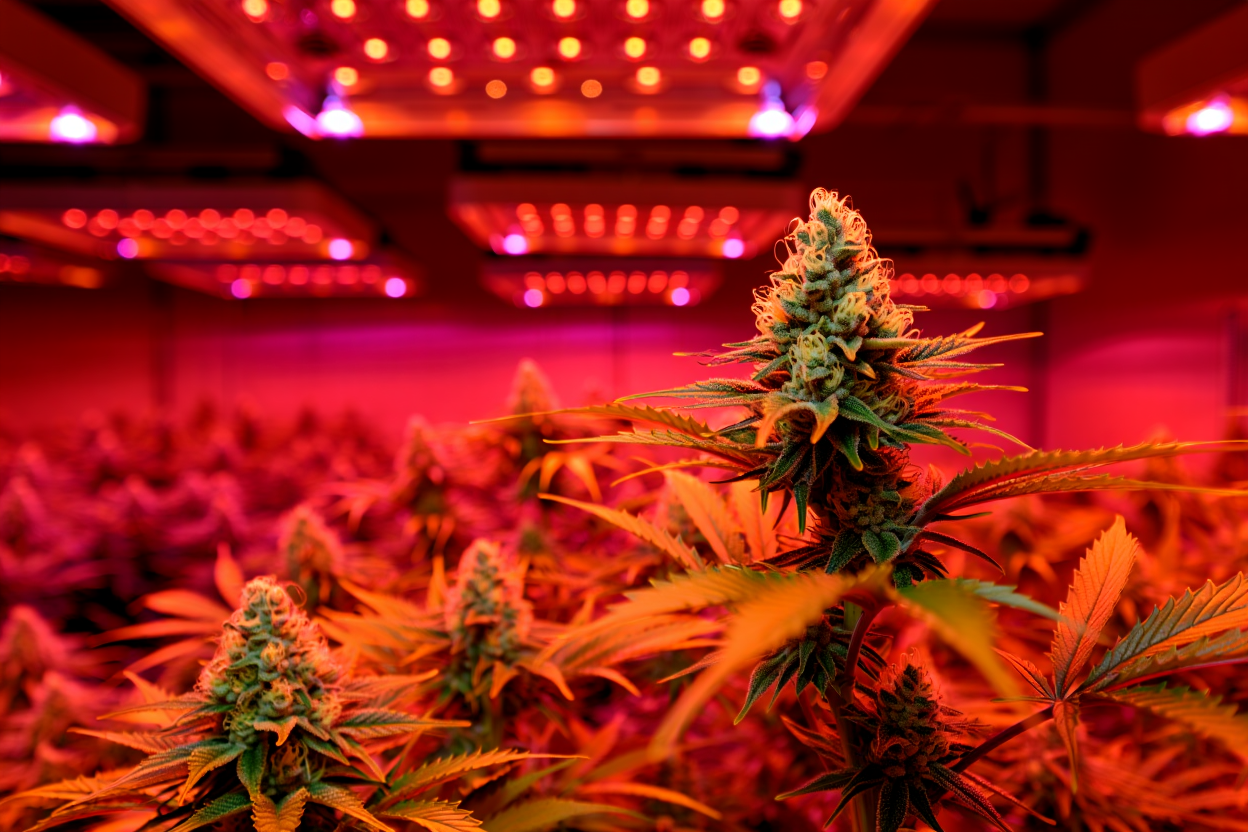
Around 660 nm, red light triggers the switch from vegetative growth to reproduction, directly promoting the appearance of flowers. Discover how red light optimizes flowering in your plants: this wavelength mimics late-summer light, a natural signal that pushes many plants to begin their flowering phase.
How red activates flowering
Pfr phytochromes are photosensitive receptors that convert from the inactive Pr form to the active Pfr form under the effect of red light. This activation triggers a genetic chain reaction, producing hormones such as gibberellins and auxins that open the buds and speed up flower maturation. Our tests at GrowLED consistently show 15 to 25% more flowers simply by optimizing the red light supply during this crucial phase.
- Precise hormonal boost: wavelengths around 660 nm increase gibberellin production, elongating the floral stems and speeding up bud opening compared to standard white lighting.
- Faster maturation: increasing the proportion of red during the final weeks can reduce flower maturation time by 10 to 20%, depending on the variety.
- More flowering sites: a daily supply of 12 to 16 hours of red light multiplies the flowering points, creating a well-filled canopy.
- Combined effect with UV-B: combining red light with low doses of UV-B (280-315 nm) at the start of flowering increases sugar content by about 15%, improving taste and density.
Light color for plants influences their development strategy: red simulates the end of the season and encourages plants to devote more energy to reproduction. Without this precise light spectrum, you risk getting sparse flowering despite correct light intensity. That's why our grow lights are designed to provide the ideal proportion of red.
Our trials show that tomato plants lit with 500W of red light at 60cm from the foliage produce their fruit about three days earlier than with traditional HPS lighting. This gain allows for shorter cycles, higher annual yields and better harvest quality - perfect for maximizing productivity and flavor.
Effective lighting duration and intensity
To trigger flowering, program 12 hours of red-rich light followed by 12 hours of total darkness: this cycle mimics the shortening days of autumn. Be careful, exceeding 14 hours of red light can keep certain species in the vegetative stage. During flowering, aim for an intensity of 300-400 µmol·m⁻²·s⁻¹ over 1m², with 40 to 45% of the light spectrum in red for highly floriferous plants.
Adjustable lighting systems let you gradually increase the proportion of red: start at 30% then gradually move to 45% during the last 2-3 weeks. This gentle transition helps plants absorb light energy better and optimizes their reproductive metabolism. Some varieties such as peppers or strawberries see their yield increase by 10 to 15% under an 18h/6h cycle set at 80%.
Harvest quality and active compounds
Red light doesn't just multiply flowers: it also improves their quality. Wavelengths close to 660 nm stimulate carotenoid production, strengthening colors and stress resistance. Under quality red LED, the concentration of terpenes and other aromatic compounds surges, giving more fragrant, resinous harvests.
Combining red with UV-B during the first weeks of flowering increases sugar content by about 15%, significantly improving the final taste. This combo mimics the light conditions of high altitudes, prompting the plant to produce more protective metabolites. Choosing a lamp with high-performance red diodes means securing flowers that are quality, beautiful to look at and flavorful.
Red light and plant growth
Contrary to what one might think, red light doesn't only affect flowering. It actively takes part in vegetative development by stimulating stem elongation, branching and leaf development. By carefully adjusting the balance between red and blue light, you can shape the morphology of your plants, prevent excessive stretching and optimize biomass production.
Your plants will adapt to their light environment: they'll stay compact or stretch toward the light source depending on the light spectrum you offer them. Let's see how to adjust each parameter to find the perfect balance at every growth stage.
What red-blue ratio during the vegetative stage
During the vegetative stage, a ratio of 1.2:1 between red and blue light offers the best compromise. Red promotes vertical development and leaf expansion, while blue (between 450-470nm) activates photosystem II, densifies the foliage and limits stem stretching.
Watch out for imbalances: too much red produces stretched plants with weak stems, while an excess of blue reduces growth and gives overly compact plants. The influence of blue and red light on plant growth is directly visible in stem vigor and speed of development.
Our customers using the HLG 600 B-Spec set between 60-70% get robust, well-structured plants. Its Samsung LM301H LEDs and 470nm blue diodes let you perfectly adjust the spectrum.
Optimizing biomass and limiting stretching
To maximize production without stretching, aim for a spectrum made up of about 60% red light and 40% blue light. This proportion allows optimal photosynthesis via chlorophyll while maintaining a compact architecture.
Studies show that replacing 20% of the blue with red can:
- Bring lettuce harvest forward by 3 days
- Increase basil biomass by 30%
- Maintain chlorophyll levels
This method is ideal for herbs and leafy vegetables. By simply adjusting the intensity of your LED lamp, you have perfect control over your plants' growth.
Versatile lamp for the spectral mix
The HLG 600 B-Spec is specially designed to manage the red-blue mix throughout the cycle. Its characteristics:
- Coverage of 1.8 x 1.8 m
- Adjustable from 60 to 600W
- Lifespan of about 50,000 hours
Our tests on tomatoes show impressive results: earlier fruiting, more branching and more flower clusters. Its passive design ensures a stable light spectrum, essential for professional crops.
Red light and far-red: synergy
Combining red light (660 nm) with far-red light (700-740 nm) produces an exceptional synergy, boosting both photosynthetic efficiency and plant development. This red and far-red duo, called the Emerson effect, simultaneously activates photosystems II and I (PSII/PSI), thus optimizing the conversion of light energy into plant growth. Once well mastered, this principle lets you calibrate a full spectrum and select the ideal LED lamp for tangible results on plant vigor and flowering.
Emerson effect and efficiency
When you combine red light and far-red light, the Emerson effect shows up immediately: photosynthetic yield jumps by more than 30% compared to using red alone. This advantage rests on balancing the red/far-red ratio, which smooths electron transfer between PSII and PSI, thus removing the blockages that slow down CO₂ assimilation. Concretely, a mix of 70% red / 30% far-red can double the leaf area of lettuce in 3 weeks, while increasing oxygen production to 72% (versus 53% with red alone).
This improvement can be explained as follows: red light mainly stimulates PSII while far-red light activates PSI, creating a steady flow of ATP and NADPH. Crops exposed to this full spectrum make use of up to 90% of the light energy received, a rate rarely matched with conventional lighting. At GrowLED, we recommend including about 10% far-red during the flowering phase to benefit from the Emerson effect without causing excessive stem stretching.
Red/far-red ratio and flowering
The red/far-red ratio modulates the state of the phytochrome (Pr/Pfr), directly influencing the plant's cycle. A high ratio (≈1.5:1) favors the Pfr form, prolonging vegetative growth, while an increased proportion of far-red lighting at night deactivates the phytochrome and speeds up flowering in photoperiodic species.
Adding 10% far-red for tomatoes brings flowering forward by 5 to 7 days and increases leaf biomass by 32%. Thanks to its strong penetration capacity, far-red even allows leaves in the lower part of the plant to capture more energy, boosting overall yield. Optimize your plants' flowering with red light using an LED bar with far-red diodes, perfect for balanced lighting between red and far-red.
Far-red also plays a signaling role: it tells the plant it is under a plant canopy, triggering a slight elongation of the stems to better reach the light. In ornamental growing (poinsettia, geranium), adjusting the red/far-red ratio thus allows control over height and flowering onset without resorting to chemicals. Be careful, however, to remove any stray red light source at night, or to send a short pulse of far-red lighting at the end of the day to speed up flowering.
Red light and practical settings
To get concrete results in your grow space, it's essential to properly set your red light. By precisely adjusting the intensity, the height of your grow light, the lighting duration and spectral stability, you'll optimize photosynthesis and promote fast, effective flowering.
Intensity targets and settings
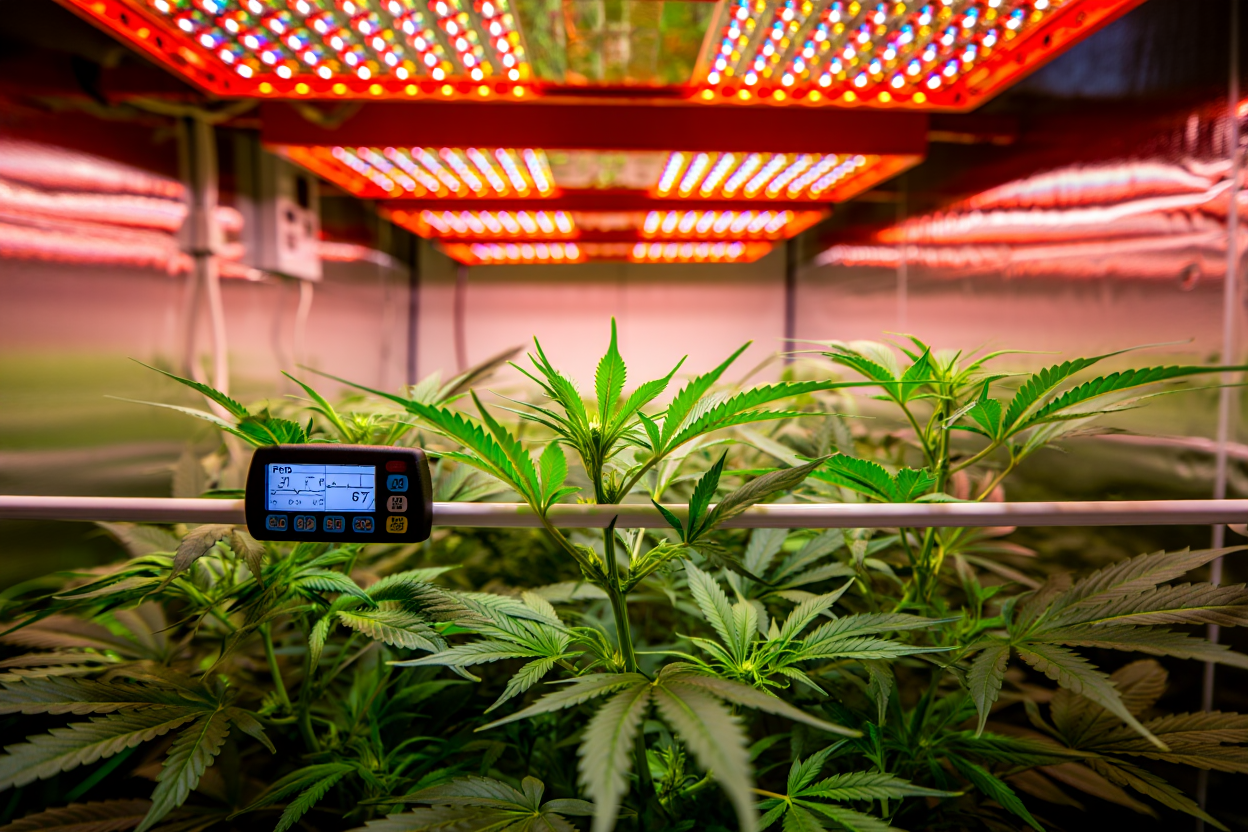
During the flowering stage, aim for a light intensity of 300 to 400 µmol·m⁻²·s⁻¹ over 1 m², with 40 to 45% red light (620-730 nm). This spectrum particularly activates chlorophyll a (peak at 660 nm) and chlorophyll b (640 nm), thus stimulating red chlorophyll photosynthesis and the production of essential ATP/NADPH. For demanding plants (tomatoes, peppers), plan for at least 20,000 lux with 60-70% red LED.
Spectral stability and uniformity
A good grow light must maintain a stable spectrum for 50,000 hours. Favor panels with OSRAM or Samsung LEDs to avoid variations that would disrupt photosynthesis and phytochromes. Passive thermal management is crucial for preserving diode longevity.
- PPFD uniformity: Systems like the SpectraB.2.G X90 (120 cm) guarantee an even distribution of red light.
- Optimized reflectors: Reflective surfaces (white/silver) can increase light intensity by 15% with no extra power draw.
- Programmable controllers: DALI/Wi-Fi systems make it easy to adjust the spectrum depending on the growth stage.
A quantum meter will let you regularly check PPFD. For example, SpectraB.2.G bars positioned at 30 cm deliver 350-450 µmol·m⁻²·s⁻¹, ideal for tomatoes or orchids. This precision ensures optimal photosynthesis for several years.
Managing heat and height
The height of your lamp directly influences light intensity and temperature. During flowering, position it between 20-30 cm from the canopy. If you notice pale or curling leaves, raise the red LED by 10 cm.
Combine height adjustment and dimmer for precise control: - Bring the LED closer at the end of the cycle to intensify the light - Reduce intensity to 60-70% at the start of growth for good acclimation
Models such as the HLG 600 B-Spec (adjustable from 60W to 600W) adapt to all plants, from delicate herbs to vigorous tomatoes, guaranteeing optimal photosynthesis and successful flowering.
Red light and harvest quality
Red lighting doesn't just stimulate growth and flowering: it also improves the chemical composition of the plants grown. By carefully adjusting your lighting's spectrum, you can obtain not only more biomass, but also products that are tastier, more colorful and richer in beneficial active compounds. Let's look at how this particular light enriches the nutritional and flavor qualities of your crops.
Yield, flavor and active compounds
The influence of blue and red light on plant growth isn't only visible on the surface. On a biochemical level, red light increases the production of essential oils, terpenes and anthocyanins. For example, on peppermint, lighting concentrated at 660 nm increases menthol content by 18% compared to a standard white spectrum.
- Increased anthocyanins: Under red-rich lighting, red and purple pigments develop more, which improves both the visual appearance of the products and their antioxidant power.
- Better sugar/acidity balance: For strawberries, boosting red during the last two weeks before harvest reduces the sugar/acidity ratio by about 5%, making the fruit sweeter and tastier.
- More complex aromas: Targeted light pulses at 660 nm stimulate the production of volatile terpenes, responsible for the characteristic scents of herbs and flowers.
- Stress protection: Combined with far-red, red light promotes the synthesis of flavonoids and carotenoids that protect plants against oxidative stress.
Our tests with HLG 600 B-Spec lighting on basil showed an 18% increase in leaf area and a noticeably stronger aroma after four weeks of exposure to an optimized red-blue light spectrum. Replacing a standard HPS lamp with LEDs containing 35% red light produces about 18% extra leaf biomass while reducing energy consumption by 45%.
Be careful, however, to maintain a sensible spectral balance: too much red light without enough blue light can reduce stomatal opening and limit growth, despite an improvement in harvest quality. Keeping 25 to 30% blue even during flowering guarantees balanced photosynthesis, efficient transpiration and therefore harvests that are both abundant and high quality.
Spectral balance for flowering
For demanding crops in flowering, aim for 60 to 70% red photons while keeping a sufficient portion of blue light. This optimal ratio maximizes photosynthesis via chlorophyll, strengthens plant structure and achieves the best possible harvest quality.
With adjustable lighting systems, you can position the species that need the most red light under the main source, while more delicate plants are placed on the periphery where intensity decreases. For modular installations, the SpectraB.2.G X90, fitted with high-end diodes, provides a stable, energy-efficient light spectrum throughout the flowering period.