



































































Do you really want to boost your plants and reach yields worthy of the pros? Discover the PPFD meter, an essential measuring tool for controlling indoor lighting without guesswork. Whether you're a beginner or an expert, knowing how many photons reach your crops changes everything: the photosynthetic photon flux density (PPFD) becomes your compass, while a quantum meter guides you step by step toward optimal growth.
Measuring PPFD and DLI
In indoor growing, watts, lumens or lux are often quoted, but these values don't reveal the photosynthetic photon flux actually captured by the plants. The PPFD tells you, square meter by square meter, second by second, about this useful light intensity; a PPFD meter therefore provides essential data that plain PPF, limited to the lamp itself, cannot. Measuring precisely lets you fine-tune the lighting, save light energy and optimize light for each growth stage.
Why you need a quantum PPFD meter
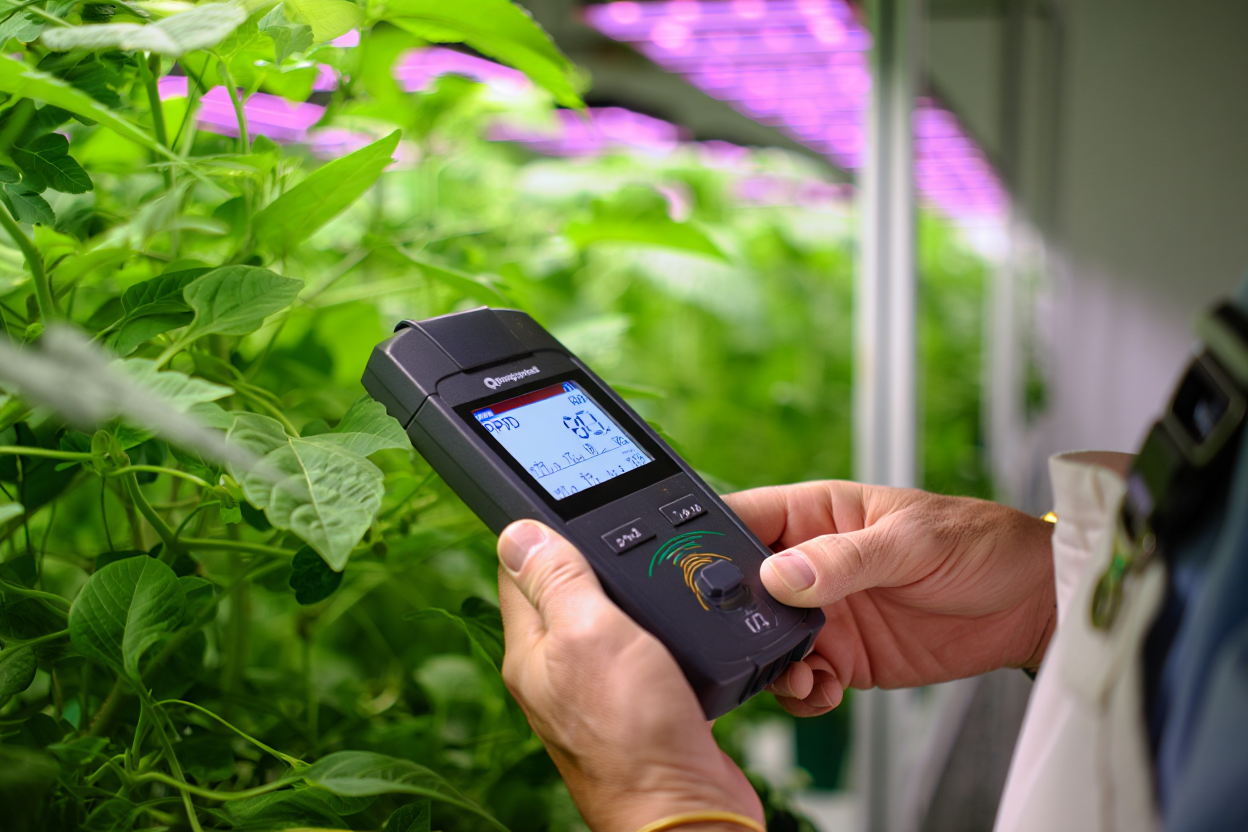
A lamp can display 4614.74 µmol/s of PPF, like the HLG Scorpion Ultima X Diablo, without guaranteeing the right intensity at canopy level. Only a quantum PPFD meter, sensitive to the 400-700 nm band, shows the actual PPFD received by the canopy and protects your plants from under- or over-lighting responsible for stress, burn or poor yield. By pointing the sensor at different heights, you adjust distance, dimming and uniformity to maintain 900-1200 µmol m⁻² s⁻¹ during flowering, avoiding any excess above 1500 µmol m⁻² s⁻¹ without CO₂.
With several measurements spread across the canopy, you check the photon distribution and correct any imbalance using reflectors or dual-zone dimming. Staying above 400 µmol m⁻² s⁻¹ guarantees vigorous growth, while precise control of daily light prolongs photosynthesis without wasting lux or PPF.
Connecting lux, PPFD and DLI
Many growers rely on a lux meter, handy but limited, because lux reflects human perception rather than what plants perceive. A red-rich LED grow light can show low lux while still delivering a high photosynthetic photon flux; only a PPFD meter reveals this reality. Both experienced and beginner gardeners therefore benefit from measuring in µmol m⁻² s⁻¹ rather than lumens to correctly adjust their grow light.
DLI (daily light) is obtained by multiplying the average PPFD by the lighting duration, then dividing by one million: 650 µmol m⁻² s⁻¹ for 12 h gives 28.08 mol m⁻² day⁻¹. This calculation shows the amount of light needed for optimal growth, and a quantum sensor gives instant feedback to correct height or intensity within seconds.
Mapping the light
To optimize a space, map the area using a 3×3 or 5×5 measurement grid; the goal is a min/max uniformity index above 0.85. If the center reaches 1000 µmol m⁻² s⁻¹ and the edges only 600, adjust the height of the lamps or add reflectors to even out the photosynthetic photon flux.
These PAR maps instantly reveal under-exposed zones, letting you reposition fixtures, adjust the dimming or supplement the lighting. With the right measuring tool, optimizing the light becomes a simple task, accessible to every indoor grower, and ensures even growth with a higher yield.
Choosing a PPFD meter for your grow light
Choosing the right PPFD measuring device means weighing up several criteria. Professional quantum meters, mobile apps and high-end spectroradiometers each have their own pros and cons. It all depends on budget, experience and the level of precision growers are looking for.
Let's take a simple look at the different solutions available to help you find the ideal tool for your indoor lighting and your plants.
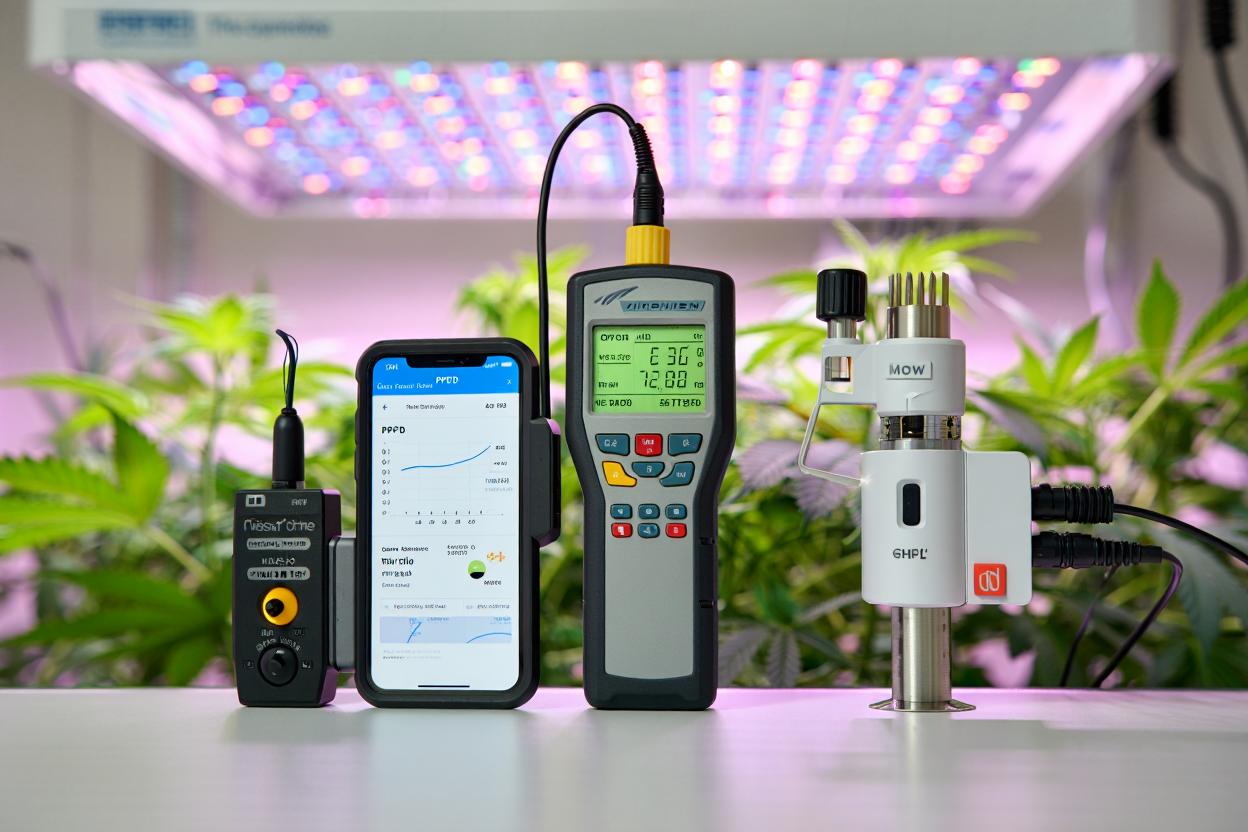
Quantum sensors and alternatives
The quantum PAR meter remains the reference device for precisely measuring photon flux (400-700 nm). Models like the Apogee MQ-200 offer precision of ±5% and cover a range of 0-2000 µmol/m²/s, suitable for most setups. Their factory calibration guarantees reliable readings for optimizing photosynthesis.
- Portable quantum meter: quick measurement, direct readout, ideal for simple, efficient use
- Spectroradiometer: full spectrum analysis (350-800 nm), a precise but costly solution
- Lux-to-PPFD conversion: an approximate method, to be used with caution depending on the spectrum of the light source
- Connected sensors: data transmitted via Bluetooth/Wi-Fi for precise DLI tracking
Careful: the µmol/m²/s-to-watts conversion varies with the light spectrum. A 10W red LED produces more useful photons than a white bulb of equivalent power - proof that photon efficiency matters more than raw power consumption.
Before buying your PPFD meter, check:
- Measurement range (minimum 0-2000 µmol/m²/s)
- Resolution (0.1 µmol/m²/s)
- Measurement angle (minimum 90°)
Compatibility with powerful grow lights like the ZEUS PRO 1000W
Apps and Bluetooth sensors
For smaller budgets, smartphone apps are an interesting alternative. They use the phone's own sensor or connect to an external Bluetooth module to estimate PPFD.
These apps give a good approximation (around 5% deviation) and provide useful features such as DLI calculation, PAR mapping and identifying poorly lit zones.
Electrical power and light
Electrical consumption (W) doesn't reflect light efficiency. PPE (µmol/J) truly measures how many useful photons your lamp produces.
Calculation example:
PPF 2600 µmol/s ÷ 1000 W = 2.6 µmol/J (good efficiency)
Over 1.44 m², this gives around 1805 µmol/m²/s
| Lamp model | PPF (µmol/s) | Power (W) | PPE (µmol/J) |
| HLG Scorpion Ultima X Diablo | 4614.74 | ~1800 | ~2.56 |
| ZEUS PRO 1000W | ~2600 | 1000 | 2.6 |
Optimizing PPFD for LED lights
Taking measurements is good, but knowing how to analyze and adjust them is even better. Now that you have a reliable PPFD meter, let's see how to use every reading to optimize your lighting. Whether it's a simple panel or a complex setup, the principle stays the same: match light intensity to your plants' real needs to boost their growth without overconsumption or light stress.
PPFD and DLI targets by stage
The optimal PPFD for each plant stage varies considerably depending on the stage of development. During germination and seedling stage, aim for 200-300 µmol·m⁻²·s⁻¹: young seedlings are fragile and too much light could burn them. In the vegetative stage, move up to 400-600 µmol·m⁻²·s⁻¹ to stimulate leaf development. During flowering, raise it to 600-900 µmol·m⁻²·s⁻¹ in a standard setup, or even 900-1200 µmol·m⁻²·s⁻¹ with added CO₂. These values, validated by many growers, ensure excellent yield without excess.
- Germination and seedlings: 200-300 µmol·m⁻²·s⁻¹, with an 18-24h photoperiod. The target DLI is 8-12 mol·m⁻²·day⁻¹ for gentle growth.
- Vegetative stage: 400-600 µmol·m⁻²·s⁻¹, 18h photoperiod. The ideal DLI is between 25-35 mol·m⁻²·day⁻¹ to strengthen plant structure.
- Flowering without CO₂: 600-900 µmol·m⁻²·s⁻¹, 12h photoperiod. The recommended DLI is 25-40 mol·m⁻²·day⁻¹ to maximize flowering without photoinhibition.
- Flowering with CO₂: 900-1200 µmol·m⁻²·s⁻¹, 12h photoperiod. DLI rises to between 40-52 mol·m⁻²·day⁻¹ to make the most of CO₂ enrichment.
If your grow space isn't enriched with CO₂, reduce intensity by about 30% to avoid light stress. Also keep an eye on leaf temperature: above 28-30°C, move your grow light slightly farther away or reduce its intensity. By regularly measuring DLI and ensuring even distribution (>0.85), you'll get uniform growth and consistent harvests.
Practical grow light settings
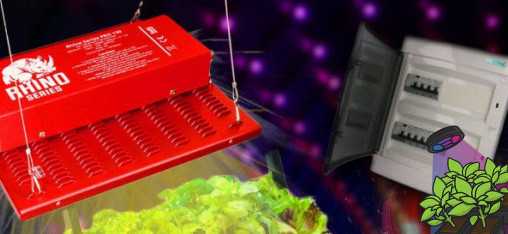
Let's take the Rhino Series 130 V4 model, which offers 260 µmol/s of PPF with an efficiency of 2.6 µmol/J. Over 0.36 m², you theoretically get around 722 µmol·m⁻²·s⁻¹ at full power. At 50% dimming, the flux drops to 361 µmol·m⁻²·s⁻¹, perfect for the vegetative stage. These estimates remain indicative: always use your meter to check and fine-tune precisely.
To effectively map PPFD for LED lights, place your sensor at canopy height and run a measurement grid (3×3 or 5×5). Start at 0% to rule out any stray light, then increase gradually to 20%, 50% and 100%. Compare the readings at the center and at the edges: if the gap exceeds 20%, adjust the height or reduce the central intensity. With a dual-zone system, set each section independently for a perfectly even spread.
Product examples and measurements
At GrowLED, you'll find brands like Lumatek, SANlight and HLG, all offering high-efficiency lamps (>2.5 µmol/J). The ZEUS PRO 1000W, thanks to its dual-zone dimming, tops 1000 µmol·m⁻²·s⁻¹ over 1.5×1.5m under enriched conditions. The Rhino Series 130 V4, more compact, is perfect for smaller grow tents.
If your PPFD stays below 600 µmol·m⁻²·s⁻¹ at 60cm during flowering, increase the dimmer to around 75%. Conversely, if you go above 1200 µmol·m⁻²·s⁻¹ without CO₂, reduce the intensity or raise the lamp. Schedule gradual adjustments every two weeks with a Lumatek controller, and log every reading to track progress. This precision-based approach will make you an expert in no time!