



































































Do you wonder why some plants thrive in indoor growing while others stagnate even under high-performance LED lighting? The key often lies in PAR, this photosynthetically active radiation that directly influences their growth. This guide explains how to measure PPF, understand PPFD, and adapt the range of wavelengths so that every photon (blue or red) fully benefits your plants.
What is photosynthetically active radiation
Photosynthetically active radiation refers to the part of light located between 400 nm and 700 nm that plants use to convert light energy into biomass. Mastering this spectral range revolutionizes the way you light your plants: you no longer choose based solely on power consumption, but also by taking into account the photosynthetic efficiency of the photons emitted.
Definition of the 400-700 nm spectrum for plants
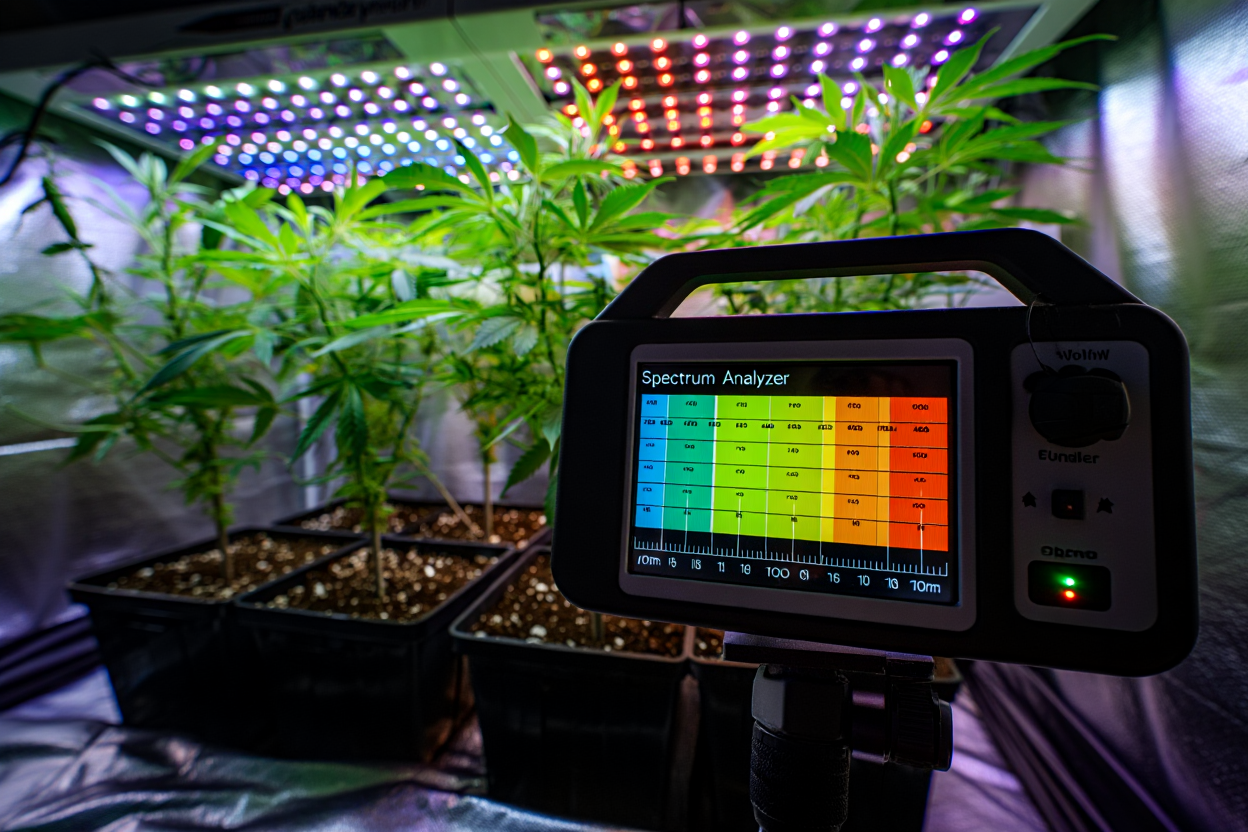
PAR covers the wavelengths from 400 nm to 700 nm, i.e. the zone absorbed by chlorophylls a and b for photosynthesis. In this range, each photon acts as an "energy unit" that fuels vital biochemical reactions, unlike UV (<400 nm) and IR (>700 nm), which have a negligible or even stress-inducing photosynthetic impact.
- Blue spectrum (400-500 nm): promotes a compact structure, stimulates chlorophyll production and densifies foliage.
- Green spectrum (500-600 nm): penetrates the canopy to light the lower leaves and balances plant architecture.
- Red spectrum (600-700 nm): triggers and optimizes flowering, while increasing final yield.
- Balanced full spectrum: combines all the wavelengths essential to photosynthesis to reproduce natural sunlight in indoor growing.
Even though every photon between 400 and 700 nm counts toward PAR, the McCree curve reveals that a red photon at 660 nm produces more glucose than a blue photon at 450 nm. Our LED grow lights therefore integrate a precise mix of diodes to maximize this action spectrum and the photosynthetic radiation available.
A full spectrum covering the entire 400-700 nm range (with 3000K/4000K white diodes and 660 nm deep red) faithfully reproduces sunlight while avoiding stretching or discoloration. This setup intelligently distributes blue and red photons to support every growth stage with optimal photosynthetic efficiency.
Role of wavelengths in photosynthesis
Understanding the impact of each wavelength on photosynthesis lets you fine-tune your lighting. Blue photons densify the structure, while red ones stimulate flowering - their combination shapes morphology and yield.
- Vegetative stage: a ratio of 30-50% blue and 40-60% red ensures robust growth, dense foliage and sturdy stems.
- Flowering stage: switching to 70-90% red, while keeping 10-30% blue, maximizes the development of flowers and fruit.
- Balanced full spectrum: adding green, white and possibly UV/IR preserves a hormonal balance close to natural light.
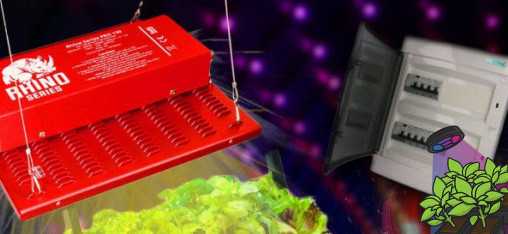
A model such as the Pure LED Pro V2.0 240 W covers the entire range of wavelengths essential to photosynthesis with a photon flux of 683 µmol/s and an efficiency of 2.82 µmol/J. This way, every photon actively contributes to photosynthesis rather than needlessly heating your grow space.
How to measure photosynthetically active light
Taking precise measurements of photosynthetically active radiation in your indoor grow makes all the difference: you move from risky guesswork to precise settings that truly boost growth and yields. PAR is measured with the PPF and PPFD units, while your quantum sensor counts every photon useful for photosynthesis. Without these sensor-based measurements, you're effectively growing blind.
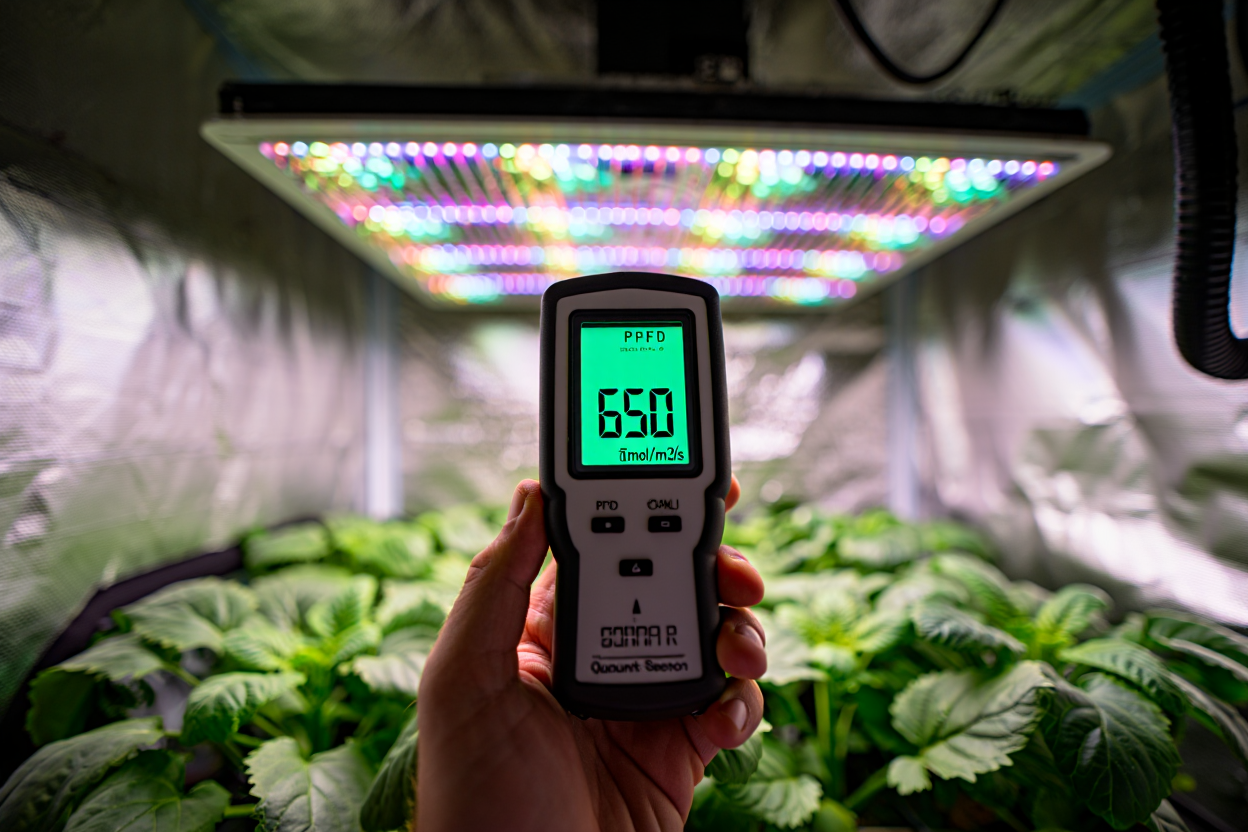
PPFD and PPF: understanding the units of measurement
PPFD (photosynthetic photon flux density) indicates how many photons usable by plants reach one square meter of leaf surface every second, expressed in micromoles. PPF, meanwhile, measures the total flux of photosynthetic photons emitted by your lamp, which lets you assess its energy efficiency. Together, these indicators give you the actual amount of light energy available for your crops.
Unlike lux, which is based on visible light as perceived by the human eye, PPFD and PPF specifically reflect the photosynthetically active radiation usable by your plants. A lamp can show 50,000 lux while still being inefficient if its light spectrum isn't suitable. Note that photon flux density decreases with distance - which is why it's crucial to position your LED grow light between 30 and 60 cm depending on its power.
| LED panel | Power (W) | PPF (µmol·s⁻¹) | Efficiency (µmol·J⁻¹) | PPFD at 30 cm |
| Pure LED Pro V2.0 | 240 W | 683 µmol·s⁻¹ | 2.82 µmol·J⁻¹ | ~600 µmol·m⁻²·s⁻¹ (80x80 cm) |
| Florastar TI EX | 325 W | 812 µmol·s⁻¹ | 2.5 µmol·J⁻¹ | ~812 µmol·m⁻²·s⁻¹ (1 m²) |
| HLG 200 RSPEC | 196 W | 495 µmol·s⁻¹ | 2.52 µmol·J⁻¹ | ~650 µmol·m⁻²·s⁻¹ (60x60 cm) |
| 400 W CMH lamp | 400 W | 600-800 µmol·s⁻¹ | 1.5-2 µmol·J⁻¹ | ~400 µmol·m⁻²·s⁻¹ (high heat) |
Using a quantum sensor to measure PAR
Your quantum sensor precisely measures photosynthetic photons between 400 and 700 nm, whatever their color. Position it horizontally under your lamp, exactly at foliage height, then note the PPFD values obtained to compare them with the manufacturer's data. This simple operation will instantly reveal any losses due to distance, light spectrum or diode degradation.
If your Florastar TI EX 325 W promises 812 µmol·m⁻²·s⁻¹ at 30 cm but you only measure 600 µmol·m⁻²·s⁻¹, adjust the height or check your setup. By regularly taking these readings, you'll monitor the stability of the photosynthetic radiation and be able to anticipate maintenance before your plants suffer from a lack of light energy.
PPFD requirements by growth phase
Every growing stage has its own light requirements: too few photons slows growth, too much light can burn the leaves. Target 300-600 µmol·m⁻²·s⁻¹ during the vegetative stage for a sturdy, vigorous plant, then 600-900 µmol·m⁻²·s⁻¹ during flowering to maximize production. Young seedlings only need 150-250 µmol·m⁻²·s⁻¹ to avoid any stress.
- Germination/Cloning: 150-250 µmol·m⁻²·s⁻¹ with the dimmer set to 25%
- Vegetative growth: 300-600 µmol·m⁻²·s⁻¹ with the dimmer between 50% and 75%
- Pre-flowering/Stretch: 500-700 µmol·m⁻²·s⁻¹ with the dimmer at 75-90%
The built-in dimmer on an LED grow light makes adjusting PPFD much easier: 25% will give you about 150 µmol·m⁻²·s⁻¹, 50% will reach 300 µmol·m⁻²·s⁻¹ and 100% will approach 600 µmol·m⁻²·s⁻¹. This flexibility ensures an ideal energy supply at every stage of photosynthesis and your plants' development.
Optimizing LED lighting for plant growth
To create a high-performing grow space, it's essential to properly understand how to use LED grow lighting and its photosynthetically active radiation. These modern lamps let you precisely control the light spectrum and its intensity, thus providing the ideal light for plant growth at every stage of their development. Discover how this technology can boost photosynthesis, reduce your energy consumption and improve your yields.
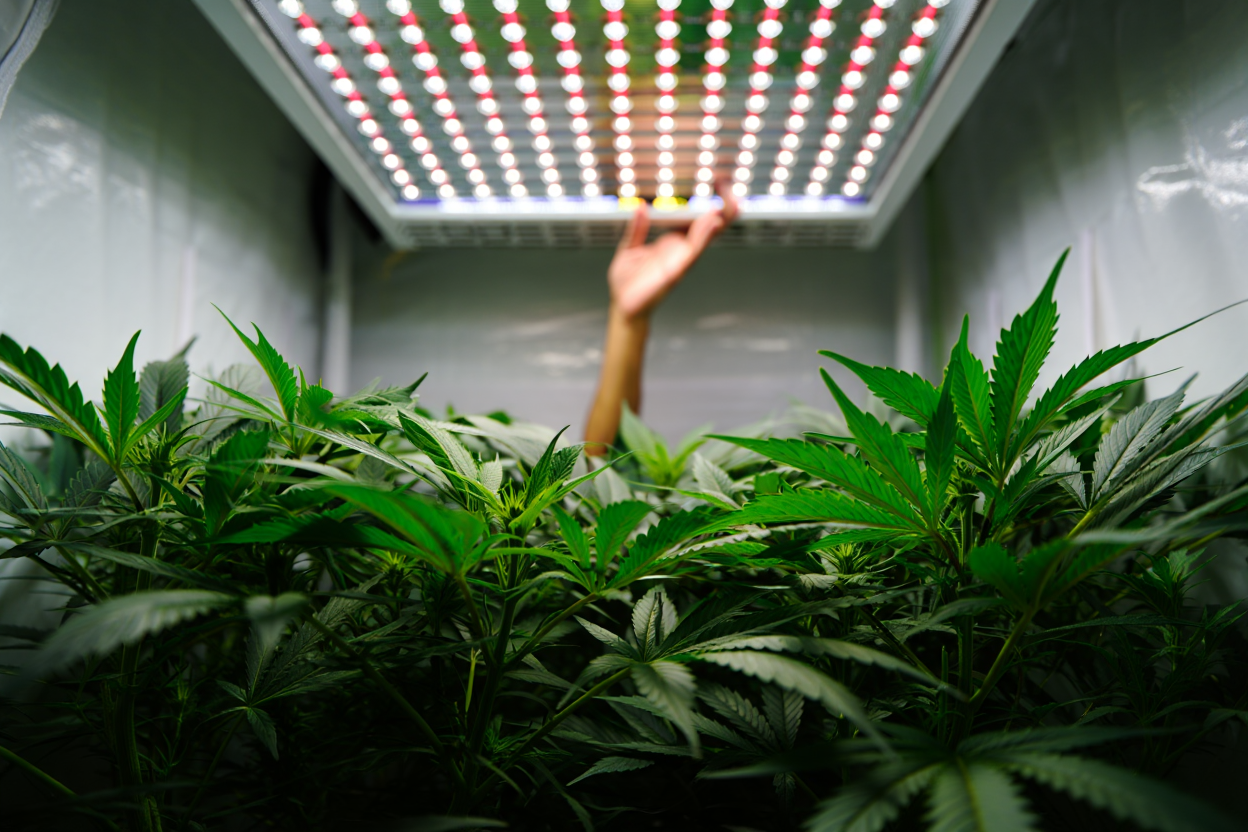
Advantages of LED panels for PAR
LED grow lights convert up to 2.5-2.82 µmol·J⁻¹ of electrical energy into useful photons (PAR), almost twice as much as HID or CMH lamps (1.5-2 µmol·J⁻¹). This superior photosynthetic efficiency delivers more photosynthetic radiation while generating less heat - a real bonus for your grow!
- Remarkable energy savings: Our Pure LED Pro V2.0 240W units produce 683 µmol·s⁻¹ of PPF with only 240W, whereas a 400W CMH consumes almost double for a similar output.
- Little heat emitted: Thanks to their design, LED grow lights limit the risk of burns on your plants and reduce air conditioning needs.
- An adjustable spectrum: A simple dimmer from 0 to 100% lets you adapt light intensity to your plants' needs.
- An impressive lifespan: With more than 50,000 hours of use, these lamps maintain their photosynthetic efficiency cycle after cycle.
Even though the initial investment is higher than for other systems, LEDs generally pay for themselves in under 18 months thanks to energy savings and their longevity. Our models using Samsung and Honglitronics diodes guarantee stable, reliable photosynthetically active radiation for all your crops.
Practical PPFD settings for indoor growing
To optimize PPFD, play with three parameters: the lamp's distance, its intensity and the lighting duration. During the vegetative stage, place your LED panel about 30 cm from the foliage, then move it back to 45-60 cm during flowering to avoid any light stress. This simple trick helps maintain optimal photosynthesis.
The HLG 200 RSPEC panel, specially designed to maximize photosynthetically active light, produces 495 µmol·s⁻¹ with excellent energy efficiency. Start with an intensity of 25% for young plants, gradually increase to 50% during the vegetative stage, and move to 100% during flowering.
For the light cycle, program 18h light / 6h darkness during vegetative growth, then switch to 12h/12h for flowering. A dimming system over 30 minutes helps avoid shocking the plants. With several synchronized panels and good ventilation, you can easily cover 1m² with an average PPFD of 600 µmol·m⁻²·s⁻¹ for optimal results.