



































































Still looking for the right light intensity for your indoor plants? This guide reveals the optimal PPFD levels for every growth stage, before covering how to dial in your grow lights, CO₂, and power to maximize your yields without stressing your plants.
PPFD and light in indoor growing
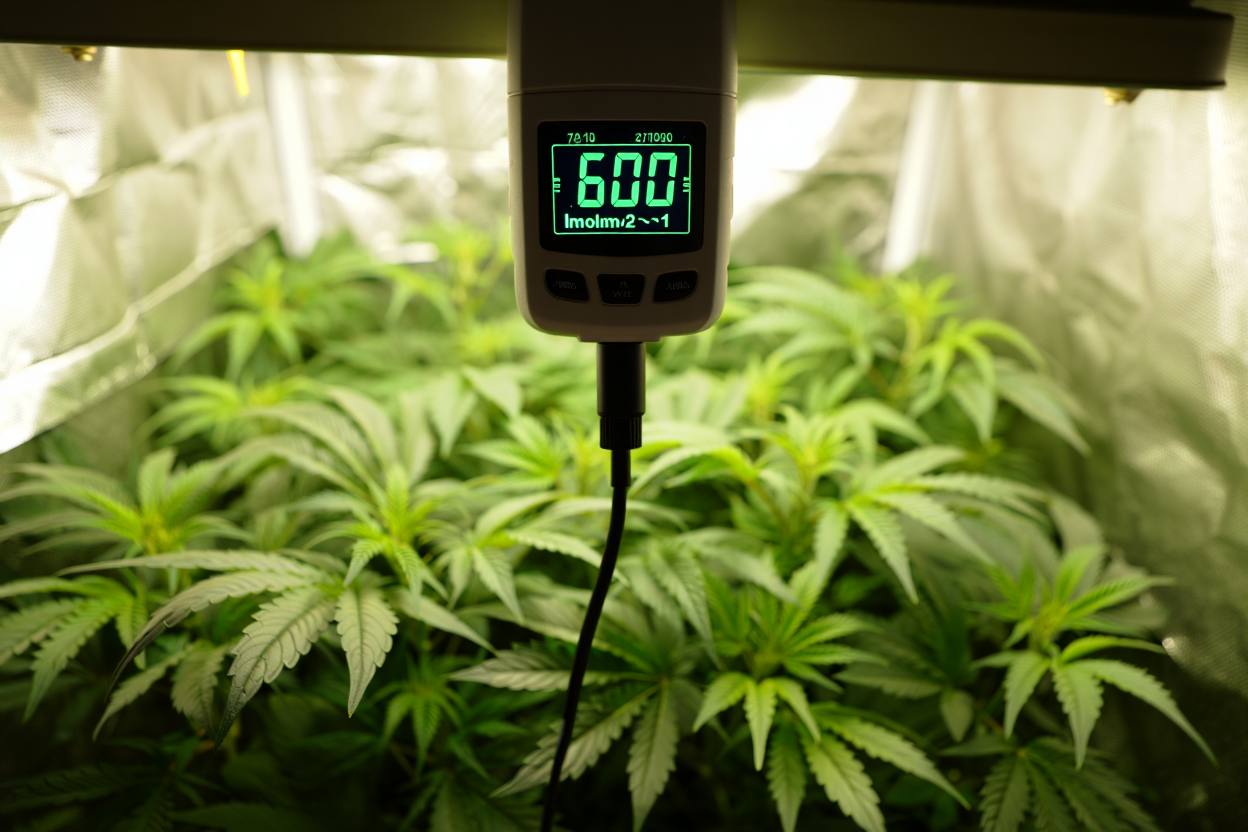
PPFD is a concrete measure of the density of photosynthetic photon flux (in µmol/m²/s) reaching the foliage. Much more precise than lumens or watts, this parameter is essential for effectively managing indoor growing.
What counts as a good PPFD?
The ideal intensity varies depending on the growth stage:
- Cuttings and young plants: 150-200 µmol are enough for solid rooting
- Vegetative stage: increase gradually up to 300-600 µmol
- Flowering: rise to 600-900 µmol for nice, dense buds
Careful: going above 1000 µmol without extra CO₂ can cause photoinhibition (scorched leaves or slowed growth). Even with CO₂, avoid exceeding 1400 µmol.
These values apply to all grow lights (LED, HPS, MH) as long as they provide a full photosynthetic spectrum. Use a PPFD meter to regularly check the intensity at leaf level.
Reading and measuring PPFD
To measure correctly:
- Place the sensor at plant level
- Record the values at the center and at the edges
- Check that the variance stays under 10%
Mobile apps can help in a pinch but need calibration. A lux meter only gives a rough estimate.
DLI and lighting duration
DLI converts your PPFD into a daily light dose. For example:
- 18h at 617 µmol = 40 mol/day (ideal in the vegetative stage)
- 12h at 925 µmol = the same DLI in flowering
As a general rule, aim for 12-20 mol/day in the vegetative stage and 20-30 mol/day in flowering for a healthy plant.
PPFD in the vegetative stage for grow lights
During the vegetative stage, well-dosed, progressive lighting is essential for strong, healthy plants. By precisely adjusting light intensity and PPFD during this period, you'll encourage a solid structure and dense foliage, perfect for supporting flowering afterward.
By simply adjusting the distance or intensity of your grow lights, you can quickly boost your plants' vigor without complicating your daily routine. Regularly monitoring these parameters will ensure optimal light to maximize your yield.
PPFD targets for the vegetative stage
During the vegetative stage, start with an intensity of 300 to 400 µmol·m⁻²·s⁻¹ right after the seedling stage, then gradually increase to 500–600 µmol over the following weeks. This gentle progression helps avoid excessive stem stretching and encourages dense, bushy foliage.
For especially leafy varieties, it's better to keep PPFD between 200 and 400 µmol to prevent shading of the lower leaves. With 18 hours of daily lighting at an average PPFD of 400 µmol, your DLI will reach around 26 mol·m⁻²·d⁻¹, which suits most plants perfectly.
One caveat, though: above 600 µmol without extra CO₂, your plants may show signs of stress (leaves paling or curling). So stay within the recommended ranges and adjust based on how your crop responds.
| Stage | Target PPFD (µmol·m⁻²·s⁻¹) | LED distance (cm) | Duration (h/day) | Approx. DLI (mol·m⁻²·d⁻¹) |
| Seedlings/clones | 150–200 | 60–90 | 18 | 10–13 |
| Early vegetative | 300–400 | 45–60 | 18 | 19–26 |
| Late vegetative | 500–600 | 45–50 | 18 | 32–39 |
Distance and dimmer settings
To hit the target PPFD values from the table, start by adjusting the height of your LEDs: moving them just 5 cm closer increases PPFD by 15 to 20%, based on the inverse-square law. During the vegetative stage, generally position your fixtures between 45 and 60 cm above the top of the plants for uniform light of 250 to 350 µmol·m⁻²·s⁻¹.
Next, use your light's dimmer, like the one on the Lumatek VF 120W system for clones and seedlings, to fine-tune your setup without changing the height. A 10% reduction in power reduces PPFD by the same amount, a handy trick when temperatures climb above 30°C.
Don't forget to measure the intensity at the center and in the four corners of your growing space: a variation of less than ±10% ensures even distribution. If the edges receive less than 80% of the central PPFD, move the side light sources closer or add reflectors. Even exposure is the key to an excellent yield and a balanced PPF across the whole area.
PPFD in flowering for indoor growing
The flowering stage is decisive for producing dense, resinous, aromatic buds. Getting the light intensity right makes all the difference between an average harvest and an exceptional yield.
PPFD and DLI targets in flowering
For PPFD in flowering, aim for a range of 600 to 900 µmol/m²/s, adjusted for the variety and growing conditions. With 12 hours of light, a PPFD between 700 and 850 µmol produces an ideal DLI of 30 to 37 mol/m²/day. Autoflowers tolerate 550 to 600 µmol better, on 18-to-20-hour cycles.
To optimize photosynthesis, keep CO₂ levels between 1200 and 1500 ppm. Keep daytime temperatures at 22-26°C and nighttime temperatures at 18-20°C. You can gradually increase up to 900-1000 µmol, but be careful: beyond that, light stress can reduce efficiency and damage the trichomes.
Gradually increasing PPFD
Start flowering around 700 µmol/m²/s, then increase by 50 to 100 µmol every 3-4 days if the plants stay vigorous. This gentle progression lets photosynthesis adapt without stress.
To convert PPFD to lux, note that under a warm white LED spectrum, 1 µmol ≈ 55-70 lux. But for more accuracy, use a quantum meter. Don't forget to increase CO₂ in parallel (400→1200 ppm) to boost photosynthetic efficiency.
Uniformity and hotspots
Make sure the light is evenly distributed (±10% max) across the whole canopy. Zones above 1000 µmol scorch the top buds, while below 400 µmol, growth of the secondary sites slows down.
For larger grows (80×80 cm+), adjust the positioning or add LEDs to balance the light spectrum and PPF. Always measure multiple points to optimize yield and get uniform buds.
Measuring PPFD and adjusting your grow lights
Optimizing your grow lighting isn't rocket science! With a few simple tools and precise measurements, you can boost the efficiency of your plant lights and maximize your yields in indoor growing.
Using a PPFD meter
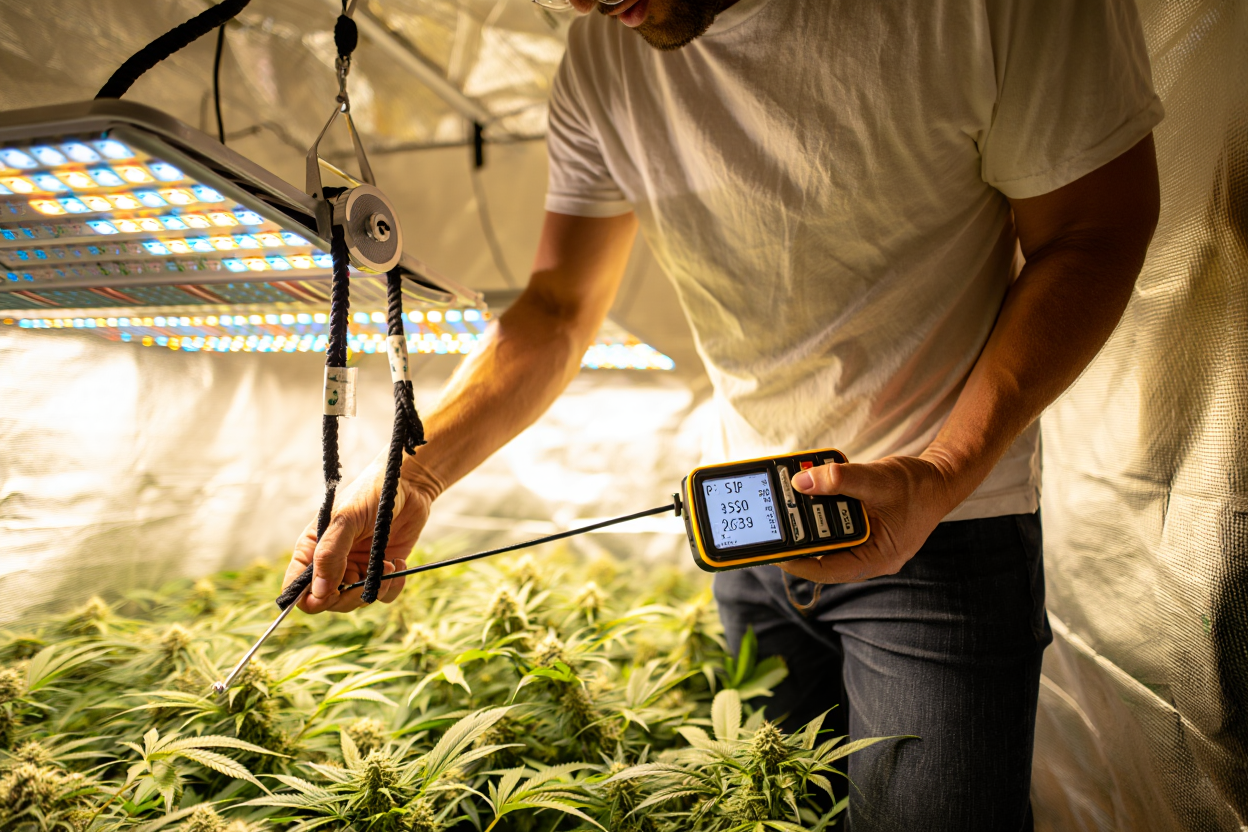
The PPFD meter (or PAR sensor) is your best ally for a perfect setup. Work through it methodically:
- Place the sensor at plant level, where they receive the light
- Take measurements at multiple points (center, edges, and in between)
- Calculate the average and check the uniformity
If the variance exceeds 10%, adjust the distance or add to your setup. Always remember to recalibrate your device after any change in spectrum or lighting configuration.
- Our pro tips: Calibration: Do it regularly for reliable PPF and light-efficiency measurements
- Mobile apps: Handy in a pinch, but should be checked against a real PPFD meter
- Checks: Systematically monitor PPFD after every grow light adjustment
Watch the temperature! Good ventilation (0.5 to 1 cfs/m³) prevents inaccurate readings under LEDs. Log your results to track progress and anticipate flowering needs.
Power, PPE, and sizing
How do you calculate the ideal PPFD for the vegetative stage? The method is simple: PPFD ≈ (Watts × PPE) ÷ area
Concrete example for a 1m² flowering tent:
- Need: about 800 µmol·m⁻²·s⁻¹
- Solution: a 600W LED at 2.7 µmol·J⁻¹ delivers 1620 µmol·s⁻¹
With these values, you comfortably cover the light needs for healthy plants!
Indoor lighting solutions and PPFD for indoor growing
At GrowLED, we support every grower, from beginner to expert, in finding grow lights that deliver the ideal PPFD for every growth stage. Our full-spectrum fixtures and the expertise of our advisors help optimize your yield while making the technique more accessible.
Below you'll find the key points to know for choosing the best grow lighting, plus answers to the main questions about PPFD.
Choosing the right fixture
To maintain a stable PPFD for your plants, go with full-spectrum LED panels (4000K white combined with 660 nm red) with a built-in dimmer and an efficiency of at least 2.5 µmol/J. The PureLED Q240 V2 delivers about 648 µmol/m²/s at 30 cm over 1m², a perfect choice for both the vegetative stage and flowering on 80×80 to 100×100 cm areas. Its 0-100% dimmer and 0-10V compatibility make it easy to fine-tune the light intensity day to day.
- Cuttings and young plants: The Lumatek VF 120W delivers 150-200 µmol at 30-60 cm, perfect for rooting without excess light.
- Vigorous vegetative growth: Position the Q240 V2 at 45-60 cm (300-500 µmol), then at 30-45 cm in flowering (700-850 µmol).
- Larger grows: Two Q240 V2 units per m² at 25-30 cm ensure even distribution (±8%) with a PPFD between 600-800 µmol, with no zones that are too bright or too dark.
Pro tip: Keep temperatures at 22-26°C during the day and 18-20°C at night, with 50-60% humidity to maximize the absorption of photosynthetic photons. Without added CO₂, stay under 600 µmol in the vegetative stage and 900 µmol in flowering. With 1200-1500 ppm of CO₂, you can reach 1000 µmol, but tightly control temperature and humidity to avoid any stress.
Essential PPFD FAQ
"Is 1000 lumens enough?" Lumens measure light that's visible to the human eye, not the photons plants can use. The conversion between PPFD and lux is only approximate and varies by spectrum: under a warm white LED, 1 µmol/m²/s corresponds to 55-70 lux. Use a quantum meter instead, since lux meters aren't suited to grow lighting.
"How do you interpret PPFD values?" Measure them in µmol/m²/s at canopy level: aim for 150-200 for young plants, 300-600 in the vegetative stage, and 600-900 in flowering (depending on variety and CO₂). To choose your lighting, multiply the target PPFD by your growing area to get the required PPF, then select a matching model. At GrowLED, you get a premium warranty, express 24h delivery, and expert support to build an indoor growing space that's both productive and balanced.