



































































Want to know the real power consumption of a 12V LED strip and pick the best power supply for your lighting project? Our complete guide walks you through 12V LED strip power consumption in detail: from precisely calculating wattage to tips for optimizing your energy costs, whether for ambient lighting or a horticultural setup.
12V power consumption and LED strips
The power consumption of a 12V LED strip mainly depends on its technical specs: the LED type used (SMD 3528, SMD 5050, or LED 2835) and the number of chips per meter. To give you an idea, SMD 3528 strips use about 4.8 W/m, while some COB models can reach 20 W/m. That difference has a direct impact on your electricity bill - which is why it's important to choose based on your brightness needs and the length required.
How to calculate 12V wattage
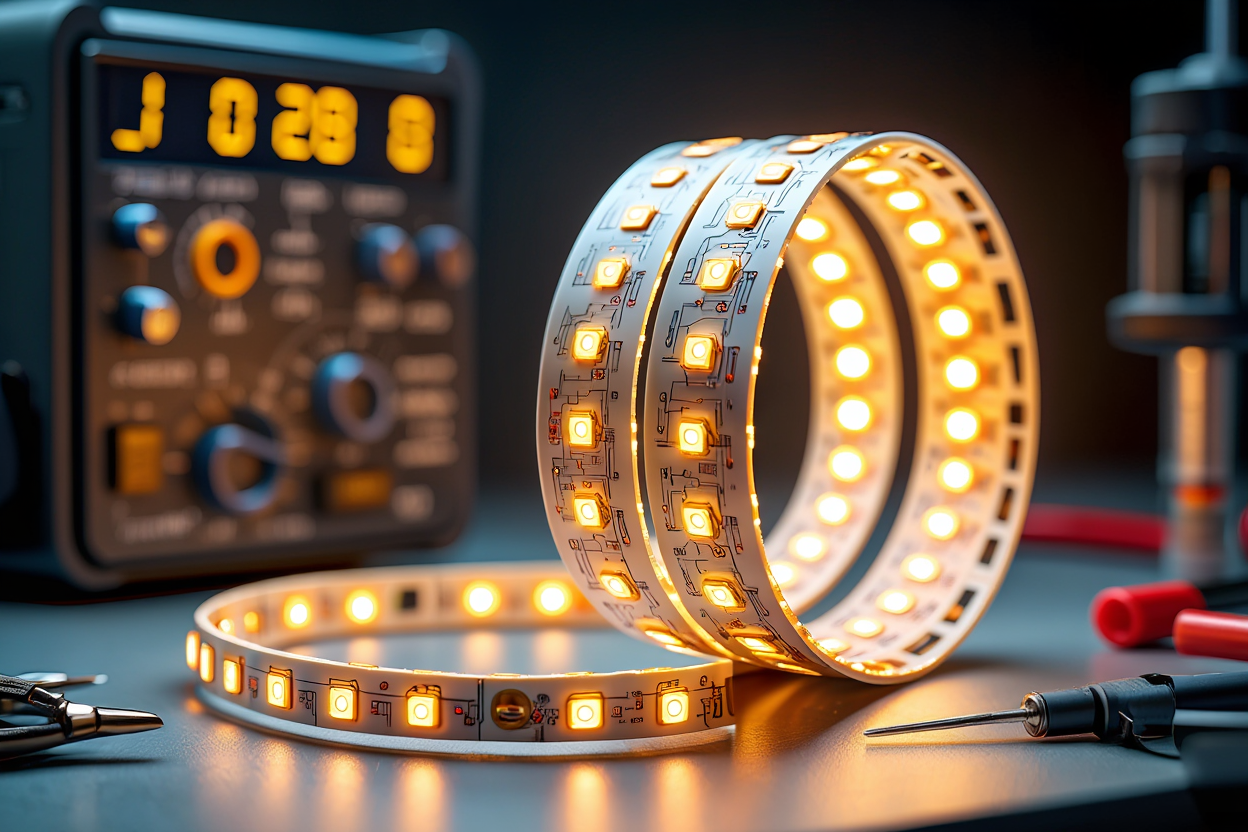
Calculating the wattage of an LED strip is very simple: multiply the per-meter consumption given by the manufacturer by the total length of your installation. For a 5-meter strip consuming 7.2 W/m, that's 36 W in total, or 3 amps at 12V (the formula is I = P ÷ 12). Easy, right?
In practice:
- Total power (W) = power/m (W) × length (m)
- Required current (A) = Total power (W) ÷ 12V
Example: 5 m of 12V 5050 LED strip at 14.4 W/m = 72 W and 6 A. Don't forget to plan for these needs when choosing the right transformer!
SMD chips and their impact on consumption
The LED type has a major influence on the strip's consumption per meter:
- LED 3528 (60 LED/m): 4.8 W/m • ≈ 400 lumens
- LED 2835 (60 LED/m): 9-12 W/m • ≈ 700 lumens
- SMD 5050 (60 or 120 LED/m): 14.4-24 W/m • 1,000-1,500 lumens
That makes a big difference in both light output and power consumption. A 12V 5050 LED strip, for example, will consume three times more than a 3528 model over the same lighting length.
For horticultural projects that demand high brightness, certain specialized 12V LED strips offer an excellent balance between energy consumption and performance.
Efficient lighting and 12V power supplies
Choosing the right 12V transformer is essential for optimal lighting. We recommend:
- A minimum 20% safety margin over the calculated wattage
- Switch-mode power supplies (90-95% efficiency)
- Suitable wiring (2.5 mm² for 8A max)
For long runs (>5m), power the strip at multiple points to avoid voltage drops that reduce brightness.
| LED type | Consumption (W/m) | 12V current (A/m) | Luminous flux (lm/m) | Typical use |
| SMD 3528 (60 LED/m) | 4.8 W/m | 0.4 A/m | ≈ 400 lumens | Ambient lighting |
| SMD 2835 (60 LED/m) | 9 W/m | 0.75 A/m | ≈ 700 lumens | Main lighting |
| SMD 5050 (60 LED/m) | 14.4 W/m | 1.2 A/m | ≈ 1000 lumens | Intensive lighting |
| High-density COB | 16.5-20 W/m | 1.4-1.7 A/m | ≈ 1500 lumens | Professional |
Cost and 12V power consumption in lighting
Now that you know how to calculate power, let's see exactly how that translates to your bill! The power consumption of your 12V LED strip has a direct impact on your budget, and understanding this mechanism lets you perfectly balance brightness and savings. Let's look at how to turn these watts into practical, usable figures.
Consumption per hour and per year
Calculating hourly LED strip consumption is simple: Energy (kWh) = Power (kW) × Time used (h). Let's take an example: a 60 W strip (5 m at 12 W/m) used 4 hours a day consumes 0.24 kWh daily, which comes to about 87.6 kWh a year. At a rate of 0.30 € per kWh, that's 26.28 € a year for your lighting - excellent value for money!
- Occasional decorative use: Strip at 4.8 W/m (24 W over 5 m) on 1h/day → 0.024 kWh/day, 8.76 kWh/year, or 2.63 €/year.
- Moderate daily lighting: Model at 9 W/m (45 W over 5 m) used 6h/day → 0.27 kWh/day, 98.55 kWh/year, 29.57 €/year.
- Intensive horticultural growing: horticultural 12v led strip at 14.4 W/m (72 W over 5 m) running 10h/day → 0.72 kWh/day, 262.8 kWh/year, 78.84 €/year.
- Continuous 24/7 use: Strip at 12 W/m (60 W over 5 m) always on → 1.44 kWh/day, 525.6 kWh/year, 157.68 €/year.
Did you know that between an economical 4.8 W/m strip and a premium 20 W/m model of the same length, the consumption gap can reach over 300 kWh per year, or about 90 € difference? Properly sizing your installation can therefore lead to substantial savings.
Optimizing lighting to pay less
There are several tricks to reduce your led strip running cost without sacrificing lighting quality. A PWM-type dimmable dimmer, for instance, lets you adjust brightness and cut power consumption by up to 50% when full power isn't needed. Perfect for nighttime lighting of indoor crops!
Motion sensors and timers prevent waste by automatically cutting power when no one's around. For efficient nighttime horticultural lighting, this green 9 W/m 12V LED strip uses only 0.75 A/m, ideal for your plants without disrupting their cycle.
- High-efficiency power supplies: At 90-95% efficiency, they outperform older transformers that waste up to 30% as heat.
- Optimized installation: Use 2.5 mm² cables for 8 A and keep connection lengths as short as possible to minimize losses.
- Heat management: Mount your strips on aluminum profiles to dissipate heat and maintain optimal brightness for 50,000 hours.
By applying this advice, you can cut your bill by 40 to 60% while keeping perfect lighting. A well-installed and properly managed warm white 12v setup delivers the same performance as conventional lighting, while using 70% less energy and lasting far longer.
12V and SMD sizing for lighting
Let's look at the technical criteria that separate a rough install from a well-built, high-performing one. Precisely sizing your 12V low-voltage system guarantees safety, durability, and energy efficiency all at once. With the right calculations, everything works in perfect harmony, with no unpleasant surprises.
Current, voltage, and line losses
The wattage of a single LED seems tiny (about 0.08 W for a 12V 2835 LED), but once you multiply these SMD chips across several meters, the total current adds up fast. For example, a five-meter white 12V LED strip in SMD 5050 consuming 14.4 W/m needs around 6 A continuously. That's why it's essential to use a transformer that can supply at least 8 A, to avoid premature overheating.
12V voltage drop is very common over long runs: beyond five meters, the strip's resistance can reduce brightness by nearly 30% at its far end. For an even distribution of light, power each section from both ends, or split your installation into parallel segments of under five meters.
Safety and 12V power supply stability
The difference between 12V and 5V LED consumption isn't just about the numbers: at equivalent wattage, a 5V strip draws almost double the current, worsening losses and voltage drop. For standard or horticultural lighting, low-voltage 12V remains the most reliable and easiest solution to install, while 5V works better for short strips or addressable RGB systems.
- Proper fuse protection: Always install a fuse rated at 1.5 times the power supply's nominal current (e.g., 8A → 12A) to protect the circuit against short circuits.
- ±3% voltage stability: Choose regulated power supplies that hold a stable voltage between 11.6 and 12.4V, which prevents flickering and protects the LED chips.
- Mandatory CE/UL certifications: Check that your equipment has CC, OVP, and OTP protections certified by these standards.
- Suitable waterproofing: In damp environments, always choose equipment with at least IP65 protection against corrosion and short circuits.
Cable choice is crucial: undersized wiring generates overheating and can waste up to 10% of the power as heat. Use at least:
- 1.5 mm² for currents up to 5A
- 2.5 mm² beyond 6A
Choose dedicated power cables rather than strip extension connectors for better heat dissipation and easier maintenance.
For stable nighttime horticultural lighting, check out our 12V LED strip at 9W/m (0.75A/m). Its waterproofing (high IP protection) and regulated power supply make it the ideal solution for humid greenhouses and successful growing.
Choosing your 12V LED strip for lighting
Now that you've mastered calculating power consumption, LED strip wattage, and the basics of sizing, it's time to choose your 12V LED strip. Whether you want a warm ambiance, horticultural lighting, or an intensive functional solution, each use requires specific features to get the perfect light output.
We'll help guide your choice between a white 12V LED strip, a COB 12V LED strip, or a waterproof LED strip, all while respecting your budget and keeping installation simple.
12V or 5V, depending on use
With 12V, you can install up to five meters of strip with no noticeable loss of brightness, which simplifies wiring and reduces the number of power supplies needed. A 5V LED strip, on the other hand, is better suited to short lengths requiring individual LED control, but be careful: beyond two meters, voltage drops and lumens fall considerably.
In short, go with 12V for most fixed or long installations, and save 5V for RGB effects on short sections.
- Ambient lighting (4.8-8 W/m): Choose a warm white 12V LED strip (3000K) with SMD LED 3528 or LED 2835 chips. It uses between 24 and 40 watts over five meters, gives off a lovely warm light, and costs less than 30€ a year in electricity.
- Functional lighting (10-14.4 W/m): The 12V 5050 LED strip produces between 800 and 1000 lumens per meter, perfect for lighting a countertop or shelving, using 50 to 72 watts over five meters.
- Horticultural use (9-16.5 W/m): A 12V COB LED strip or a red/blue spectrum model provides the light plants need to grow, using just 45 to 82 watts over five meters – far more efficient than traditional HPS lamps.
- High-performance RGB/W installation (14-20 W/m): Multicolor 5050 LEDs or high-density COB (120 LEDs per meter) reach 1200 to 1500 lumens/meter, consuming 70 to 100 watts over five meters for dynamic lighting.
The number of LEDs isn't the only factor to consider: a 60 LED/m strip with powerful LED 2835 chips can consume more than a 120 LED/m strip fitted with economical LED 3528 chips. Always check the power consumption in watts per meter to know the actual energy used and the light output you'll get.
Installing without voltage drop
To keep brightness uniform along the whole length, limit each continuous section to five meters maximum. Beyond that, the circuit board's resistance drags down the 12V voltage, affecting light output. This rule applies to all strips, whether entry-level or premium.
Power each strip in parallel, add injection points every three to five meters, and use waterproof connectors if needed. 1.5 mm² cables are enough up to 5A; move up to 2.5 mm² beyond 10A to avoid losses and ensure safety.
- Heat dissipation: About 30% of the power consumed turns into heat. Always mount your strip on an aluminum profile or metal surface to keep the temperature under 40°C and extend its lifespan.
At GrowLED, we've been selecting the best 12V LED strips, reliable SMD components, and suitable accessories since 2009. Our catalog includes LED strips in 2835, 3528, and 5050, CE/UL-certified power supplies, profiles, waterproof connectors, and expert advice to make your LED lighting project efficient, durable, and perfectly sized.