

















































































Have you ever wondered whether humans could, like plants, draw energy directly from sunlight? While the idea of human photosynthesis may sound appealing, the biological reality is quite different. This article explains why our bodies cannot carry out photosynthesis, details how the process works in plants, and explores the real effects of sunlight on the human body.
Why humans don't photosynthesize
As appealing as the idea of "recharging" in the sun may be, our cells simply don't have the biological toolkit for it. Unlike plants, our cells lack every tool needed to turn light into organic matter: no chloroplasts, no chlorophyll, and none of the enzymes specific to photosynthetic organisms.
The biological reasons behind this impossibility
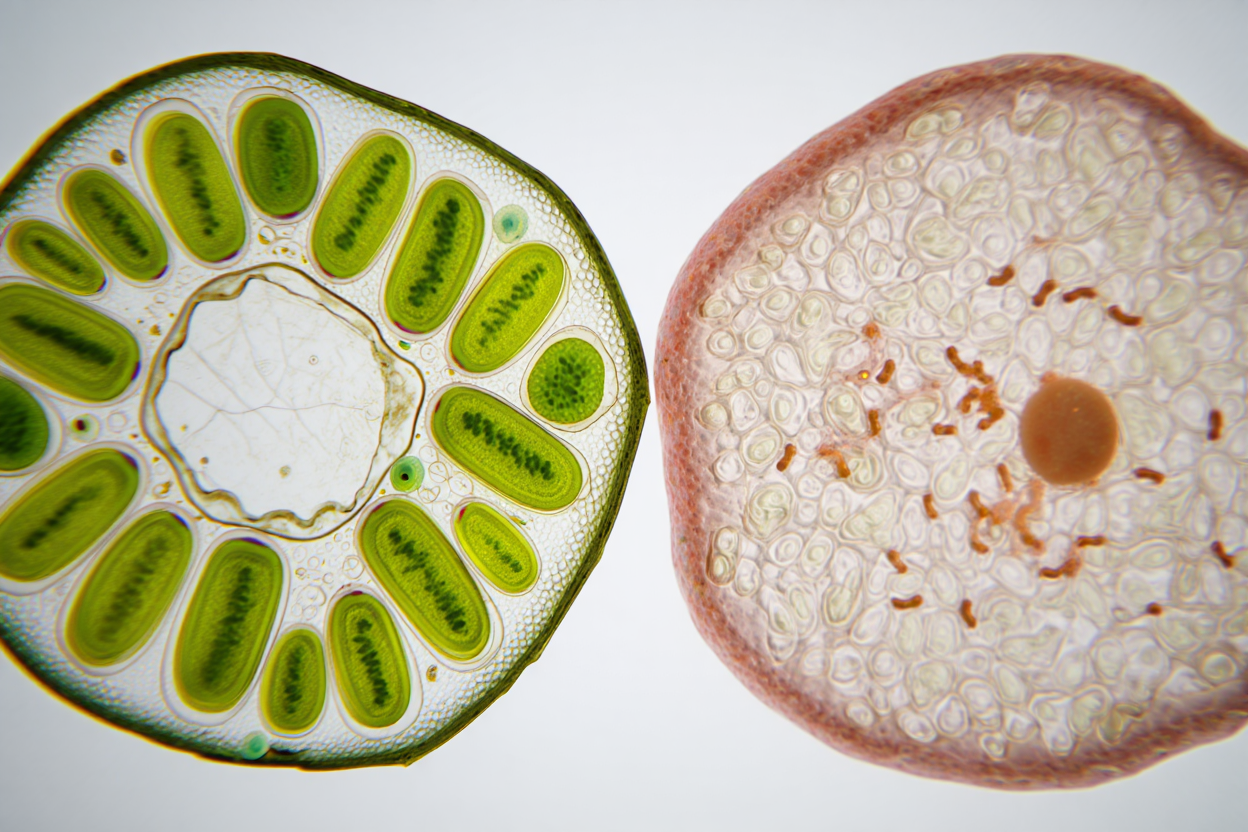
By photosynthesis definition, we mean the process by which certain organisms convert light energy into organic matter. This complex mechanism requires specialized cellular structures that our DNA doesn't encode. The chloroplasts, those small green factories found in green plants, are completely absent from our tissues.
- No chloroplasts: These organelles, which contain chlorophyll and are essential for capturing light energy, don't exist in our cells.
- Missing enzymes: Rubisco (crucial for fixing carbon dioxide) and the proteins of photosystems I and II aren't part of our genetic makeup.
- Unsuitable cell structure: Our cells have neither thylakoids nor stroma, the compartments essential for converting solar energy into ATP and NADPH.
- Different metabolism: Our mitochondria consume glucose and oxygen to produce energy, a process that runs in reverse compared to photosynthesis.
Attempts to introduce chloroplasts into animal cells have failed: the organism rejects them and cannot maintain the necessary proton gradients. Learn more about the differences between plants and humans helps explain the complexity of turning atmospheric carbon into biomass.
Respiration and photosynthesis: two opposing processes
The simplified equation for photosynthesis is: 6 CO₂ + 6 H₂O + light → C₆H₁₂O₆ + 6 O₂. Plants absorb carbon dioxide and water, then produce glucose and oxygen using the energy captured by chlorophyll.
Conversely, our cells consume glucose and oxygen to produce ATP, releasing carbon dioxide and water in the process. This cellular respiration is our main energy source, with no direct reliance on the light of the sun.
Plants use their stomata for gas exchange, their chloroplasts to capture light energy, and the Calvin cycle to fix carbon. We, on the other hand, have lungs to breathe, a digestive system to absorb nutrients, and metabolic pathways like glycolysis to extract energy: two entirely distinct evolutionary strategies.
The precise mechanism of photosynthesis
To really understand why photosynthesis is impossible for us, let's look at how it works in plants. The light-dependent reactions take place in the thylakoids, where chlorophyll captures light energy to produce ATP and NADPH. The Calvin cycle then uses these molecules to convert CO₂ into glucose.
Photosystem II splits water into oxygen, protons, and electrons, kicking off a transport chain that creates a proton gradient. Photosystem I then uses these electrons to produce NADPH, essential for building organic matter. Nothing comparable exists in human physiology.
| Criterion | Plant photosynthesis | Human respiration |
| Main organelle | Chloroplast (with thylakoids) | Mitochondrion |
| Energy source | Sunlight | Dietary glucose |
| Gas absorbed | CO₂ (carbon dioxide) | O₂ (oxygen) |
| Gas released | O₂ (oxygen) | CO₂ (carbon dioxide) |
| Key pigment | Chlorophyll (green) | No photosynthetic pigment |
| End product | Glucose + biomass | ATP + water + CO₂ |
| Energy efficiency | ~1% of light energy | ~40% of glucose energy |
Plant photosynthesis vs. the human body
To really understand why photosynthesis isn't possible in humans, we need to take a close look at the steps of photosynthesis. This complex process requires specific structures, particular enzymes, and biochemical conditions that our bodies simply don't have — which is exactly what creates such a fundamental difference between plants and humans.
The key steps of photosynthesis
Photosynthesis begins with the light-dependent reactions: photosystems II and I, located in the chloroplasts, capture solar energy and use light to split water. This reaction releases oxygen into the air while producing ATP and NADPH. Note that nighttime photosynthesis is impossible for most plants.
Next, the Calvin cycle (the dark phase) takes over: with no direct need for light, it fixes atmospheric carbon dioxide using the enzyme Rubisco. This mechanism, which takes place in the chloroplasts, converts atmospheric carbon into glucose, fueling plant growth.
Why this doesn't apply to humans
Our bodies cannot carry out photosynthesis because they lack essential elements: no chloroplasts, no enzymes like Rubisco, and no photosystems. What's more, our metabolism produces energy by oxidizing glucose with oxygen, without relying on light at all.
Even in a hypothetical scenario where our skin (with a surface area of about 1.7 m²) contained chloroplasts, the amount of solar energy captured would be nowhere near enough to cover our daily energy needs. What's more, our body temperature of 37°C would quickly render photosynthetic proteins ineffective. To better understand these mechanisms in plants, check out this guide: Optimize your plants' photosynthesis in indoor growing.
Artificial photosynthesis and human limitations
While photosynthesis is biologically impossible for humans, scientists are working to recreate its mechanisms in the lab. Artificial photosynthesis represents an extremely promising clean energy source. However, adapting it to the human physiological system still seems out of reach today. Let's take a look at where things stand and what obstacles are still blocking this transfer.
What artificial photosynthesis does
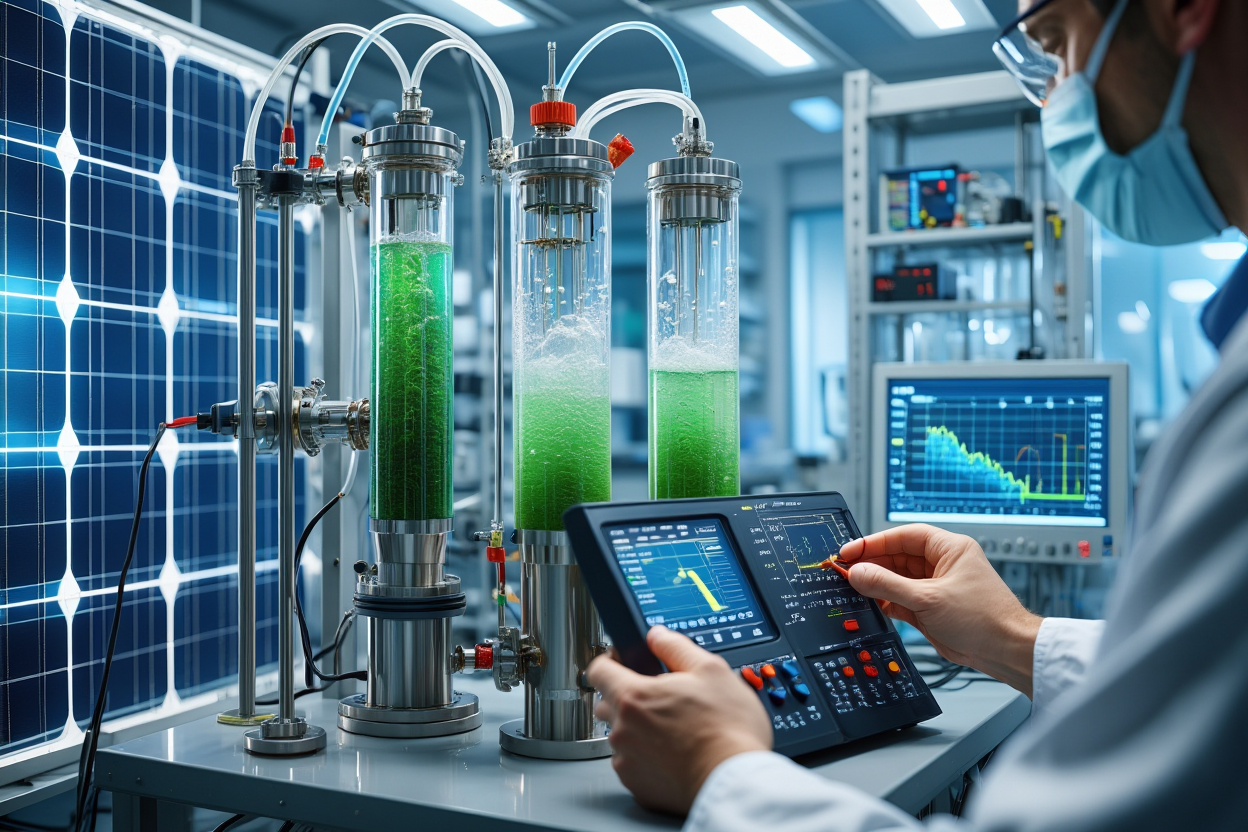
Artificial photosynthesis borrows the principles of the natural process to convert light energy into energy-rich chemical compounds. Using metal catalysts and specialized cells, it manages to split water into hydrogen and oxygen, or convert atmospheric carbon into fuels. Some prototypes achieve impressive efficiencies of 10 to 15%, well beyond the typical 1% seen in natural plants.
Why this can't be transposed to the body
According to any artificial photosynthesis summary, these systems require very tightly controlled conditions — stable pH, regulated temperature, absolute purity — that are impossible to maintain in a living organism. What's more, our internal environment (the presence of air, proteins, etc.) would interfere with the required chemical reactions. The catalysts used (such as cobalt or platinum) also turn out to be toxic to human cells.
Even if we managed to introduce chlorophyll or another photosynthetic pigment into our cells, the energy yield would be negligible. The energy produced this way (in the form of electricity or fuel) cannot be used directly by our metabolism, which runs on glucose. Ideas suggesting our bodies could capture energy from Wi-Fi or radio waves belong to pure fiction: the solar energy available is far too weak for our needs.
Photosynthesis summary for learning
In plants, photosynthesis takes place in the chloroplasts thanks to chlorophyll. This process uses solar light energy to combine CO₂ and water, producing glucose and releasing oxygen. It enables the creation of biomass and forms the base of the food chain.
As humans, we benefit indirectly from this energy by consuming that organic matter. Any attempt to directly integrate artificial photosynthesis into our physiology runs into major technological barriers. In the meantime, improving crop lighting to maximize photosynthetic yield seems like the most realistic path to boosting agricultural output.
Myths and facts about photosynthesis
Some ideas circulating online suggest that humans could "feed on light," or that melanin acts as a form of chlorophyll. Let's examine these beliefs in light of scientific research, with a mindset that's both critical and curious.
Debunking human photosynthesis
The phrase "photosynthesis to recharge our batteries" is a good example of the misconceptions that need correcting. Unlike plants, our bodies cannot directly convert sunlight into energy. Our cells need glucose from the food we eat and oxygen from the air to function.
- Melanin is not chlorophyll: While it absorbs UV rays to protect our DNA, it cannot carry out photosynthesis the way plant chloroplasts do.
- Alternative theories lack evidence: Some authors cite studies that have never been validated by the scientific community.
- "Photosynthetic" supplements don't work: No product has ever demonstrated an ability to fix carbon dioxide or produce energy the way plants do.
- Experiments that can't be reproduced: The few studies on the subject have significant methodological gaps.
Attempts to demonstrate glucose production in humans under the effect of light have always come up empty. Without specialized structures like the photosystem found in plants, our bodies are simply incapable of carrying out photosynthesis.
Some dubious practices claim to "activate human photosynthesis," which can lead to serious nutritional deficiencies. The science is clear: we depend on organic matter produced by other living things for our survival.
Mental model: respiration vs. photosynthesis
To make this easier to picture, imagine a simple photosynthesis diagram. Photosynthetic organisms such as plants, algae, and cyanobacteria use water, carbon dioxide, and sunlight to produce their own food. Humans, in turn, consume that biomass and the oxygen they produce, releasing CO₂ back in return.
This complementary relationship is the result of billions of years of evolution. Cyanobacteria developed photosynthesis a very long time ago, while our own lineage chose an equally effective strategy for tapping into solar energy indirectly, through the consumption of organic matter.