



































































Are you passionate about indoor growing and LED grow lights? Then you've probably already heard about the risks linked to full-spectrum bulbs. Anses, the French national health and safety agency, warns against the blue light emitted by these devices, which is particularly harmful to the retina. Vulnerable groups such as children or night shift workers need to be especially careful. Let's explore these risks together, along with solutions for growing in total safety without compromising your eye health.
Why full-spectrum bulbs pose dangers
Full-spectrum LEDs have transformed indoor growing, but they raise a genuine public health issue. Their high concentration of blue light increases eye exposure to hazards that current standards don't sufficiently account for. Simply knowing about this danger is already a first layer of protection.
The problematic spectral makeup of modern LEDs
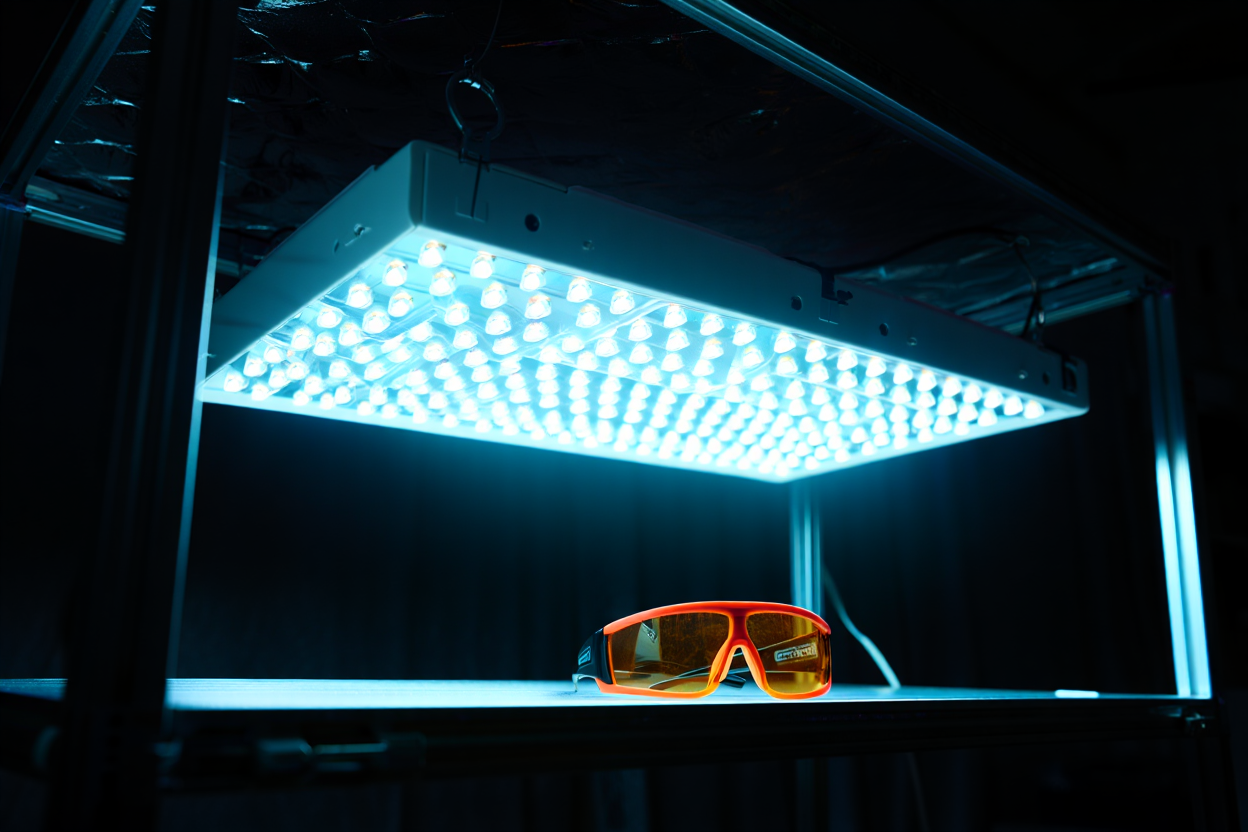
A full-spectrum LED light emits a considerable amount of blue radiation (between 380 and 450 nm), far more than traditional light sources. When the color temperature exceeds 6000 K, this artificial light reaches the retina directly, without the protective infrared found in daylight.
- Too much blue: white LEDs can emit up to 40% blue light, compared to just 15% for a standard bulb.
- Discontinuous spectrum: unlike natural light, LEDs produce intensity spikes at the most harmful wavelengths.
- High power: a 420 W module over a small area drastically increases light density.
Because of this particular spectral signature, many grow lights fall into risk group 2 or 3 under the NF EN 62471 standard. Just a few seconds of exposure are enough to permanently damage the retina - a danger confirmed by Anses.
The biological mechanisms of retinal toxicity
The question of how artificial light affects health came to the forefront after Inserm demonstrated that blue light causes oxidative stress that destroys retinal cells. Blue photons (440 nm) penetrate deep into the eye, generate free radicals, and gradually destroy photoreceptors.
Daily exposure of more than two hours at full intensity, without protection, triples the risk of early macular degeneration. In animals, just a few weeks are enough to cause lesions - in humans, the damage silently accumulates for years before it becomes apparent.
Tests show that a blue intensity of 10 mW/cm² for just thirty minutes already impairs visual sensitivity. At thirty centimeters from a grow light, you easily exceed the safety thresholds recommended by ICNIRP by two to three times - and the damage occurs without any immediate pain.
Risk classification under the NF EN 62471 standard
This standard classifies light sources into four categories: GR0 (no risk), GR1 (low risk), GR2 (moderate risk), and GR3 (high risk). Professional grow lights generally fall into risk group 2 or 3 because of their spectrum and power.
Major problem: this standard, established before the rise of LEDs, doesn't account for the oxidative stress specific to this technology. As Alicia Torriglia, a researcher at Inserm, points out, current protocols underestimate the intensity of blue light and its effects during prolonged exposure.
| Risk group | Tolerated exposure time | Lamp type | Hazard level |
| GR0 (exempt) | Unlimited | Warm white household | None |
| GR1 (low) | Several hours | Office LED | Minimal |
| GR2 (moderate) | 0.25 second | 200-400 W grow light | High |
| GR3 (high) | Instant | Industrial floodlight | Critical |
Blue Light and Phototoxicity: Scientifically Proven Risks
Retinal phototoxicity isn't just a theory: it's a biological phenomenon clearly established by scientific studies. When our retina is exposed for a prolonged period to wavelengths between 440 and 460 nm, it undergoes oxidative stress that accelerates its aging and can lead to irreversible vision damage.
Impact of blue light on the retina and vision
Of all the visible colors, blue light carries the strongest energy. While grow lights use these wavelengths (440-460 nm) to stimulate plant growth, they also bombard our eyes' photoreceptors. This phenomenon produces free radicals that progressively attack the DNA and membranes of retinal cells.
- Proven phototoxicity risks: ANSES considers LEDs emitting at 440 nm to be particularly dangerous for the retina
- Early AMD: daily exposure exceeding 2 hours triples the risk of developing this eye condition
- Reduced visual acuity: just 30 minutes of exposure at 10 mW/cm² is enough to temporarily impair vision
- Warning symptoms: tired, red, or stinging eyes after 3 hours already signal micro-lesions in the retina
At 30 cm from an LED grow light, light intensity often exceeds safety standards by 2 to 3 times. The danger is real: looking directly at this light without protection can cause permanent retinal burns within seconds. Worse, our retina has no pain sensors, making these lesions painless but just as serious.
Disruption of the circadian cycle and sleep quality
Beyond its effect on the retina, blue light disrupts our biological rhythms. When ganglion cells detect this light, they send a signal that inhibits melatonin production, completely throwing off our natural sleep cycles.
ANSES studies show that evening exposure to a 6500K bulb (cool light) delays melatonin secretion by 45 minutes and reduces deep sleep. Even weak blue light (an LED night-light or screen) before 10 p.m. can lengthen the time it takes to fall asleep by 30 to 60 minutes, creating a sleep debt with multiple health consequences.
Working daily under a grow light rich in blue light worsens dry-eye symptoms and headaches. This visual fatigue creates a vicious circle: the less you sleep, the more vulnerable your retina becomes to blue light the next day.
Populations at Risk from Full-Spectrum Lights
The impact of full-spectrum grow lights varies depending on each individual's degree of exposure. The eye's lens, which acts as a natural barrier against blue light, changes with age and doesn't protect everyone equally well. This exposes certain vulnerable groups to increased risks, requiring special safety measures.
Why children are more vulnerable to LEDs
In young children, the especially clear lens lets through nearly 90% of blue light, compared with about 60% in adults. This high permeability directly exposes the still-immature retina to phototoxic energy, multiplying the eye risks linked to LED grow lights.
The ANSES warns about early exposure in young generations, particularly via light-up toys, screens, night-lights, and school lighting. In a grow space, always keep at least 70 cm between the light and a child's eyes - versus 45 cm for an adult - to ensure optimal safety.
Older adults and pre-existing eye conditions
Older adults face several combined vulnerabilities: a yellowed lens, reduced retinal density, and pre-existing eye conditions. Cataracts, AMD, glaucoma, or retinitis pigmentosa make the retina more sensitive to the oxidative stress caused by intense blue light.
Regular exposure can accelerate the progression of these conditions and prolong glare effects. Wearing specialized glasses that filter 440 nm (with an OD ≥ 3) becomes essential as soon as you enter the grow area, to limit these eye risks.
- Macular degeneration (AMD): blue light worsens the destruction of already weakened macular cells.
- Cataract surgery: intraocular implants filter the blue spectrum less effectively than a natural lens.
- Glaucoma: high intraocular pressure makes the optic nerve more vulnerable to intense light exposure.
Systematic training in good safety practices and the use of protective equipment is the best safeguard for these vulnerable groups.
Prevention measures tailored to each profile
For children: always position lights out of their field of view and out of reach, ideally in a space that locks. Use clear warning pictograms and minimize the risk of accidental exposure as much as possible.
For older adults and at-risk individuals: favor remote scheduling systems and limit their presence during lit phases. Clear information about the dangers of blue light and the available means of protection strengthens safety in all grow environments.
Intensity and the Limits of Current Safety Standards
Designed before the era of LED grow lights, photobiological safety standards don't account for the specifics of this LED technology. With their concentrated power and specific light spectrum, these modern lighting systems reveal a genuine regulatory gap. The result: prolonged exposure to these hyper-intense artificial light sources can become dangerous for users.
The gaps in the NF EN 62471 standard when it comes to LEDs
Drawn up before the massive rise of LEDs, the NF EN 62471 standard is now showing its limits. Its broad-brush approach to photobiological energy fails to properly assess the specific risks tied to light-emitting diodes. In particular, it ignores the harmful effects of blue light spikes - a perfect example of artificial light regulation that's poorly suited to today's eye safety challenges.
- Outdated methodology: the tests don't precisely measure the impact of blue rays, even though they exceed hazard thresholds.
- Incomplete assessment: according to Alicia Torriglia's research, risks to the retina are systematically underestimated.
- Problematic categorization: some lights classified as GR1 can cause cumulative damage with repeated professional use.
- Exposure duration ignored: the standard doesn't account for the effects of daily use over several years.
In light of this, the ANSES is calling for a complete overhaul of assessment protocols and stricter standards for devices classified as GR2/GR3. Pending this reform, their experts estimate that the real hazard level of your grow lighting system could be underrated by 30 to 50 %.
Stroboscopic effect and glare from powerful lights
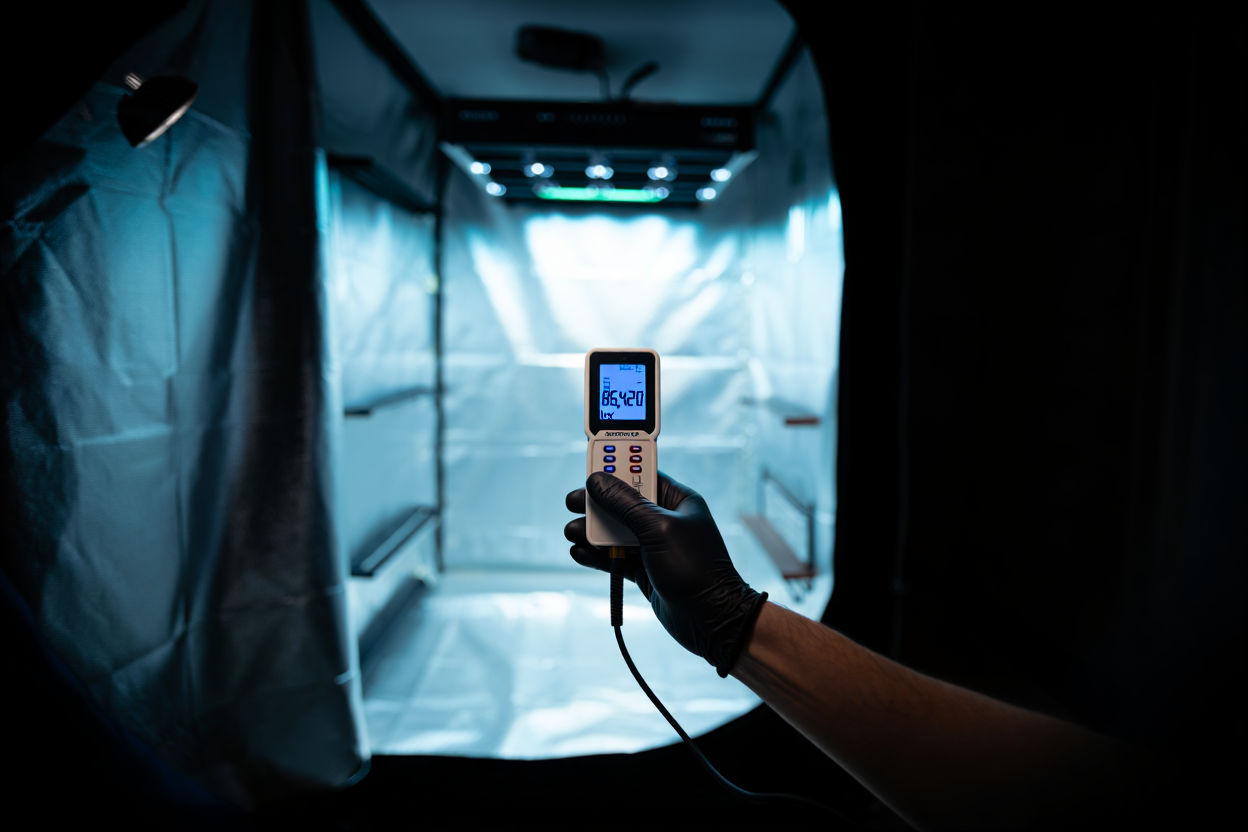
The light intensity of LED grow lights reaches impressive levels - up to 12 000 lux at their center, four times more than a standard compact fluorescent bulb. This extreme concentration can cause instant glare, leaving afterimages on the retina and triggering significant oxidative stress above 3 000 lux after just two hours of exposure.
- Temporary glare: momentary loss of central vision after looking directly at the light source.
- Thermal discomfort: a feeling of heat around the eyes that triggers a reflex to close the eyelids.
- Stroboscopic effect: overly rapid flickering can trigger migraines or seizures in people with photosensitive epilepsy.
Installing diffusers or filters helps spread light more evenly by reducing luminance spikes, improving visual comfort during prolonged use. Be careful, though: even with these precautions, a poorly positioned light without adequate eye protection can permanently damage your vision in just a few seconds.
The SpectraWILD S320 combines the performance of professional lighting with genuine eye protection.
How to Effectively Protect Yourself from Full-Spectrum Bulbs
Identifying the risks isn't enough - you need to adopt rigorous safety habits. Between personal protection, thoughtful setup, and suitable alternatives, you can protect your health while keeping your crops productive.
Essential personal protective equipment
Natural light triggers the eyes' protective reflexes, unlike LED grow lights. Always wear blue-light-filtering glasses whenever you're working close to the lights. This equipment effectively blocks 99.9% of harmful radiation (400-450 nm) without impairing your vision.
- Glasses certified OD > 3: an essential barrier against blue-tinted light
- Blue-light filters for screens: reduce cumulative exposure by 30 to 60%
- Opaque panels: isolate the lit area
- Protective gloves: limit effects on the skin
Avoid looking directly at the light source at all costs - even briefly. This reflex should become as natural as avoiding a hot surface.
Best practices for setup and safety distances
Position your lights at least 45 cm from adults and 70 cm from children to keep exposure below the critical threshold of 1 mW/cm². This simple distance considerably reduces the risks, thanks to the physics of light diffusion.
Favor matte surfaces over reflective materials, which dangerously scatter light rich in blue. A diffusing Mylar is an excellent alternative for limiting unforeseen health risks.
Choose remote control and smartly schedule your light cycles (night, time away). Good modulation can limit blue light emission to just 30% during maintenance phases.
Alternative solutions for reducing daily exposure
Choose bulbs with a warm color temperature (2500-3000 K), which emit 70% less cool, blue light, protecting your circadian rhythm and your sleep.
Apply the 20-20-20 rule: every 20 minutes, look at something 6 m away for 20 seconds. Add regular breaks to rest your eyes.
Wear blue-light-blocking glasses outside your grow area and turn on software filters on your screens in the evening. At night, favor warm white or red light to protect your sleep cycles.
The ANSES stresses that health and safety with LEDs requires: controlled intensities, physical protection, and proper training. At home, position your lights outside your direct field of view and more than a meter from living areas.
Make sure to turn lights off after 10pm: evening exposure to blue-tinted light delays melatonin production and seriously disrupts sleep. LEDs emit their maximum output immediately - so reducing blue light in the evening is crucial.
In conclusion, growing under a full-spectrum bulb without precautions exposes your retina and your sleep to avoidable dangers. By adopting the right protection, safety distances, and settings, you can combine exceptional yields with preserved health.