






































































Wondering what wattage of 600x600 LED panel would be best suited for your lighting project? This guide reviews the different options, ranging from 22W to 45W, to help you make your choice simply, without getting bogged down in technical details. You'll discover how an optimal light output can make all the difference to the final result.
Available wattages for 60x60 LED panels: from 22W to 45W
The LED panel is now available in many standard wattages to suit every need. Depending on the model and manufacturer, you'll commonly find versions at 24W, 25W, 27W, 30W, 32W, but also more powerful models at 35W and 40W. Choosing the perfect wattage is crucial for creating the ideal lighting ambiance in your room.
Designed to fit effortlessly into most suspended ceilings, the 60x60 format (or 600x600) is both an aesthetic and practical solution. This 60x60 LED panel instantly modernizes a space while simplifying its installation.

Light output: how many lumens per watt
Light output, expressed in lumens per watt (lm/W), is the key indicator for assessing your lighting's real performance. Modern technologies, such as those used in a high-end Philips 60x60 LED panel, can reach up to 160 lm/W, notably thanks to the use of a high-performance driver. The higher this ratio, the greater the amount of useful light produced for each watt consumed.
To give you an idea, an efficient 27W panel can produce as many lumens as an older 40W model. This increased efficiency is directly linked to the quality of the components. It's therefore essential to select an LED panel offering an output above 90 lm/W.
- Excellent output (120-160 lm/W): These products use cutting-edge technology and an optimized driver for maximum energy efficiency.
- Good output (100-120 lm/W): A reliable option offering an excellent balance between purchase price and performance.
- To be avoided entirely (< 90 lm/W): These panels are energy-hungry and generally have a poor lifespan, making them a bad investment.
In short, for equal consumption, the panel with the best output will always be more economical over time. It's an essential selection criterion.
Philips 60x60 LED panels and premium brands compared
Major brands, like Philips, offer Philips 60x60 LED panel models with very well-developed technical specifications. They often guarantee a UGR (Unified Glare Rating) below 19, which minimizes glare, along with excellent color rendering. This ensures optimal visual comfort, particularly valuable in offices.
Fortunately, other manufacturers also offer quality alternatives at often more affordable prices. The key is to compare spec sheets to find the perfect wattage and the best output, whatever the brand of your future 600x600 LED panel.
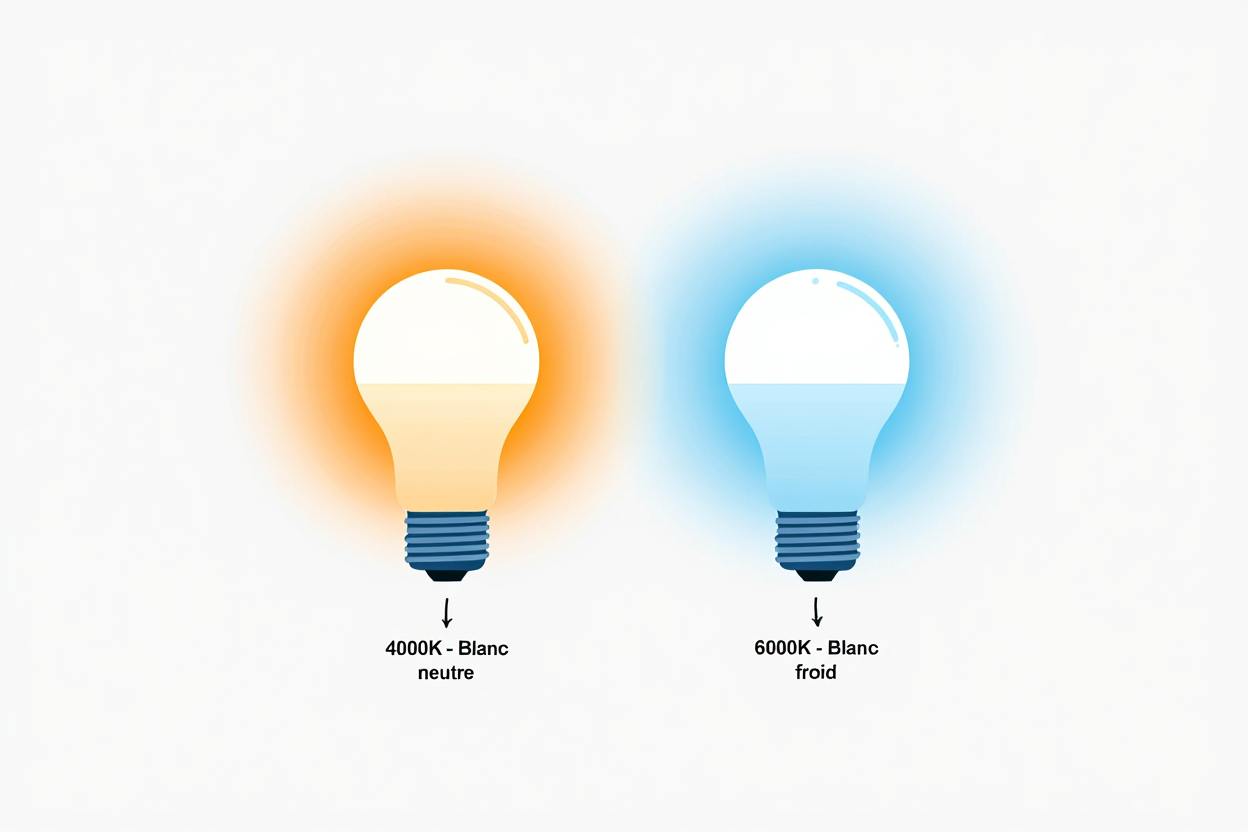
4000K color temperature: why this standard
4000K, corresponding to a neutral white, has established itself as the reference in professional lighting. This color temperature, or CCT, is perfectly suited for lighting offices and commercial spaces. It gives off a bright, natural light that remains pleasant on the eyes without being harsh.
This light spectrum helps reduce eye strain and improves the perception of detail. This is why the 600x600 LED panel in 4000K is highly favored for boosting concentration and productivity.
How to calculate the wattage needed based on your surface area
Technical figures shouldn't intimidate you anymore. Here's an extremely simple method for calculating your wattage without any complications. Only three pieces of information are essential: your surface area in m², the desired lighting intensity, and the light output of your bulbs or panels.

Calculation formula: surface area, lux, and output
The secret lies in this simple formula: Wattage (W) = Surface area (m²) × Illuminance (lux) ÷ Light output (lm/W). Let's imagine a 20 m² office that needs 500 lux. The calculation gives us approximately 67W. This is ideally covered by two 40W panels for great lighting.
The reasoning is very clear: you multiply the surface area by the desired lux level, then divide by the bulb's efficiency. The result gives you the total wattage required. Simple mathematical logic for achieving perfect light.
| Type of space | Recommended lux | Example surface area | Estimated wattage | Number of 40W panels |
| Standard office | 300-350 lux | 15 m² | 45-52W | 1x 40W panel + 1x 22W panel |
| Store/Showroom | 500-600 lux | 20 m² | 66-80W | 2x 40W panels |
| Workshop/Production | 750-1000 lux | 25 m² | 125-166W | 4x 40W panels |
| Corridor/Passage | 150 lux | 10 m² | 10-12W | Less than one 22W panel |
Every room has its own lighting and visibility requirements. The more precision your activity requires, the higher the required lux level will be. A relaxation room doesn't have the same needs as a DIY workshop.
Ceiling height coefficient and adjustments
One parameter is often overlooked: the ceiling height has a direct impact on your project. A higher ceiling disperses light more, so you need to plan for more wattage to compensate. Don't forget to apply a multiplying coefficient to your setup.
- Ceiling at 2.5 m: coefficient ×1, this is the standard height for ideal diffusion.
- Ceiling at 3 m: coefficient ×1.2, add 20% wattage due to the extra distance.
- Ceiling at 3.5 m: coefficient ×1.4, light dispersion is more significant here.
- Ceiling at 4 m or more: coefficient ×1.6 to ×2, opt for 40W panels or double your installation.
If your room has windows and natural light, you can reduce the required wattage by 15 to 30%. Light-colored walls, which reflect light well, also help with lighting. Finally, plan for a small extra margin to compensate for the decline in light output over time.
What ceiling LED panel wattage to choose based on use
Now that the basics are established, let's get practical: how do you choose the right wattage for each type of room? Every space has its own lighting needs, and that's what should guide your final choice. There's no point choosing an overly powerful LED panel for a corridor, just as it's essential to properly light a technical work area.

Offices, shops, and workshops: 22W, 40W, or 45W
For standard offices, a 22W LED panel works perfectly for a surface area of around 8 m². A brightness of 300 to 350 lux offers ideal visual comfort for screen work. The built-in driver manages the power supply reliably and discreetly.
For a shop or a reception hall, the goal is to create bright, appealing light. Go for a wattage of 40W or 45W to reach 500 to 600 lux and showcase your products. This kind of lighting improves the customer experience and is an investment that pays for itself quickly.
- 22W panel (offices, small spaces): produces about 300-350 lux over 8 m². Ideal for economical lighting in administrative settings.
- 25W or 27W panel (spacious offices): offers a good balance between performance and consumption for progressive, uniform lighting.
- 40W panel (shops, showrooms): generates about 500-600 lux over 10-12 m². Perfect for showcasing the space and the items.
- 45W panel or double installation (workshops): essential for reaching 750-1000 lux at workstations demanding precision.
In a workshop, lighting quality shouldn't be overlooked. Technicians need excellent visibility. Depending on your ceiling configuration, you can choose two 22W panels or a single 45W LED panel. The key is ensuring optimal comfort and precision.
Driver and installation: essential technical criteria
The LED panel driver is at the heart of the system. Standard models, often equipped with a non-dimmable external driver, offer simple, reliable management. If you want to adjust the light intensity, opt for a DALI-compatible version for precise control.
The installation of a 600x600 LED panel is simplified thanks to quick connectors and recessed mounting. This cuts installation time by 30 to 40% compared to older systems, without requiring any special expertise. Add motion detectors to further optimize energy savings.
Durability and operating costs of LED panels
On the budget side: a 22W LED panel costs only about €1.80 a year in electricity for standard use. Compared to compact fluorescent lighting, the investment pays for itself in under two years. With a lifespan of up to 50,000 hours, the savings add up over the long term.
Another notable advantage: the absence of flicker (Flicker-Free), which preserves visual comfort and eye health. This ceiling LED panel avoids eye strain and headaches caused by unstable light. Sturdy and reliable, your 600x600 LED panel will serve you for years to come.