




































































Ever wonder what your lighting really costs you every month? This guide will help you calculate a 100W bulb's consumption in kWh, using simple, practical methods. Let's see together how to easily estimate these costs!
How to calculate a 100W bulb's consumption
It's essential to know your lamps' consumption to better control your electricity bill. Good news: making this estimate is much simpler than you might think. Calculating a 100W bulb's consumption relies on a standard formula that you can apply to all your appliances. With a bit of basic information, you'll be able to precisely anticipate your monthly expenses.

Calculation formula and conversion to kilowatts
The essential formula for estimating your consumption is: Consumption (kWh) = power (kW) × usage time (h). It's a very simple calculation to do. Start by converting your bulb's power to kilowatts. For a 100W bulb, just divide by 1,000, which gives 0.1 kW.
- Basic conversion: always divide the power in watts by 1,000 to get the value in kilowatts (0.1 kW).
- Total duration: the usage time corresponds to the total number of hours the bulb is switched on over the chosen period.
- Final result: the kilowatt-hour (kWh) is the main unit of measurement for your energy consumption.
- Universal application: this calculation method applies to all types of lighting, whether LED or halogen.
Let's take a concrete example to better understand. If your 100W bulb stays on for 10 hours, the calculation will be: 0.1 kW × 10 h = 1 kWh. This is the kilowatt-hour that your electricity supplier uses to draw up your bill. The relationship is simple: the longer you keep it on, the higher your electricity consumption gets.
Consumption examples based on usage time
Let's move on to real-life situations, since lighting time has a huge effect on the final cost. Your expenses vary considerably depending on whether you use your bulb for 2 hours or 20 hours a day. These examples will let you make a precise comparison with your own setup.
To get the annual consumption, simply multiply the daily usage by 365 days. For example, five hours a day generates about 182.5 kWh a year. With 18 hours of use a day, you quickly reach 657 kWh a year. These figures show just how much managing your lighting time affects your budget.
| Daily duration | Daily consumption (kWh) | Monthly consumption (kWh) | Annual consumption (kWh) |
| 8 hours/day | 0.8 | 24 | 292 |
| 12 hours/day | 1.2 | 36 | 438 |
| 18 hours/day | 1.8 | 54 | 657 |
| 24 hours/day | 2.4 | 72 | 876 |
As this table shows, using a bulb for 18 hours a day results in a consumption of 54 kWh per month! A lamp left on 24/7 would reach nearly 876 kWh over the year. Reducing your usage time therefore remains the best way to save money.
Practical measurement methods with a power meter
Beyond the theoretical calculation, measuring your actual consumption with a dedicated device is very useful. A power meter plugged directly into the wall outlet will give you the exact power consumed by your system. This lets you compare your estimates with reality, including any losses.
Why is this step important? An old or faulty piece of equipment can sometimes consume far more than expected. Measuring regularly lets you spot a drop in efficiency or an overly power-hungry device before you get your bill. It's the best way to keep an eye on your energy consumption without any bad surprises.
Comparison and energy savings for 100W bulbs
Once you've mastered the basic calculations, it's time to address an essential question for any grower mindful of their budget: how do you durably lower your electricity bill? The solution often comes down to a simple choice: choosing an LED over an incandescent bulb makes a huge difference.

LED versus 100W incandescent and halogen bulbs
To get the same brightness as a 100W incandescent bulb, an LED consumes about 90% less electricity. The difference is considerable: an equivalent LED uses only 9 to 12 watts to produce the same amount of light. The consumption of an LED bulb is therefore much lower, which quickly offsets its higher purchase cost.
The numbers speak for themselves: an incandescent bulb uses 182.5 kWh a year, versus only 16.4 kWh for its LED equivalent. As for 100W halogen bulbs, they consume as much as classic incandescent models, but give off far more heat. This excess heat requires more powerful ventilation, which further increases your energy bill.
Halogen bulbs are therefore not suited to optimal indoor growing, unlike LEDs with their excellent energy efficiency. What's more, an incandescent bulb has a lifespan of about 1,000 hours, while an LED can run for between 15,000 and 25,000 hours. You change your bulbs much less often, which represents a significant energy saving as well as a real maintenance benefit.
- Light efficiency: a 9-12W LED produces as much light as a 100W incandescent bulb, with optimal conversion into photons.
- Heat generation: LEDs give off 80% less heat, which lightens the load on your ventilation system and reduces indirect costs.
- Lifespan and replacement: an LED lasts up to 25 times longer, which virtually eliminates replacement costs for years.
To help you, GrowLED exclusively offers premium LED brands like Lumatek, SANlight, and HLG, which guarantee maximum energy efficiency. We also offer an exclusive warranty to protect your investment. Our goal: to offer you bulbs that shine bright while consuming little.
Estimating the real annual electricity cost
Let's now look at the financial side to understand what this choice really means in terms of cost. The final amount depends on your amount of energy consumed (in kWh) and your electricity supplier's rate. The basic formula is: Cost = consumption (kWh) × rate (€/kWh), knowing that the average price in France is about €0.18/kWh.
Let's take the example of a 100W incandescent bulb used 5 hours a day throughout the year. The calculation gives 182.5 kWh/year multiplied by €0.18, for an annual expense of €32.85. Let's compare that with the consumption of a 9W LED bulb giving the same brightness.
With the LED, the cost drops radically: 16.4 kWh/year × €0.18 = only €2.95 a year. This energy saving amounts to close to €30 saved every year. Over the LED's total lifespan, that can add up to €600 in cumulative savings.
If you use ten bulbs in your grow space, the financial impact becomes very significant over the long term. You can save several thousand euros over twenty years, which makes this strategy essential. Energy savings aren't just a technical detail - they're a powerful financial lever.
Let's finally look at the monthly impact: an incandescent bulb left on 12 hours a day costs about €2.50 a month. An equivalent LED only costs €0.27, for a monthly saving of €2.23 per bulb. By replacing five old bulbs, you keep an extra €134 in your pocket every year.
Optimizing bulb consumption in indoor growing
You now know the basics of calculating costs and the undeniable benefits of LED technology. To reach expert level, you need to dig deeper into optimizing your setup. Effectively managing a 100W bulb in indoor growing means mastering heat and ventilation. Using your lamps smartly will make a real difference to your electricity bill.
Thermal impact and ventilation sizing
It's often overlooked that every watt a lamp uses inevitably turns into heat. A 100W bulb produces about 341 BTU per hour, which raises the room's temperature. Without a suitable exhaust system, this heat alters humidity and can stress your plants. It's therefore essential to properly size your ventilation, especially for a 100W bulb in indoor growing that runs for 18 hours straight.
- Heat generation: a power of 100W corresponds to a significant amount of heat, even though LEDs produce significantly less.
- Required air extraction: the exhaust fan must be able to fully renew the air volume within one to three minutes to effectively remove this heat.
- Carbon filter: adding a filter increases resistance, forcing the exhaust fan to use more energy to maintain its performance.
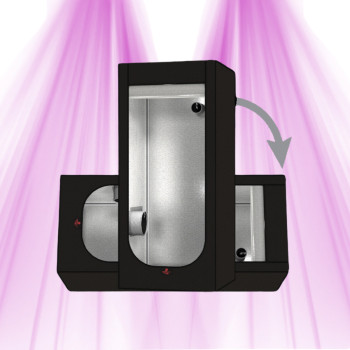
In the Probox Ecopro 60, a 100W (3000K) LED grow light has a grow light energy consumption of about 1.8 kWh per day for 18h of operation, or nearly 54 kWh a month. It delivers an output of 130 to 160 lumens per watt, equivalent to almost 15,000 lumens. Its interior Mylar lining, reflecting 97% of the light, maximizes light efficiency, boosting productivity while limiting overall energy expense. For more details, check out our guide on calculating a 100W bulb's consumption.
Calculations for multi-bulb grow light setups
If you use several light sources, the calculation principle stays the same and remains very simple. First add up all the wattages to get the total in kW, for example 0.5 kW for five 100W lamps. Then multiply this result by 18 hours to get 9 kWh per day, or 270 kWh over a month. This approach lets you precisely estimate the grow light energy consumption of your entire setup.
Watch out: adding more lamps considerably increases the heat that needs to be removed, which calls for a more powerful exhaust fan. With 500W of thermal power, active air conditioning may even become necessary to prevent overheating. It's crucial to anticipate these needs to protect your plants from excessive temperatures. Our calculator takes these parameters into account to recommend the perfect extraction rate and ensure your grow's safety.
GrowLED solutions to reduce your electricity bill
We offer you practical solutions to lower what your setup costs you, without ever compromising yield. Our ProBox grow tents are fitted with a Mylar lining that reflects 97% of the light. This high reflectivity lets you get excellent results with 15 to 20% lower power. This is a passive, lasting energy saving for your indoor growing.
Installing a programmable timer is essential to avoid any unnecessary consumption and any accidental switching on. Cutting the cycle from 18 hours (vegetative stage) to 12 hours (flowering) instantly reduces grow light energy consumption by 33%. Finally, our high-end LED lamps guarantee stable light efficiency over thousands of hours. You know exactly what your lighting costs in energy, from the first day to the last.