


































































Hydroponic System: DWC, RDWC, Ebb and Flow or Aeroponics – Which Should a Beginner Choose?
DWC, RDWC, ebb and flow (Ebb & Grow) or aeroponics: each system suits a different grower. Here is how to choose by tent size, plant count and electricity budget.

For a first try, an ebb and flow table (Ebb & Grow) is an easy place to start: one reservoir, one pump and a timer. RDWC makes sense from 4 plants under one light, as long as you are willing to track the water temperature. Aeroponics and gutter systems such as GrowStream suit larger plant counts. A single-bucket DWC needs little equipment (a bucket and an air pump), but it forgives neither a failed air pump nor warm water.
The five systems at a glance
| System | How it works | Best for | Watch out for |
|---|---|---|---|
| DWC (deep water culture) | Roots sit in a bucket of nutrient water, oxygenated by an air pump. | One or two plants, a low-budget first try. | A failed air pump suffocates the roots; the water warms up quickly in summer. |
| RDWC (recirculating DWC) | Several buckets are linked and the water circulates in a loop, so it stays the same everywhere. | 4 plants or more under one light. | Leak-tight fittings, water temperature and pumps need checking. |
| Ebb and flow (Ebb & Grow) | The grow tray is flooded, then drained, at regular intervals set by a timer. | Beginners, several potted plants, clay pebbles as medium. | A failed timer or pump shows up right away; set the cycles first. |
| NFT (nutrient film technique) | A thin stream of solution runs continuously past the roots in a gutter. | Lettuce and herbs grown in rows. | If the pump stops, the roots are left without water. |
| Aeroponics, aero-hydroponics | Roots are sprayed with, or bathed in, a mist or flow of solution. | Many plants, growers ready to monitor the setup. | Nozzles and filters must stay clean. |
Which one should you choose?
| Your situation | Our advice |
|---|---|
| First try, one to a few plants, small space | A compact system or a simple DWC. |
| First try, tent of about 100 × 100 cm | An ebb and flow table: the Ebb & Grow system below is designed for a grow tent of at least 100 × 100 cm. |
| 4 plants, 120 × 120 cm tent | A 4-pot RDWC: its product page says it suits a tent of 120 × 120 cm or larger. |
| 6 plants or more | A 6-pot RDWC, or GrowStream gutters if you aim for 10 plants and more. |
If you are still weighing hydroponics against soil and coco, our comparison soil, coco or hydro puts the three methods side by side.
Method: size and cost your first system
Worked example: you are setting up 4 plants in a 120 × 120 cm tent.
- Size the lighting. Based on our calculation (a 2.7 µmol/J light, no light losses), a 120 × 120 cm tent needs 215 to 320 real watts, drawn at the plug, for vegetative growth (18/6 cycle) and 320 to 480 W for demanding flowering plants (12/12 cycle). The calculation and its sources are in our guide what wattage LED grow light to choose.
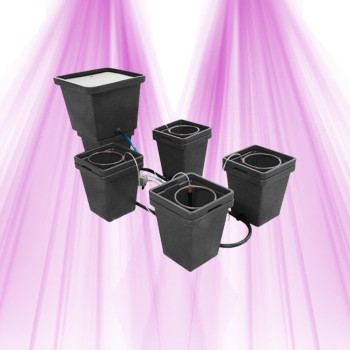
- Pick the system by plant count. Four plants: a 4-pot RDWC. The central bucket and the four pots are linked by pipes and the water circulates in a loop.
- Plan for water temperature. The 4-pot RDWC product page advises keeping it between 18 and 22 °C to limit root disease. In a warm room, a water chiller (HY1000 with heating element), adjustable from 18 to 22 °C according to its product page, stops the water from drifting.
- Plan your measurements. A pH meter and an EC tester, read every day at the same time (see below).
- Work out the power use. kWh per month = real watts × hours per day × 30 ÷ 1,000, then multiply by €0.18/kWh (the rate we use for our examples).
| Item | Calculation | kWh per month | Cost per month |
|---|---|---|---|
| Lighting, vegetative growth, 215 to 320 W, 18 h | W × 18 × 30 ÷ 1,000 | 116.1 to 172.8 | €20.90 to €31.10 |
| Lighting, flowering, 320 to 480 W, 12 h | W × 12 × 30 ÷ 1,000 | 115.2 to 172.8 | €20.74 to €31.10 |
| 2 W pump, 24 hours a day (the one in the compact CultiMate system) | 2 × 24 × 30 ÷ 1,000 | 1.44 | €0.26 |
| 310 W chiller, theoretical ceiling running non-stop | 310 × 24 × 30 ÷ 1,000 | 223.2 | €40.18 |
Read the table this way: the light accounts for most of the bill. A 2 W pump costs less than 30 cents a month. The chiller, which has a built-in thermostat according to its product page, does not run non-stop: it switches off once the water reaches the set point. The last line is therefore a maximum, not a forecast. The product page of our 4-pot RDWC does not give the power of its pumps: read it on each pump's label and apply the same calculation.
Water, pH, EC: what to monitor
- pH. The product pages of our nutrients and regulators give similar ranges: 5.5 to 6.2 for Plagron Hydro A & B, 5.7 to 6.5 for the Torus PerfectPH regulator in recirculating systems. Follow the instructions of the product you use.
- EC. The same Plagron page lists a maximum EC of 1.2 to 2.5 mS/cm depending on the dose. Start low and increase in steps.
- How often. Oklahoma State University Extension recommends checking pH and EC every day, at the same time of day, and calibrating the pH meter probe with a buffer solution. It also advises bringing the EC into range before checking the pH.
- Oxygen. University of Missouri Extension gives more than 6 ppm of dissolved oxygen as the optimum and points out that the warmer the water, the less oxygen it can hold. It advises DWC growers to monitor dissolved oxygen and water temperature. The 4-pot RDWC product page also links its 18 to 22 °C set point to oxygenation as well as to root disease.
Which equipment to choose
The products below match the profiles in the table. Browse the full range in the hydroponic and aeroponic systems category, RDWC kits in PRO RDWC systems, measuring tools in EC/pH testers and the rest of the equipment in hydroponics.
- To start small: the CultiMate system by Terra Aquatica, compact, with a 2 W pump according to its product page. It is filled with clay pebbles (not supplied).
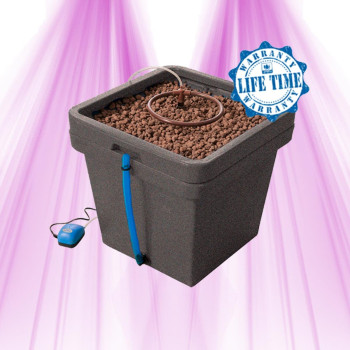
- For an ebb and flow table: the Ebb & Grow system, 95 × 95 × 38 cm, supplied with two trays, ten 4 L fabric pots and a 600 L/h pump, with a 100-litre reservoir.
- For 4 plants: the 4-pot 27 L RDWC, with reservoir and pumps, for a 120 × 120 cm tent or larger.
- For 6 plants: the 6-pot 27 L RDWC, with a footprint of 167 × 90 cm according to its product page: it does not fit in a 120 × 120 cm tent.
- For 10 plants: the GrowStream 10-V2 by Terra Aquatica (109 × 49 × 57 cm), expandable with modules according to its product page. Check the product page for the pump you need.
- To measure: the Vanguard pH meter, with an accuracy of ±0.1 pH according to its product page; calibrate it regularly.
Frequently asked questions
Which hydroponic system should I choose as a beginner?
An ebb and flow table such as the Ebb & Grow, or a small compact system. They need few adjustments at the start and a fault shows quickly: empty tray, stopped pump. Choose RDWC later, when you aim for 4 plants or more.
What is the difference between DWC and RDWC?
In DWC, each bucket is independent, with its own water and air pump. In RDWC, the buckets are linked and the water circulates in a loop: pH and EC are the same everywhere and only one reservoir needs checking.
Do I need a water chiller?
Not necessarily. The product page of our 4-pot RDWC says it can help when the room temperature is high, because water that is too warm favours root pathogens. Measure your water temperature in summer first.
What lighting do I need above a hydroponic system?
The same as in soil: hydroponics does not change light needs. For 120 × 120 cm, plan on 215 to 320 real watts for vegetative growth and 320 to 480 W for demanding flowering plants (our calculation at 2.7 µmol/J).
How much does a hydroponic system cost to run in electricity?
The light is most of it: €20.90 to €31.10 per month in growth on 120 × 120 cm, at €0.18/kWh. A 2 W pump running 24 hours a day costs €0.26 per month.
Can I leave the system alone for a weekend?
Yes, if you have tested the setup first: enough water, pumps and timer that have proven reliable, fresh nutrient solution. Do not leave a brand-new setup, or one adjusted the day before, unattended.
Which plants can I grow in these systems?
The product pages mention vegetables, herbs and flowers. Pick a plant suited to the light you can provide, then a system sized for the number of plants.
Sources: GrowLED calculation at 2.7 µmol/J, detailed in our guide to grow light wattage (€0.18/kWh is the rate we use for our examples); the shop's product pages; Oklahoma State University Extension, "Electrical Conductivity and pH Guide for Hydroponics" (fact sheet HLA-6722); University of Missouri Extension, "Hydroponic Nutrient Solutions" (publication G6984).