




































































 Biobizz Light Mix 50 L 5,0 (26) In stock 29,90 € incl. tax
Potting soils & pots, the right soil, from sowing to repotting
Soil determines half your harvest; the pot determines the rest. Four substrate families, every pot size, and one simple rule: match the plant, its stage and its pot volume.
- Free pickup-point delivery from €89
- Soils stored under cover, never outdoors
- Out of stock? Reserve now for delivery on restock
- 4,7/5 · 1 766 verified reviews
— free pickup-point delivery from €89
Best sellers in this category
Swipe to view products →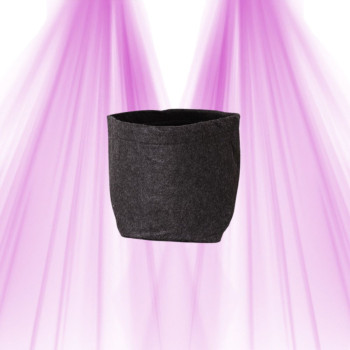 Fabric pot 7 L ★ 4,9 · 19 reviews · In stock 3,00 €
 Seedling pot 7 × 7 cm ★ 5,0 · 4 reviews · In stock 0,50 € Biobizz Light Mix 50 L ★ 5,0 · 26 reviews · In stock 29,90 €
 2L pot - 13cm x 13cm - Draining bottom ★ 4,9 · 7 reviews · In stock 0,60 €
 Rock wool cube 40mmx40mm Grodan ★ 5,0 · 1 review · Awaiting stock 0,30 €
 Fabric pot 15 L ★ 5,0 · 21 reviews · In stock 4,29 €
The foundation of everything
The potting soil, the choice that shapes everything else
With lightly fertilised soil, you control nutrients yourself. With enriched soil, you can go three weeks without dosing. That is the choice, and it takes thirty seconds.
The 30-second guide
The simple rule: light soil needs feeding from week two; enriched soil lasts three to four weeks without fertiliser. Beginners wanting simplicity: enriched. Growers wanting control over doses: light. Allow about 1 L of soil per litre of pot volume.
Light Mix or All Mix?
Light Mix is lightly fertilised: feed from week two and control everything. All Mix is prefertilised: use plain water for the first three to four weeks. For a first grow, All Mix is more forgiving.
Can I reuse my soil?
For a second grow, yes, if you remove roots, aerate the mix and replenish it with worm humus or base fertiliser. Beyond that, the structure collapses and roots struggle to breathe.
Should I add perlite?
Our potting soils already contain it. Add more for heavy watering or large pots: 10–20% perlite lightens the mix and prevents standing water.
The 3 best-selling soils
Biobizz Light Mix 50 L 5,0 (26) In stock 29,90 € incl. tax 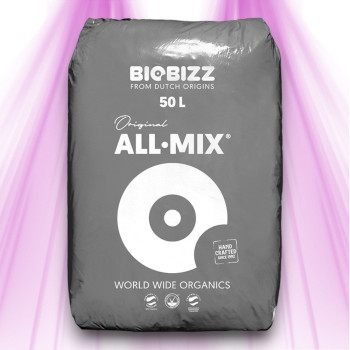 Biobizz All Mix 50 L 5,0 (8) In stock 39,90 € incl. tax
 Plagron Light Mix In stock 27,90 € incl. tax
The same products in smaller sizes
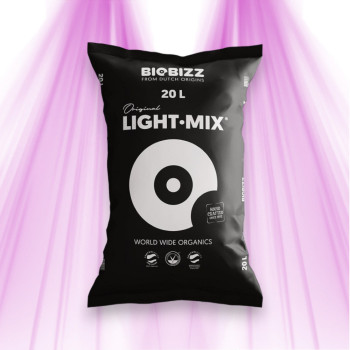

All potting soils and substrates Our best sellers over 24 months, across all brands.
The repotting kit, ready to plant
Matching soil, pots and trays in the right volumes. Add everything to your cart in one click.
- Biobizz All-Mix potting soil 50 L39,90 €
- 4 × Fabric pot 11 L4 × 3,00 €
- 4 × Growing tray carré 29 × 29 cm4 × 1,95 €
- Biobizz Light-Mix potting soil 20 L22,90 €
- 10 × Seedling pot 7 × 7 cm10 × 0,50 €
- Growing tray Garland10,90 €
The volume refers to the final pot. Unsure? The “Your stage, your pot” table explains it step by step.
The container
The pot : fabric, plastic or none at all
Fabric pots aerate roots and prevent circling. Plastic retains water longer and costs three times less. Both work, but suit different growers.
The 30-second guide
The simple rule: allow 10–15 L of pot volume per flowering plant, 3–7 L during vegetative growth and a small pot for seedlings. Too small restricts growth; too large keeps soil wet and suffocates roots. A saucer under every pot, always.
Fabric or plastic?
Fabric allows air through: roots stop at the wall and branch instead of circling. Plastic retains moisture longer, cleans more easily and costs far less. Fabric has the edge in a tent; plastic is practical for larger numbers.
Can I wash a fabric pot?
Yes, by hand in hot water without detergent. A fabric pot lasts three to five grows. Remove dry roots first, as they cling to the fibres.
Why use a saucer?
It catches drainage water and lets you see the runoff. A saucer overflowing at every watering means too much water. Empty it; never leave the pot standing in water.
The 3 best-selling pots
Fabric pot 7 L 4,9 (19) In stock 3,00 € incl. tax  Fabric pot 11 L 4,8 (17) In stock 3,00 € incl. tax Fabric pot 15 L 5,0 (21) In stock 4,29 € incl. tax
The same volumes in plastic


All pots and saucers From seedling pots to 50 L containers.
Under every pot
Saucers and trays
From small pots to growing trays, find sizes to catch drainage and protect your floor.
Choose the right dimensions
Measure your pot's base and choose a slightly wider tray. Check its usable area and empty excess water after watering. Sizes below range from small containers to growing trays.
All saucer and tray sizes
Scroll to see all sizes →
 Square tray · 14 × 14 cm In stock 0,60 € incl. tax
 Square saucer · 14,1 × 14,1 cm 5,0 (2) In stock 0,50 € incl. tax
 Clear saucer · 16,5 cm In stock 1,80 € incl. tax Square tray · 17 × 17 cm In stock 0,80 € incl. tax
 Square saucer · 18,9 × 18,9 cm 5,0 (4) In stock 0,80 € incl. tax
 Raised tray · 19,7 × 19,7 cm In stock 1,80 € incl. tax
 Square saucer · 21 × 21 cm 5,0 (9) In stock 0,99 € incl. tax
 Square saucer · 23 × 23 cm 5,0 (9) In stock 1,00 € incl. tax Square tray · 25 × 25 cm In stock 1,40 € incl. tax
 Square saucer · 28,5 × 28,5 cm 5,0 (14) In stock 1,65 € incl. tax Square tray · 29 × 29 cm In stock 1,95 € incl. tax
 Square saucer · 30,5 × 30,5 cm 5,0 (9) Awaiting stock: reserve yours 1,90 € incl. tax
 Square saucer · 33,5 × 33,5 cm 5,0 (4) In stock 2,29 € incl. tax Square tray · 34 × 34 cm In stock 2,20 € incl. tax
 Square saucer · 36,5 × 36,5 cm 5,0 (1) In stock 2,70 € incl. tax
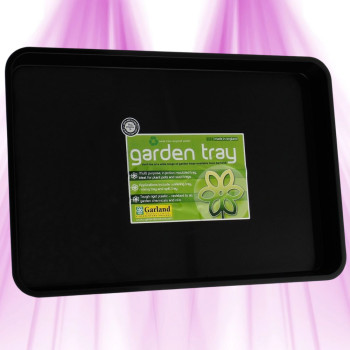 Garland tray · 57 × 39 cm In stock 10,90 € incl. tax
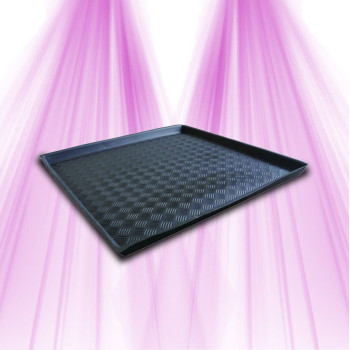 Flexi Tray · 80 × 80 cm Awaiting stock: reserve yours 29,90 € incl. tax Flexi Tray · 100 × 100 cm Awaiting stock: reserve yours 39,90 € incl. tax Flexi Tray · 120 × 120 cm In stock 49,90 € incl. tax Flexi Tray · 150 × 150 cm Awaiting stock: reserve yours 59,90 € incl. tax or 3× 19,97 € with alma
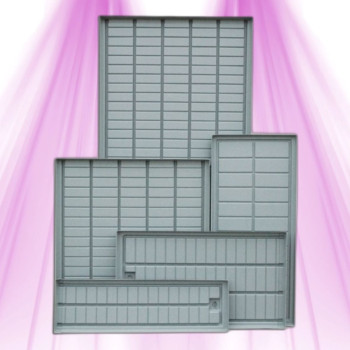 Stal Plast tray · 33 × 110 cm In stock 54,90 € incl. tax or 3× 18,30 € with alma Stal Plast tray · 55 × 126 cm Awaiting stock: reserve yours 56,90 € incl. tax or 3× 18,97 € with alma Stal Plast tray · 63 × 110 cm In stock 65,48 € incl. tax or 3× 21,83 € with alma Stal Plast tray · 80 × 120 cm In stock 77,90 € incl. tax or 3× 25,97 € with alma Stal Plast tray · 100 × 110 cm Awaiting stock: reserve yours 82,91 € incl. tax or 3× 27,64 € with alma Stal Plast tray · 100 × 204 cm Awaiting stock: reserve yours 184,25 € incl. tax or 3× 61,42 € with alma Stal Plast tray · 120 × 120 cm Awaiting stock: reserve yours 92,90 € incl. tax or 3× 30,97 € with alma Stal Plast tray · 120 × 204 cm Awaiting stock: reserve yours 192,90 € incl. tax or 3× 64,30 € with alma Stal Plast tray · 160 × 160 cm Awaiting stock: reserve yours 206,90 € incl. tax or 3× 68,97 € with alma Stal Plast tray · 150 × 300 cm Awaiting stock: reserve yours 276,90 € incl. tax or 3× 92,30 € with alma
 Growing tray · 200 × 100 cm 5,0 (4) In stock 64,90 € incl. tax or 3× 21,63 € with alma
All saucers Square trays, Flexi Tray and Stal Plast trays offer several sizes on their product pages.
Getting started
Seedlings and propagation : substrates for the start
Seeds need air and steady moisture, not fertiliser. That is why cubes and plugs work well: they maintain moisture and roots grow straight.
The 30-second guide
The simple rule: seedling substrate is low in nutrients and very airy. Moisten a coco cube or pressed plug once, then leave it undisturbed. No fertiliser before the third pair of leaves. Plant the whole cube into the pot without touching the roots.
Coco cube or peat plug?
Coco cubes drain better and tolerate slightly generous watering. Pressed plugs retain more water, useful if you cannot check daily. Both are planted whole.
Should seedlings have a humidity dome?
Cuttings do: they have no roots and lose moisture through leaves, so need almost saturated air. For seeds, a dome helps initially but should be removed after emergence to prevent stretching.
When should I repot a seedling?
When roots emerge from underneath the cube or pot, usually after two to three weeks. Earlier risks broken roots; later can stall growth.
For a successful start
 Root Riot · 24 plugs 5,0 (1) In stock 9,90 € incl. tax
 Clonex · rooting gel 5,0 (4) In stock 11,85 € incl. tax
Small seedling essentials
All propagation substrates Find complete seedling equipment in its own category.
The comparison
Four families of soil, four ways to grow
These are growing methods, not price ranges. Choose how you want to feed your plants first; the brand comes afterwards.
Light Mix
For those who dose their own nutrients
- Light soil with very few nutrients
- Feed from week 2 and control everything
- Liquid fertilisers, week by week
- Less forgiving of missed nutrient waterings
Avoid if you do not want to manage doses every week.
View light potting soils11Enriched (All Mix)
For those wanting to start without dosing
- Prefertilised: guano, humus and base feed
- Three to four weeks with plain water
- The simplest first-grow option
- Too rich for seedlings and cuttings
Avoid if you start seeds or cuttings in it: it can burn them.
View enriched soils16Coconut fibre
For frequent watering and faster growth
- Neutral substrate: all nutrition comes from your solution
- Rapid root development and vigorous growth
- Requires coco-specific fertilisers
- More frequent watering than soil
Avoid if you go on holiday: coco dries quickly and is less forgiving.
View coco substrates9
Peat-free
For an ecological option without changing methods
- No peat: peatlands stay intact
- Used exactly like standard soil
- Available in light and enriched versions
- Good long-term structure
Avoid if you follow a dosing schedule rigidly: wood fibre mineralises less evenly than peat and available nitrogen varies between bags.
View peat-free soils4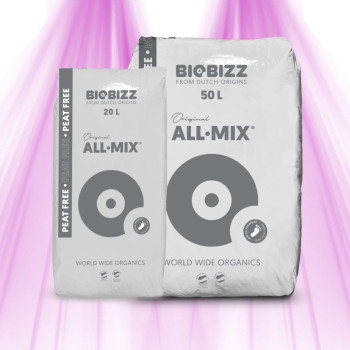
Still choosing between light and enriched soil? The Light Mix or All Mix guide settles it in five minutes.
The soil & pots catalogue
Your soil, your way
Three routes to the same catalogue: what you want to do, the container type or the brand.
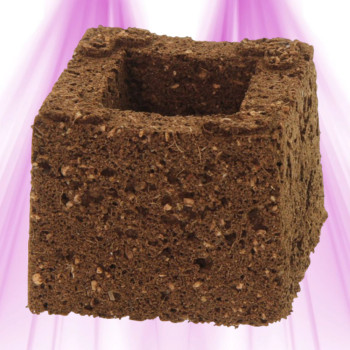
Switch to coco faster growth neutral substrate  The highlightPlagron Cocos Premium36,90 € 9 products→
Cannot find what you need? or see the whole category at once →
The volume rule
Your stage, your pot
The plant determines the volume, not the other way round. The matching sizes, explained once and for all.
| The stage | Pot volume | Soil per plant | Suitable containers |
|---|---|---|---|
| Sowing, germination | 7 × 7 cm seedling pot | ≈ 0,3 L | View selection |
| Cutting, young plant | 1.5–4 L | ≈ 3 L | View selection |
| Vegetative growth | 7–11 L | ≈ 9 L | View selection |
| Flowering, one plant | 15–20 L | ≈ 18 L | View selection |
| Large plant, terrace | 30–50 L | ≈ 40 L | View selection |
Oversized pots retain water and chill roots; undersized pots restrict plants. If unsure, choose the smaller size and repot. Your tent size determines how many pots fit →
The equipment
What goes around the soil
Support, drain, propagate: small essentials that prevent puddles and waterlogged roots.
Support
Drain


Missing something? All substrates and soil amendments →
Our partners
The brands we stand behind
Four brands whose recipes we know inside out, with around thirty more growshop brands below.
Biobizz
Light Mix and All Mix: our two best-selling soils for ten years, 100% organic and now available peat-free too.
The benchmark Plagron
Light Mix, Grow Mix, Royalmix: the catalogue's broadest range, from lightly fertilised soil to ready-to-flower mixes.
A wide choice CANNA
Terra Professional and Coco Professional Plus: precisely prepared substrates, a reliable choice for closely managed grows.
Consistency Garden HighPro
Fabric pots from 1.5 to 50 L: over 1500 sold in two years, a complete repotting range.
The best seller 




























Expert advice
All guides Before you buy, understand
Soil, pots and peat: guides to avoid beginner mistakes.

Help & advice
Questions we are asked
About Soil / Pots: click a question to see the answer.
Which soil is best for beginners?
An enriched soil such as All Mix already feeds the plant for three to four weeks: simply use plain water. This gives you time to learn how to read your plants before adding fertilisers.
How many litres of soil do I need?
Allow roughly 1 L of soil per litre of pot volume, plus 10% for settling. Four plants in 11 L pots therefore need a 50 L bag. A 20 L bag covers one 11 L plant or around ten seedlings in small pots.
Soil or coconut fibre?
Soil tolerates missed waterings and feeds gradually. Coco is neutral and faster, but all nutrition comes from your solution and watering is more frequent. First grow: soil. Closely managed regular growing: coco.
Fabric pot ou pot en plastique ?
Fabric lets roots breathe and prevents circling, producing denser root systems. Plastic holds water longer, cleans more easily and costs three times less. In a tent, fabric has the advantage.
Are your soils stored outside?
No. Bags are kept under cover at a stable temperature. Soil left outdoors over winter compacts, loses microbial life and can bring fungus gnats into your grow.
Can I pay in instalments?
Yes: 3 or 4 instalments on orders from €50, 10 instalments or payment deferred by 15 days from €100, with Alma.
Cannot find your answer? 01 88 33 45 52 or by message.
All soils and pots. Everything available to order.
In stock or available to reserve on restock, with personal phone advice on the right volume.
Browse the categoryYour soil is ready; does it need feeding? All fertilisers and boosters are here →
Learn more about Soil / Pots
Potting mixes and pots are essential elements for growing plants indoors or outdoors. They provide support and a growing medium adapted to the needs of the plants.
Potting soils are mixtures of different organic and mineral materials which serve as a growing substrate for plants. They can be used in pots or in the ground and are designed to provide plants with the nutrients, water and oxygen they need to grow. There are different types of soil adapted to the needs of different plants (universal soil, special cactus soil, special green plant soil, etc.).
Pots are containers in which plants are grown. They can be made of terracotta, plastic, wood or other materials. Pots can be of different sizes and shapes, adapted to the needs of the plants and the space available. They allow you to grow plants indoors or outdoors and easily move them if necessary.
It is important to choose the right type of potting soil and pot for each plant based on its nutrient and growing space needs. If in doubt, it is advisable to consult a professional or refer to the manufacturer's instructions.


